Last one

This model is currently sold out. Enter your email and we'll let you know when it's back in stock.
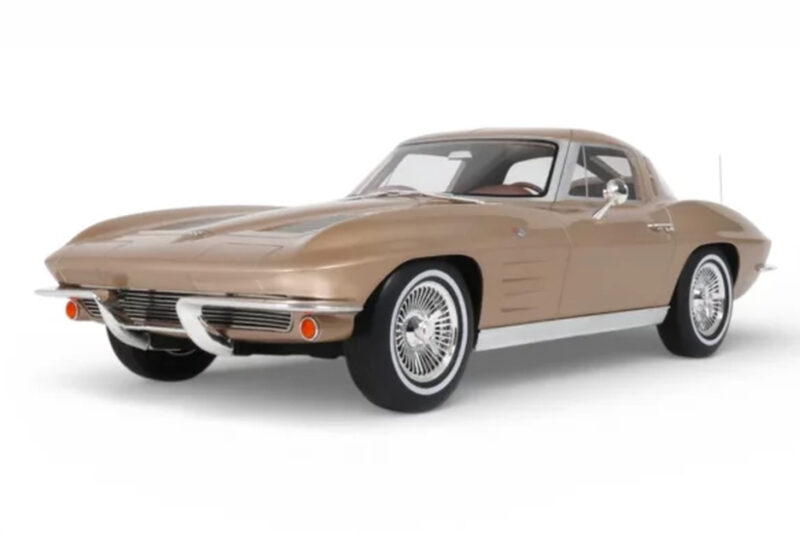
TL;DR: GT Spirit's 1:12 resin Chevrolet Corvette C2 Sting Ray reproduces the 1963 split-window coupe in saddle tan, cast as a sealed one-piece body. The larger 1:12 scale gives the C2's angular styling and split rear glass real presence, with no panels to open on this casting.
Chevrolet only built the split rear window for a single model year before caving to complaints about visibility, which makes 1963 the one year every C2 collector wants first. GT Spirit's 1:12 resin coupe puts that exact year on a shelf, large enough to actually see why the split window mattered.
The Corvette Sting Ray arrived for 1963 as a clean break from the rounded C1 that preceded it, styled under GM's Bill Mitchell with input from Larry Shinoda and drawing heavily on Mitchell's earlier Sting Ray racer. The result was a car defined by hidden headlamps, a pointed nose and sharp body creases running the car's length, a genuinely different visual language from anything Chevrolet had built before.
The rear window split by a body-colored spine was unique to the 1963 coupe. Chief engineer Zora Arkus-Duntov argued against it on visibility grounds, and Chevrolet dropped it for 1964 in favor of a single pane, which is exactly why the 1963 split-window car became the most sought-after example of the C2 generation almost immediately.
At 1:12, a car of the Corvette's dimensions comes out close to 40 centimeters long, nearly double the footprint of a 1:18 equivalent, and that extra size lets GT Spirit render the split window's dividing spine, the hidden headlamp covers and the body's sharp creases with far more physical clarity than a smaller scale could manage. Resin suits this kind of angular, crease-heavy bodywork particularly well, holding sharp panel lines and consistent shut lines that a die would soften slightly at the same price point.
Nothing opens on this casting. The doors, hood and any trunk lid are fixed as part of a single-piece body, which means the entire case for the model rests on its exterior: panel gap consistency, the crispness of the split-window divider, glazing clarity and how the paint sits across those sharp body creases. Removing hinge tolerances from the equation is exactly what lets a resin body like this hold tighter, more continuous lines than an articulated equivalent at the same scale would allow.
Saddle tan was a genuine period color option on early Corvettes, and it plays differently on a resin body than a brighter shade would: the warmer, muted tone lets the C2's sharp creases and pointed fenders read through shadow and highlight rather than through color contrast alone. Under a directed lamp, the finish shows a smooth, even depth typical of a factory-painted resin production piece, with no visible texture break to distract from the bodywork's own lines. At this scale the split rear window becomes genuinely legible from a normal viewing distance, which is the entire reason a collector chooses 1:12 over 1:18 for this specific car: the detail that makes the 1963 model significant needs the extra size to actually register. GT Spirit's resin pricing at this scale sits in the mid-tier range for the hobby, reflecting a larger casting and hand-finished paint rather than tooled mass production.
For a Corvette collector, owning the split-window year is close to a rite of passage, and doing it at 1:12 rather than 1:18 is a deliberate choice to let that one detail actually be seen. Set beside a 1964 single-window coupe, the pair would tell the whole story of Duntov's visibility argument in a single shelf comparison, which is exactly the kind of context that makes a themed C2 display worth building.