Last one
Used
This model is currently sold out. Enter your email and we'll let you know when it's back in stock.
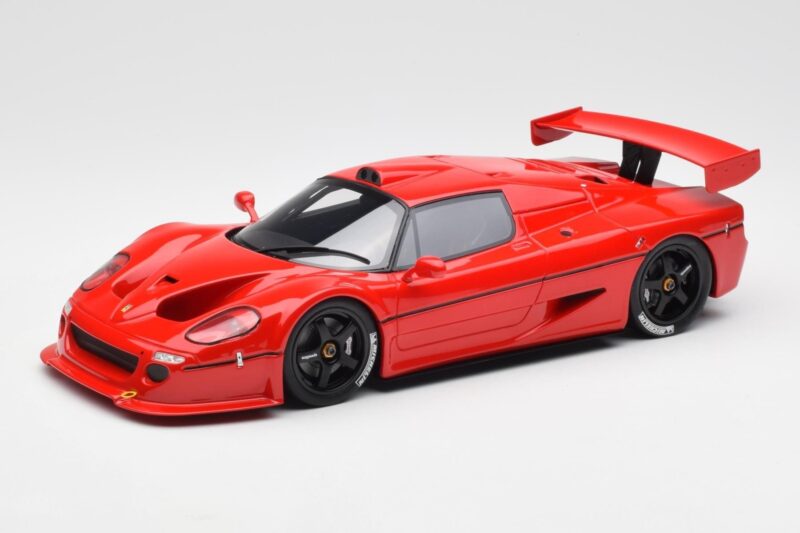
TL;DR: GT Spirit's 1:18 resin Ferrari F50 GT in Red is a sealed one-piece casting, its aerodynamic bodywork carried entirely on the exterior surface. This is a new model in new packaging, reproducing a racing-only F50 variant that never reached Ferrari's regular road-car catalog.
The F50 GT was built purely for competition and never sold to the public, which makes any accurate replica of it inherently a specialist subject rather than a common shelf piece.
This casting has no opening doors or hood, so the entire model is one continuous shell, and that construction is what lets a resin cast hold the tight, complex shut lines a heavily reworked competition body demands. The F50 GT's deeper front splitter, extended rear wing, and wider bodywork over the standard F50 are reproduced with genuine sharpness along the fenders and sills, a level of edge definition a diecast die would struggle to match on this shape. The Red paint sits with real depth under direct light, consistent with factory-finished resin work. Shipped new in new packaging, it arrives without the handling history a used piece would carry.
Ferrari developed the F50 GT as a competition variant of its V12-powered supercar, built with a stripped interior, revised aerodynamics, and racing-spec running gear, but the program was ultimately shelved before it reached a full competitive season. That abandoned status is exactly why the F50 GT remains a niche subject even among Ferrari specialists, and why a resin cast of it carries genuine discovery value for a collector who already owns the standard road-going F50.
At 1:18, the F50 GT's widened bodywork and aggressive wing give it a visibly more aggressive stance than a standard F50 casting, making a side-by-side pairing of the two an effective way to show how far the competition program departed from the road car. Its sealed body displays cleanly with nothing to align after handling, making it a stable centerpiece for a Ferrari V12 supercar section built around the F40, F50, and Enzo generations.