Last one

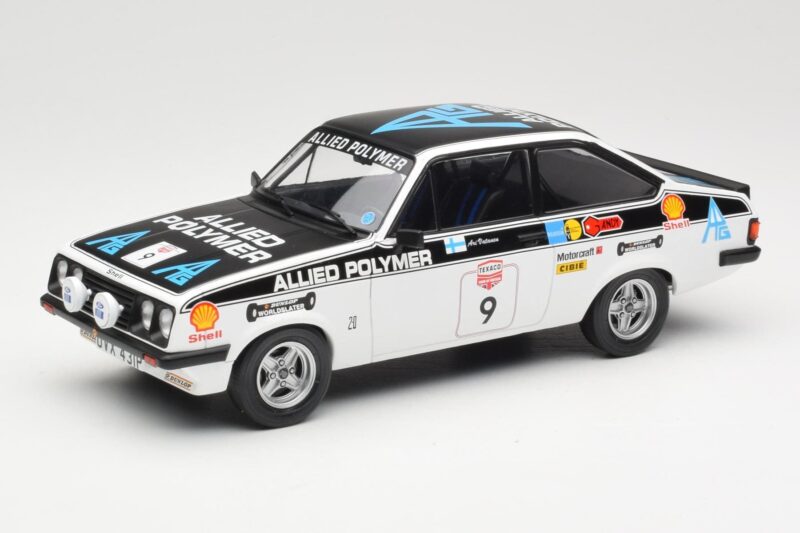
TL;DR: MCG's 1:18 diecast Ford Escort Mk2 RS2000 reproduces car #9, driven by Ari Vatanen and Peter Bryant at the 1977 RAC Rally. Cast as a sealed one-piece zinc alloy shell, it carries period rally graphics, auxiliary lighting, and flared arches. A mid-tier diecast anchor for a 1970s World Rally Championship shelf.
Ari Vatanen's name would eventually top World Rally Championship results with Ford, but in 1977 he was still building a reputation on events like the RAC Rally, one of the toughest rounds on the calendar. The Escort Mk2 RS2000 he shares here with co-driver Peter Bryant sat a notch below the factory RS1800 works cars, a detail that shapes how this model reads on a shelf.
Ford campaigned the Escort Mk2 in two distinct rally specifications through the mid-to-late 1970s. The works RS1800 carried the twin-cam BDA engine and the bulk of factory development, while the RS2000 relied on a 2.0-liter Pinto four-cylinder, a simpler and more affordable route into international rallying. Privateer and semi-works entries leaned on the RS2000 to compete against factory machinery without factory budgets, and the car still carried the Escort's short wheelbase and light weight, the qualities that made the Mk2 so adaptable on loose surfaces regardless of which engine sat under the bonnet.
The Lombard RAC Rally ran through the forests of Wales and northern England each November, and its reputation for chewing through entries was earned honestly: fog, mud, and darkness turned the stages into an endurance test as much as a speed contest. Cars that survived to the finish often did so through driver management as much as raw pace. That reputation is part of what makes a period-correct RAC Rally livery meaningful on a model shelf: the car represents an entry into one of the most demanding events a rally driver could face, run on roads that gave no margin for a mechanical problem or a driving mistake.
Ari Vatanen's rise through the 1970s ran largely through Ford machinery, and by the end of the decade he had become one of the most recognizable names in the sport, a trajectory that peaked with the 1981 World Rally Championship title in a works Escort. The 1977 RAC Rally sits earlier in that arc, a season where Vatanen was still proving himself against established factory drivers rather than leading the field outright. Peter Bryant's role in the co-driver's seat mattered as much as any engine specification: pace notes read correctly at speed, in the dark, on roads narrowed by hedgerows, decided finishing positions as often as horsepower did. Car #9's livery, reproduced here in MCG's diecast, carries the sponsor decals and number-board conventions of British national and international rallying in period, bold panel graphics designed to be legible through mud spray and to a marshal standing in the dark at a stage finish. That graphic language is as much a historical document as the car underneath it, and it is the reason liveried rally reproductions hold interest even among collectors who never followed the results sheet. Whatever the outcome of this particular run through the forest stages, the entry itself belongs to a period when Ford's Escort program was building the depth of talent that would define the marque's rally success into the next decade.
Reproducing a period rally livery accurately depends on tampo printing rather than simple paint masking: multi-color sponsor logos, number boards, and stripe graphics need to sit flat and crisp across compound curves without the print lifting at panel edges. On a rally subject like this Escort, that printing has to survive scrutiny at close range because the graphics carry so much of the car's identity: bonnet number, door logos, and the auxiliary spotlight mounts that every RAC-spec Escort of the era carried for driving through the dark forest stages. Getting the registration and sponsor typography legible at 1:18 scale, rather than reduced to a blurred approximation, separates a serious diecast from a toy-grade one.
This casting has no opening doors, hood, or trunk, a sealed body that is a normal and common choice at this tier rather than a shortcoming. What it buys is consistency: the shut lines around the doors and boot read as continuous grooves rather than gaps that widen or narrow depending on how a hinge sits, and the zinc alloy body carries a density in the hand that plastic-heavy toys never manage. Paint sits on that metal shell with an even gloss that holds up under a display lamp, and the flared wheel arches and rally-spec ride height come through as one clean silhouette rather than a shape interrupted by mismatched panel gaps.
At roughly 21 centimeters long, this 1:18 Escort holds a compact rally footprint next to bigger GT and supercar castings, but its short wheelbase and boxy proportions read as pure period Group 1/Group 4 rally hardware rather than a scaled-down road car. It pairs naturally with other Mk2 Escorts wearing different rally liveries, or with period Ford competitors from the same RAC Rally seasons, building a themed shelf around 1970s forest-stage rallying rather than a single marque timeline. The zinc alloy build and sealed body place this comfortably in the mid-tier diecast segment: above toy-grade mass production, below the multi-part, opening-panel builds that command a premium for interior access most rally subjects rarely reward anyway, since the cars themselves were stripped for weight. For a buyer building a WRC Classic-era collection, or simply drawn to the Vatanen name before it became a championship one, this is an honest, well-finished way to own that history.