Last one
Used
This model is currently sold out. Enter your email and we'll let you know when it's back in stock.
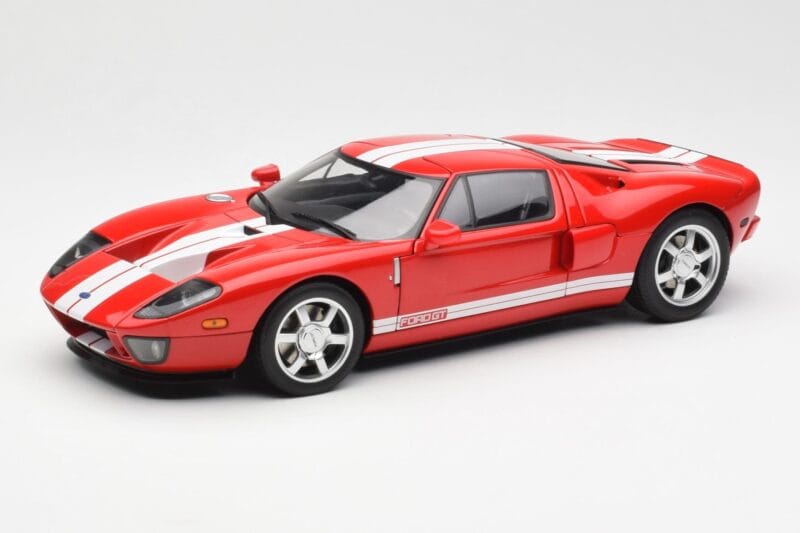
TL;DR: AUTOart's 1:18 diecast Ford GT in Red opens its doors and hood, built with AUTOart's tighter mid-to-upper tier diecast tolerances. This is a used model; the box carries traces of storage, the casting itself intact. A modern supercar built directly on GT40 racing heritage.
Ford revived the GT40's silhouette almost exactly for its 2000s successor, and AUTOart's diecast makes that deliberate throwback legible at 1:18.
The body is zinc alloy, with doors and hood that open to show the cabin and supercharged V8 beneath a Red finish that carries genuine depth under a display lamp. AUTOart's tighter panel gaps hold up well on the GT's long, low fenders, a shape that leaves little room to hide tooling inconsistency. Interior detailing is legible through the opened doors, including the centrally mounted gauge cluster the real car carried as a deliberate period-correct touch. This example is used, and the box shows traces of storage while the model itself carries none of that wear.
Ford built the 2000s GT as a direct visual homage to its 1960s GT40 Le Mans racers, reproducing the low, wide silhouette almost panel for panel while updating the engineering underneath with a modern supercharged V8 and contemporary chassis technology. That deliberate throwback approach made the GT as much a statement about Ford's racing heritage as a standalone supercar, a rare case of a modern manufacturer building a halo car explicitly to honor its own motorsport past.
At 1:18, the GT's low, wide stance gives it genuine presence beside European supercars from the same era, making a strong case for including American performance cars in a broader supercar display rather than treating them as a separate category. Its opening doors and hood invite handling and close inspection, and pairing it with period Ferrari or Lamborghini models highlights how differently manufacturers approached the same performance-car brief during the 2000s.