Last one
Used

This model is currently sold out. Enter your email and we'll let you know when it's back in stock.
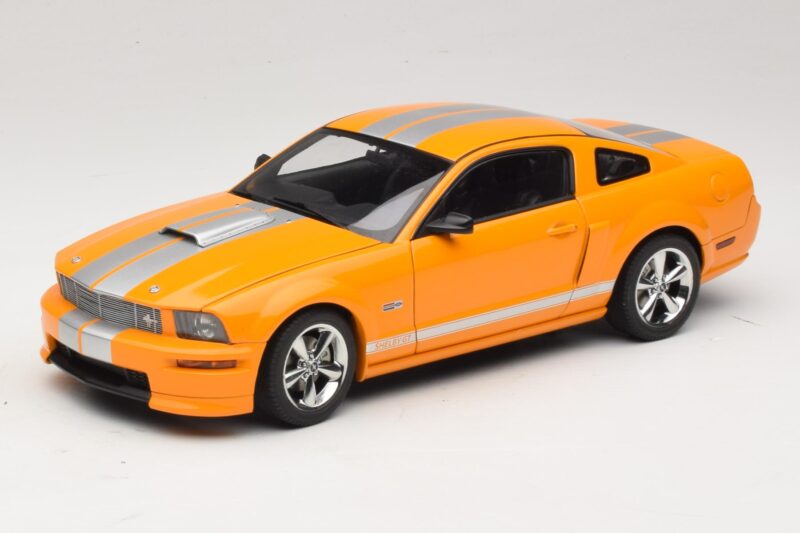
TL;DR: AUTOart's 1:18 diecast Ford Mustang GT S197 reproduces the fifth-generation Mustang Ford launched in 2005, a deliberately retro-styled coupe echoing the 1969 fastback, finished here in Grabber Orange, a heritage Ford muscle-car shade revived from the Boss 302 era. The diecast body opens, with zinc-alloy weight and V8-correct detailing throughout.
Ford's fifth-generation Mustang, internally coded S197, arrived for the 2005 model year with a design brief that broke from decades of gradual evolution: look back deliberately at the 1969 fastback rather than forward at contemporary styling trends. That retro-futurist approach struck an immediate chord with American buyers nostalgic for muscle car's golden age, and it reestablished the Mustang as a genuine cultural presence rather than just another sports coupe competing on spec sheets.
Ford gave its fifth-generation Mustang, developed under the S197 platform code, a design mandate unlike anything the nameplate had followed in decades: rather than evolving the outgoing car's shape incrementally, the styling team deliberately referenced the 1969 fastback's proportions, reviving the long hood, short deck silhouette and the tri-bar taillights that had defined the Mustang's most celebrated era. That retro-futurist approach launched for the 2005 model year at the same moment Chrysler was reviving the Dodge Charger name and Chevrolet was previewing a modern Camaro concept, part of a broader mid-2000s wave of American manufacturers rediscovering their own muscle car heritage after decades of moving away from it. The GT trim sold here carried a 4.6-liter V8 under the hood, the volume performance engine that gave the S197 genuine muscle car character without the price or exclusivity of the later, more powerful Shelby variants. American buyers responded immediately: the S197 became a sales success and a genuine cultural moment, appearing in films, magazines, and dealer lots in numbers that hadn't attached to a Mustang generation in years. This diecast captures that specific moment, the GT trim that most buyers actually drove rather than a rarer performance variant.
AUTOart built its reputation among collectors by pushing diecast detail closer to the standard hand-built resin manufacturers set, a manufacturer willing to spend more on tooling and finishing than typical mass-market diecast competitors while still keeping the format's inherent weight and durability advantages. This Mustang GT reflects that approach: a zinc-alloy body with real heft in the hand, the doors and hood opening on hinges that hold their set position rather than swinging loose or drooping under their own weight. Lifting the hood reveals a V8 engine bay reproduced with genuine intake and accessory detail rather than a flat, simplified block, a feature that separates a serious diecast build from a cheaper casting that treats the engine bay as an afterthought. Panel gaps around the doors and hood run tight and consistent, holding their line across the S197's flat hood and long fenders, surfaces large enough that any inconsistency in tolerance would be immediately visible under direct light. The interior carries the S197's retro-inspired dashboard, with the twin-cowl gauge binnacle that consciously echoed the original 1960s Mustang's cockpit layout. For a car whose entire appeal rests on nostalgic details done correctly, getting the dashboard's retro cues right matters as much as the exterior styling.
Grabber Orange traces back to Ford's early 1970s performance color palette, a shade the company originally offered on the Boss 302 and other high-performance Mustangs of that era before the color largely disappeared from Ford's lineup for decades. Reviving it for the S197 generation was a deliberate nod to that heritage, giving buyers a color option that carried genuine historical weight rather than a generic modern metallic. Diecast paint sits on a hard metal shell, and this orange shows a vivid metallic depth under direct light that a flat single-stage finish could never achieve, catching highlights differently across the Mustang's long hood and muscular rear haunches. Most Mustang reproductions default to red, the color most associated with the nameplate historically, which makes a well-executed Grabber Orange example a distinctive way to represent the S197's specific heritage-color choice rather than the expected shade. The stripes and badging that often accompanied this color on the real car are reproduced with correct placement and proportion, and getting those proportions right is part of what separates a genuinely collector-grade Mustang reproduction from a generic muscle car casting wearing the same paint.
Muscle car collecting remains one of the deepest and most active segments in American diecast, and the S197 generation holds a specific place in that culture as the car that proved Ford's muscle car heritage could sell in the modern era rather than existing only in nostalgia. AUTOart sits at a premium diecast tier, priced above mass-market competitors while staying below fully hand-built resin, a fair position for a manufacturer known for pushing detail further than typical series production. At roughly 21 centimeters long in 1:18, the S197's proportions fit comfortably into a standard cabinet row alongside a genuine 1969 fastback reproduction, a pairing that tells the Mustang's retro design story more directly than either car could alone. For collectors building an American muscle car shelf, this Grabber Orange S197 represents the generation that brought the whole genre back.