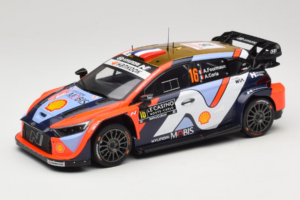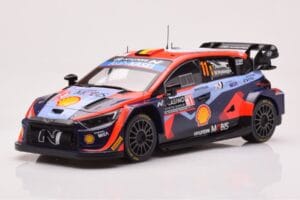
Hyundai i20 N Rally1 #11 T. Neuville / M. Wydaeghe Rally Monte Carlo 2023 IXO 1:18
Only 2 left
Price:
66.00 €
This model is currently sold out. Enter your email and we'll let you know when it's back in stock.
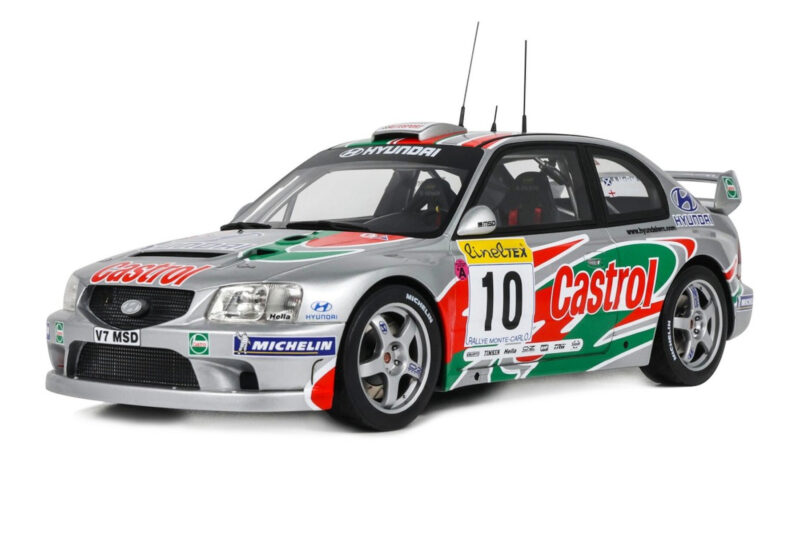
TL;DR: Otto Mobile's 1:18 resin Hyundai Accent WRC #10 reproduces Alister McRae and David Senior's entry at the 2001 Monte Carlo Rally, an early round in Hyundai's developing factory World Rally program. Built as a sealed one-piece body with no opening panels, the resin casting holds the rally livery's decal lines and mud-flap detail with sharp, consistent edges.
Monte Carlo has opened the World Rally Championship season for decades, its mixed snow-and-tarmac stages through the French Alps testing a car and driver pairing before the rest of the year even begins. In 2001, Hyundai's still-young factory effort sent Alister McRae and co-driver David Senior into that gauntlet aboard the Accent WRC.
Hyundai entered top-level world rallying with the Accent WRC in the late 1990s and early 2000s, a period when the manufacturer was still establishing itself against long-running programs from Subaru, Ford, Peugeot, and Mitsubishi. Compared to those established teams, Hyundai's early WRC campaign was a genuine underdog effort, working to build the infrastructure and experience that more seasoned squads had accumulated over years. That context matters when looking at any Accent WRC entry from this era: results have to be read against a program still finding its footing. The #10 entry reproduced here comes from exactly that formative period.
Alister McRae, younger brother of 1995 World Rally Champion Colin McRae, drove for Hyundai's factory team through this era, paired with co-driver David Senior for the Monte Carlo round. Carrying the McRae name onto a Hyundai entry meant something specific: it brought a recognized rallying pedigree to a program still building its own reputation from scratch. Monte Carlo itself is one of the WRC calendar's most demanding events, its narrow mountain stages shifting unpredictably between dry tarmac, ice, and fresh snow within a single run.
Otto Mobile builds this Accent WRC as a sealed one-piece resin body, with no doors, hood, or trunk that open. Rally liveries carry more graphic detail per square inch than almost any other motorsport category, with sponsor logos, number panels, and homologation markings covering nearly the entire body, and resin's tighter casting tolerances give those decals and printed elements a cleaner surface to sit against than a diecast body's slightly rougher texture would allow. The factory-applied livery carries the crisp registration a rally subject demands.
The sealed construction also means the rally-specific exterior details, the mud flaps, the auxiliary light mounts, and the reinforced arch trim, read as integrated parts of the body rather than separately fitted pieces with visible seams. Resin is lighter in the hand than diecast at this scale, and on a rally car built for lightness and agility in period, that lighter feel arguably tracks the source vehicle's own priorities more closely than added metal mass would. Checking the number panel edges under close light is a reliable way to judge how carefully a rally livery has been applied.
Hyundai's early-2000s WRC program rarely gets the same attention as the era's dominant Subaru and Ford entries, which makes reproductions like this one genuinely useful for a collector interested in the full competitive picture rather than just the podium finishers. Alister McRae's presence on this Hyundai entry is exactly that kind of detail: a driver with genuine pedigree lending credibility to a program still finding its footing, a storyline that rewards a collector who knows the wider context of the 2001 season. Otto Mobile's resin range has increasingly covered this kind of underrepresented rally subject, filling gaps that larger manufacturers often skip in favor of the most famous cars and drivers. That completeness is worth pursuing even when the underlying result on the road wasn't a winning one.
At roughly 20 centimeters in 1:18, this Accent WRC fits comfortably alongside other rally-liveried models from the same era, its proportions matching the compact hatchback silhouette most late-1990s and early-2000s WRC cars shared. The livery's sharpest detail shows best under a single angled light that traces the decal lines and mud-flap edges without flattening under diffuse overhead lighting. Paired with a period Subaru Impreza WRC or Ford Focus WRC, this Hyundai entry rounds out a Monte Carlo grid rather than repeating the same familiar winners most rally collections default to.