Back in stock

This model is currently sold out. Enter your email and we'll let you know when it's back in stock.
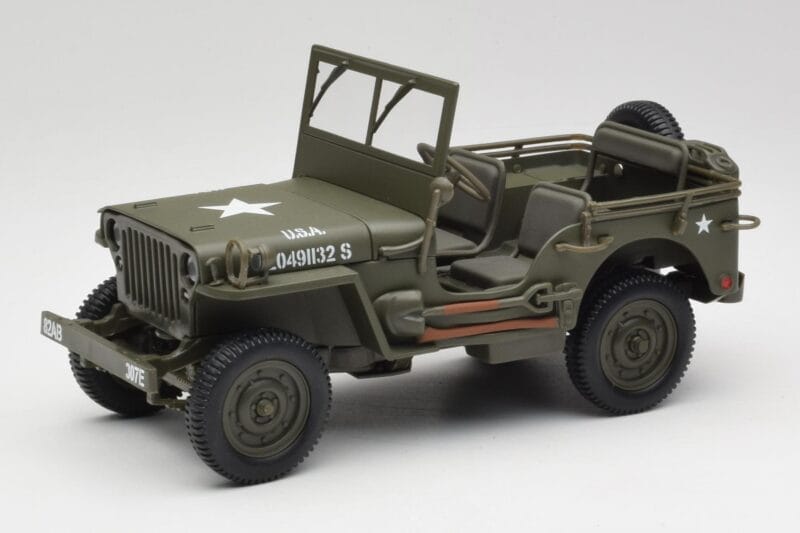
TL;DR: Gate's 1:18 diecast Jeep Willys MB reproduces the WWII-era workhorse in Military Green, with flat fenders, a folding windshield, and an open cabin true to the original. Built for Allied forces in the 1940s, the Willys MB became the template for every civilian Jeep that followed. A compact, honest piece for a vintage military shelf.
Some vehicles earn their place in history through speed or beauty. The Willys MB earned it through sheer usefulness, and Gate's 1:18 diecast treats that plain-spoken toughness as the whole point rather than something to dress up.
There is nothing to hide on a Willys MB, and that works in the model's favor. Flat stamped fenders, an exposed grille with the vertical slat pattern the Army specified, and a windshield that folds flat against the hood are all straightforward shapes to reproduce accurately, and Gate gets the proportions right rather than rounding them off for a friendlier look. The doors are absent entirely on the real vehicle, and the model follows suit, leaving the cabin open on both sides with a visible bench seat and a simple dashboard carrying only the gauges the original needed. Lifted from its packaging, the diecast body has a dense, utilitarian heft that suits a vehicle built for durability over comfort.
Military Green on a Jeep like this is not meant to shine. Gate applies a matte-leaning finish rather than a showroom gloss, which reads as correct for a vehicle that spent its working life in mud and dust rather than a dealership lot. The paint sits evenly across the flat panels without the metallic fleck a modern sports car casting would carry, and stenciled markings, where present, stay legible rather than smeared. It is a finish that photographs plainly and honestly, which suits the subject better than a polished alternative would.
The Willys MB was developed in the early 1940s to meet a US Army requirement for a light, rugged reconnaissance vehicle that multiple manufacturers could build to identical specification, and Willys-Overland's design became the standard alongside Ford's licensed version. It served across every theater of the Second World War, hauling troops, towing light guns, and running messages over terrain wheeled vehicles were never meant to cross, earning a reputation for reliability that outlasted the war itself.
After 1945, Willys turned the MB's basic layout into the civilian CJ line, and that lineage runs in an unbroken thread through decades of Jeep products that followed, right up to the models still built today. Few vehicles can claim to have founded an entire body-style category the way the Willys MB did, and that historical weight is part of why a well-executed 1:18 diecast of the original still holds appeal for collectors who never served near one but recognize its silhouette instantly.
At a compact 1:18 footprint, the Willys MB takes up noticeably less shelf depth than the postwar sedans and sports cars it often sits beside, since the original vehicle itself was small and utilitarian. It works as a standalone piece for military vehicle collectors, but it also anchors a broader off-road or 4x4 theme alongside later Jeep, Land Rover, or Toyota Land Cruiser castings, tracing how the go-anywhere formula evolved. Priced well below the resin-built supercars elsewhere in a collection, this diecast proves historical significance and complex tooling do not have to go together, and that a simple, honestly built subject can hold its own next to far more expensive company.