Last one
Used
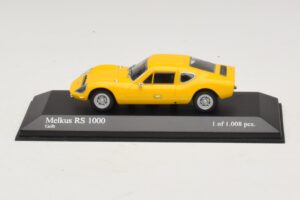
Melkus scale models center on the RS1000, a gull-wing fiberglass sports car built in East Germany during the 1970s using Wartburg-derived mechanicals. Minichamps renders it in 1:43 diecast, giving collectors a focused, single-subject niche rather than a sprawling marque landscape.
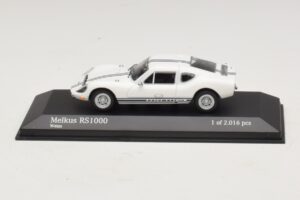

TL;DR: Melkus scale models document the RS1000, the fiberglass-bodied sports car built in East Germany through the 1970s, reproduced here by Minichamps in 1:43 diecast. This is a narrow, single-subject category rather than a broad marque landscape, prized for its rarity and distinct Eastern Bloc automotive design.
Melkus occupies a genuinely small corner of scale model collecting, built entirely around one car: the RS1000, a wedge-shaped, gull-wing sports car assembled in Dresden through the 1970s using Wartburg-derived mechanicals. Where most brand categories span decades and dozens of models, this one centers on a single East German subject rare enough that most Western collectors never encounter the real car. Minichamps renders it in 1:43, giving the Melkus shape the detail it needs without demanding specialist knowledge most collectors lack.
The Melkus RS1000 is the brand, in every practical sense that matters to a collector. Built in Dresden during East Germany's planned economy, the car paired a lightweight fiberglass body with gull-wing doors and a wedge profile that looked nothing like the Trabants and Wartburgs sharing its roads, powered by mechanicals borrowed from the Wartburg parts bin rather than any bespoke engineering program. That contrast, a genuine sports car silhouette built from utilitarian componentry, is what gives the RS1000 its lasting appeal among collectors who specialize in Eastern Bloc automotive history.
Because the real car was produced in modest numbers and rarely left the Eastern Bloc during its production years, most Western collectors know it only through photographs and, increasingly, through scale replicas. That scarcity shapes the category: there is no deep bench of RS1000 variants or competing manufacturers to compare, just a small number of faithful renderings of a genuinely unusual car. Collectors drawn to this subject tend to already know its backstory rather than discovering it through the model itself.
Minichamps built its reputation on detailed, accurately proportioned 1:43 diecast across road cars and motorsport subjects, sitting at a mid-to-premium tier above mass-market diecast without reaching the hand-built resin tier's razor-sharp panel lines. That positioning matters for a subject like the RS1000, where there is no competing manufacturer's version to cross-check against: the model's fidelity rests entirely on Minichamps' own research into a car most reference libraries cover thinly.
Evaluating a Minichamps piece on an unfamiliar subject like this means checking the same fundamentals that apply to any diecast at this tier: even panel gaps along the gull-wing door seams, a paint finish that captures the car's distinctive wedge profile without flattening its proportions, and wheel and glazing detail proportioned correctly against the compact body. Because the RS1000's gull-wing doors are a defining visual feature of the real car, how convincingly a model handles that detail, whether rendered as a sealed body or with an opening panel, says more about the casting's care than almost any other single element.
1:43 has long been the default scale for documenting unusual or regional subjects that larger manufacturers never touch, precisely because its smaller footprint and lower tooling cost make niche subjects viable to produce at all. A car like the RS1000, with a limited real-world production run and a narrow collector base outside its home region, fits naturally into 1:43 rather than the flagship 1:18 scale that demands far wider commercial appeal to justify the investment.
At roughly 9 to 10cm depending on the exact proportions, a 1:43 Melkus sits easily on a shelf dedicated to classic sports cars from smaller or regional manufacturers, the kind of company a flagship-scale collection rarely accommodates. The scale trades the examination-level detail of 1:18 for density: a collector can display the RS1000 alongside other Eastern Bloc or regional sports cars without the shelf space a larger scale would demand, which suits a subject this specialized far better than a more prominent display scale would.
Honesty about scope matters here: Melkus is not a brand that supports a sprawling collection the way larger European sports car marques do. This category offers a focused, single-subject scope rather than a full manufacturer landscape, and that is a genuine feature for the right collector rather than a shortcoming. A Melkus RS1000 works best as an anchor piece within a broader Eastern Bloc or regional sports car theme, sitting alongside Eastern European subjects that rarely appear in Western diecast catalogs.
For collectors building a display around Cold War-era automotive design, the RS1000 provides a genuinely distinct contrast to the Trabants and Wartburgs most people associate with East German cars. Pairing it with other 1970s regional sports cars, rather than mainstream Western marques, gives the piece the context it needs to read as significant rather than curious. Because the subject pool here is narrow by nature, patience matters more than breadth: a single well-chosen RS1000 says more about a themed collection than several lesser-known subjects acquired just to fill shelf space.
The RS1000 was a genuine sports car built in East Germany using Wartburg-derived mechanicals, giving it a wedge-shaped, gull-wing silhouette unlike anything else produced in the Eastern Bloc during the 1970s. That contrast between utilitarian origins and sports car styling is what draws collectors to the subject.
Minichamps has a history of documenting unusual and regional subjects at 1:43 scale precisely because the smaller scale lowers the tooling investment needed to justify a niche car. The RS1000 fits that pattern as a distinctive, under-documented subject worth covering despite its narrow collector base.
Because the real RS1000 was produced in modest numbers over a short run, the subject pool for scale replicas stays naturally limited. Collectors should approach this category as a focused, single-subject niche rather than expect the broad variant coverage that larger, higher-volume marques typically receive.
Other Eastern Bloc or regional 1970s sports cars make the most natural companions, giving the RS1000 the Cold War-era design context it needs. Pairing it with mainstream Western marques tends to undersell what makes the Melkus shape genuinely unusual.