Used

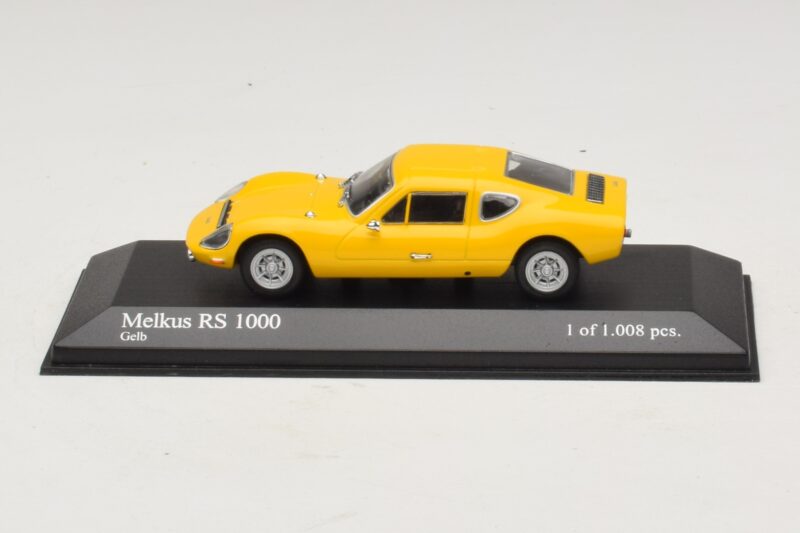
TL;DR: Minichamps' 1:43 diecast Melkus RS1000 in yellow reproduces the 1972 mid-engine coupe built in Dresden, East Germany's only purpose-built sports car manufacturer. The body is a sealed one-piece casting, so the car's low wedge profile and fiberglass-style surfacing are captured entirely through exterior lines rather than any opening panel.
The Melkus RS1000 holds a singular place in automotive history as the only sports car series-produced in East Germany, built in Dresden by a small team around Heinz Melkus's design using mechanical components sourced from the state-run Wartburg factory. A mid-engine fiberglass coupe emerging from a planned economy was never a safe bet, which makes its existence genuinely remarkable.
Minichamps casts this RS1000 as a single sealed body, and on a subject this obscure, that construction choice puts real pressure on getting the surfacing right, since there is no established reference library of RS1000 castings for a buyer to compare against. The real car's fiberglass body was hand-laid in small numbers, which gave it slightly soft, organic surfacing rather than the crisp creases of a stamped-steel production car, and Minichamps' zinc alloy casting translates that character reasonably well, holding the wedge-shaped nose and low, flat hood line that gave the RS1000 its distinctly 1970s wedge profile.
Yellow is a historically plausible color for an RS1000, since bright, saturated paint was one of the few forms of visual individuality available to owners of a car built under East German industrial constraints, and the color lets the model's limited surface detailing, headlight bezels, bumper trim, and the car's compact glasshouse, stand out clearly rather than disappearing into a more muted factory shade.
Because genuine RS1000s survive in very small numbers today, a well-researched 1:43 casting like this one carries real documentary value beyond typical collector appeal: for most enthusiasts, a diecast model is the closest and most practical way to study this car's proportions and detailing at all, which raises the bar for getting the shape right in a way that a mass-produced subject with thousands of surviving originals does not face.
Heinz Melkus, a racing driver and engineer, began building sports cars in Dresden in the 1950s, but it was the RS1000, introduced in 1969 and refined through the early 1970s, that became his best-known and most successful design. Operating within the GDR's planned economy, Melkus could not simply source a bespoke engine or specialized components; instead, the RS1000 used a tuned version of the three-cylinder two-stroke engine from the state-produced Wartburg sedan, mounted behind the driver in a layout more commonly associated with Italian exotics than with Eastern Bloc family cars.
That combination, genuine mid-engine sports car architecture built from humble, mass-produced mechanical parts, makes the RS1000 one of the more fascinating engineering stories to come out of the communist-era automotive world. Production numbers were tiny throughout the car's run, constrained by both material shortages and the state's limited interest in prioritizing a sports car within its planned production quotas, which is precisely why surviving examples are now scarce and why the car remains relatively unknown outside dedicated Eastern Bloc automotive circles.
For American collectors, the RS1000 represents a genuine discovery: a car with none of the brand recognition of a Porsche or Lotus from the same era, but with an engineering story, sports car ambition realized inside a planned economy, that rewards the kind of research-driven collecting this hobby values most.
At roughly 8cm, the RS1000's compact wedge body fits easily into a mixed-era European sports car shelf, though it earns its place through rarity of subject rather than scale footprint. Yellow gives the piece immediate shelf presence, a useful quality for a car most visitors to a collection will not recognize at a glance.
For collectors building an Eastern Bloc or communist-era automotive theme, this RS1000 pairs naturally alongside Trabant, Wartburg, and other state-produced castings, though it stands apart from all of them as the only genuine sports car the arrangement produced. Buyers new to the subject should treat this casting as both a model purchase and a small piece of automotive history that mainstream diecast catalogs rarely cover. Few 1:43 lineups give this car its due.