Used

TL;DR: Minichamps' 1:43 Melkus RS1000 reproduces East Germany's only series-built sports car in white, a sealed one-piece diecast capturing the fiberglass body's distinctive gull-wing door design in its closed position. A niche 1972 Wartburg-engined coupe for collectors exploring Eastern Bloc automotive history.
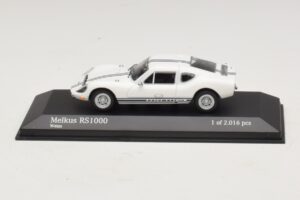
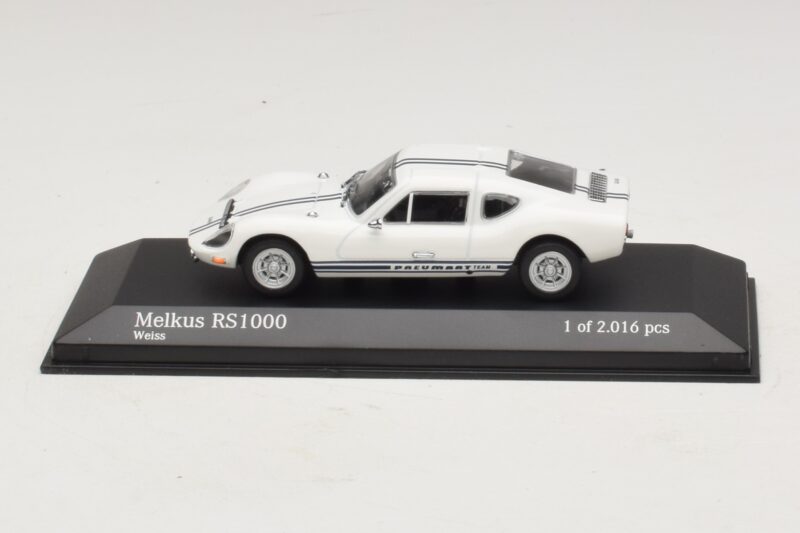
The Melkus RS1000 holds a singular place in automotive history as East Germany's only series-produced sports car, built in Dresden on a shoestring with mechanical parts borrowed from the everyday Wartburg. Minichamps reproduces that unlikely machine in white, a color that lets the car's wedge-shaped fiberglass body and gull-wing doors read clearly at 1:43.
This Melkus comes as a fixed, single-piece body, with no panels that open on the model, which keeps the tooling's attention on a shape that is genuinely unusual among European sports cars of its era. The real RS1000 used upward-swinging gull-wing doors, a design more commonly associated with far more expensive machinery, and this casting captures that door design in its closed position: the distinctive cut line running up and over the roof rather than down the body side, exactly where it sits on the real car.
The white paint covers the fiberglass-inspired body shape cleanly, letting the car's low, wedge-like nose and simple, unadorned flanks read without distraction. Minichamps tools its 1:43 line to hold detail that larger-run budget diecast tends to lose, and on a subject this obscure outside its home market, accuracy matters more than usual since there is no widely familiar silhouette to fall back on for comparison. The rear engine cover, wheel arches, and simple badging are all picked out with the same small-scale precision the brand applies to better-known Western European subjects.
Heinz Melkus built the RS1000 in Dresden starting in the early 1970s, and it remains East Germany's only sports car to reach anything resembling series production, a genuine rarity given how tightly the GDR's planned economy controlled industrial output and access to specialized materials. The car used a three-cylinder, two-stroke engine derived from the Wartburg, the everyday East German family car, mounted amidships rather than up front, a configuration that gave the lightweight fiberglass-bodied RS1000 genuine sporting credentials despite its humble mechanical origins.
Production numbers stayed small throughout the model's run, limited as much by the GDR's industrial constraints as by demand, and the car saw use in East German motorsport as well as on the road. For Western collectors, the Melkus represents a corner of automotive history that mainstream collecting rarely touches, a genuine curiosity built under circumstances that would have made a conventional sports car project nearly impossible. Few other cars tell as much about a nation's engineering resourcefulness in a single shape.
At 1:43, the Melkus occupies a compact footprint that fits easily alongside other small-displacement European sports cars, though its story sets it apart from nearly everything else on a typical shelf. The sealed body keeps attention on the wedge shape and gull-wing door design that make the RS1000 instantly distinctive once a collector knows what they are looking at. This is not a car most American buyers will recognize at a glance, which is precisely its appeal for a collector drawn to genuine discovery pieces rather than familiar names.