Mercedes S-Class W220 S600 Limited Edition Norev 1:18
Price:
91.00 €
This model is currently sold out. Enter your email and we'll let you know when it's back in stock.
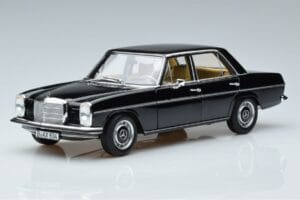
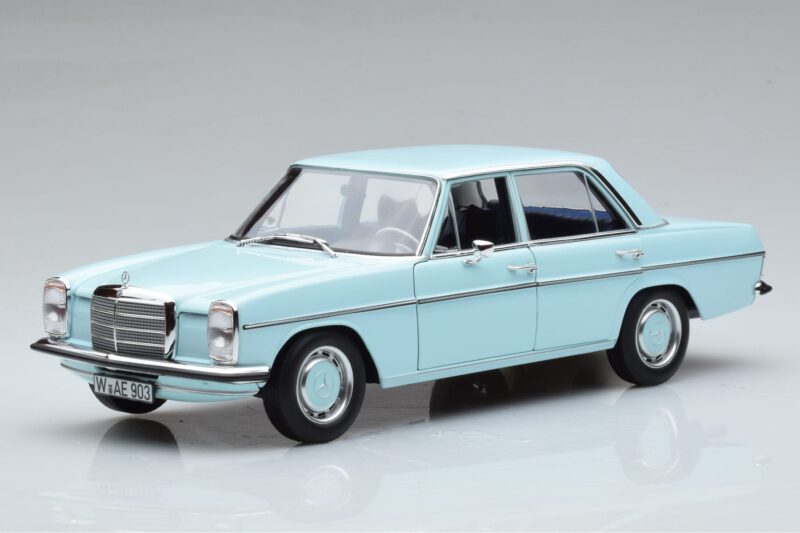
TL;DR: Norev's 1:18 diecast Mercedes 200 W115 recreates the 1968 'Stroke Eight' sedan, the entry point into Mercedes' most over-engineered generation of the 1960s and 1970s. Doors, hood and trunk open on this zinc alloy body, exposing cabin and engine detail. A quiet, honest sedan for a Modern Classics collection built on durability rather than glamour.
Mercedes-Benz built the W115 through the late 1960s and into the mid-1970s, and German enthusiasts still call it the Strich Acht, or Stroke Eight, for its 1968 introduction year. The 200 sat at the modest end of the range, a four-cylinder sedan bought by buyers who wanted Mercedes reliability without the six-cylinder price tag, and Norev's diecast treats that ordinariness as a genuine strength.
Mercedes engineers in the late 1960s built cars with tolerances and material quality far beyond what the era's competition offered, and the W115 became the generation's most visible proof. Taxi fleets across Germany ran these sedans past hundreds of thousands of kilometers on original mechanicals, a durability record that turned an unglamorous mid-size sedan into something closer to a legend among people who actually drove for a living rather than people chasing badges.
The 200 badge marked the smallest engine in the W115 range, a four-cylinder unit well below the six-cylinder 250 and 280 variants that carried more prestige. Norev's choice to model the entry-level car rather than a flagship variant matches how these cars were actually bought and driven, and it gives collectors a genuinely different subject than the six-cylinder sedans that usually get scale model attention.
All three major panels open on this model, and lifting the hood reveals an engine bay laid out to match the W115's straightforward four-cylinder architecture, no unnecessary complexity, much like the real car. The trunk opens to a cargo area sized for a family sedan rather than a sports coupe. Zinc alloy construction handles the hinge points well, giving each panel a defined stop rather than a loose swing, and the added weight from the metal body reinforces the sense of a solidly built machine, fitting for a car whose reputation rests entirely on solidity.
The W115's design offers Norev little ornamentation to hide behind: flat door panels, a simple grille, and modest chrome trim mean any flaw in paint or panel fit shows immediately. A clean, even finish over the metal body reads as deep and consistent under shelf lighting, and the chrome trim around the windows and grille needs to sit precisely to avoid looking cheap on a car this understated. Norev's licensed approach to Mercedes subjects generally serves plainer cars well, since there's no flashy bodywork to distract from finish quality.
At 1:18, the W115 sedan comes out to roughly 25 centimeters long, a standard footprint that fits any cabinet built for full-size sedan models. The proportions are unremarkable by design, upright greenhouse, modest overhangs, a shape built for interior space rather than aerodynamic drama, and that honesty is exactly what makes the model valuable to a collector building a chronology of Mercedes sedans rather than chasing individual halo cars. Diecast construction suits this subject well: the W115 was a mass-produced, durable machine, and a metal body with real weight and opening panels matches that character far better than a delicate hand-built resin casting would. Buyers should expect wider panel gaps than a sealed resin body offers, a fair trade for the hands-on access that lets a new collector inspect hinge quality and interior detail directly. Compared with the flashier 280SE coupe from the same general era, the 200 sedan asks for a different kind of appreciation, one built on engineering restraint rather than visual excess.
This Mercedes 200 works best as connective tissue in a broader collection, the honest, everyday counterpart to a 300SL or a 280SE that dominates the same shelf through pure visual presence. It also stands as a genuinely accessible entry point into Mercedes collecting, priced well below the brand's more celebrated models while carrying real historical weight of its own. Anyone building a decade-by-decade Mercedes sedan lineup will eventually need a Strich Acht in the collection, and Norev's diecast treatment, opening panels included, gives that gap a model worth actually handling rather than just displaying.