Last one
Used

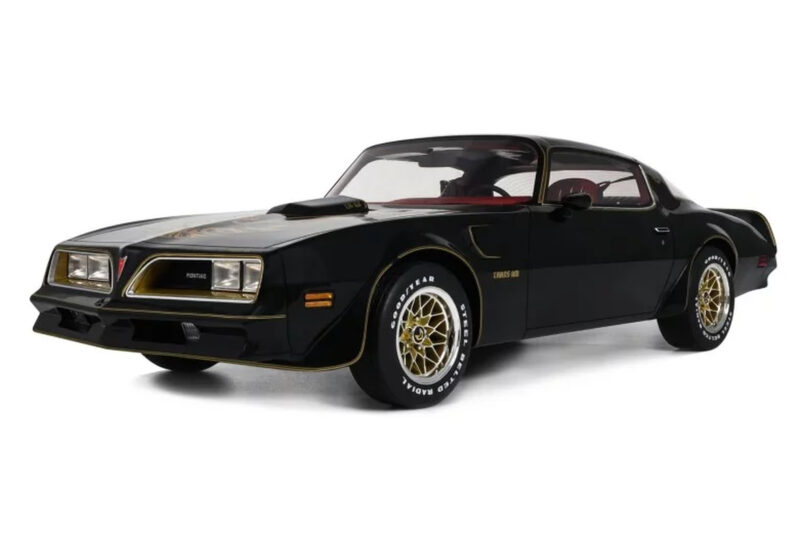
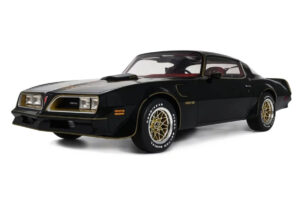
TL;DR: Otto's 1:12 resin Pontiac Firebird Trans Am reproduces the 1978 second-generation coupe in Starlight Black, from the Trans Am's most culturally visible years. Cast as a one-piece resin body with no opening panels, it trades interior access for razor-sharp shut lines at a display-commanding museum scale, positioned as a premium-tier muscle car anchor piece.
Burt Reynolds never drove this exact car — but the black Trans Am he piloted through "Smokey and the Bandit" put Pontiac's coupe on driveways across the country, and Otto's 1:12 resin replica of the 1978 model in Starlight Black revisits that moment at a genuinely commanding scale.
The second-generation Firebird ran from 1970 to 1981, and by 1978 the Trans Am wore the styling cues most collectors picture immediately: the shaker hood scoop feeding cold air straight to the carburetor, the wraparound taillights, and the low, long nose Pontiac's studio had drawn a decade earlier. T-tops had joined the options list two years prior, giving buyers open-air motoring without the Firebird's convertible ever returning to production. Whether or not a given car left the factory with the era's giant hood graphic, the coupe's silhouette alone was enough to make it recognizable at a glance.
Black finishes carry outsized weight in Trans Am history because of the car's exposure on movie screens at the end of the 1970s, most famously the black-and-gold coupe Burt Reynolds drove through "Smokey and the Bandit." That car wore gold snowflake wheels and a matching decal package; this Otto replica finishes its 1978 coupe in solid Starlight Black without that gold trim, closer to how many Trans Ams actually left dealer lots. It's a more restrained read of the same era, one that lets the shape and the shaker scoop carry the presence instead of graphics.
At 1:12, this Trans Am scales up to roughly 42 centimeters, about half again the length of a 1:18 rendition of the same car, closer to what collectors call museum scale. Resin casting suits that jump in size: it holds compound curves and thin body creases without the wider tolerances a die-cast tool needs at that dimension, so the shaker scoop and the wheel arch lips stay crisp rather than softened. The trade-off is mass. A resin body this size is lighter in the hand than an equivalent zinc-alloy casting would be, though the extra surface area still gives it real shelf presence.
This casting has no opening doors, hood, or trunk. Read that as a construction choice rather than a shortfall: with no hinge geometry to accommodate, the door lines and the panel gap along the trunk lid stay narrow and consistent all the way around the body, and the roofline runs as one unbroken curve above the T-top outline. Everything a buyer needs to judge sits on the outside, from the depth of the black paint under a spotlight to how cleanly the chrome trim separates from the body color. Anyone who wants to see a recreated V8 under a lifted hood should look toward a model built with an opening engine bay instead.
A model this size changes how a display works. Most muscle car collections build around 1:18, the format that lets a dozen or more cars share a long shelf without crowding; at 1:12 a single Trans Am claims roughly the footprint of two 1:18 cars side by side, which pushes it toward a featured position rather than one entry in a row. That scale jump also means more surface for the black paint and chrome trim to read from across a room, so this coupe works best lit on its own rather than tucked between smaller companions. Pontiac's muscle car survivors, from the 1970s Trans Am through the Firebird's later turbo years, hold enough of a following that a well-finished 1:12 piece can anchor a themed shelf even without support from other scales. Positioned that way, it becomes the piece a Pontiac-focused collection is built around rather than one of many.
Mass-market die-cast muscle cars are common at 1:18 and smaller scales, built to wider tolerances and priced for volume. Otto's 1:12 resin build sits in a different tier: smaller production runs, tighter panel fit, and a paint finish built to reward close inspection rather than a glance across a toy aisle. That positioning costs more per unit than a die-cast equivalent, and the sealed body means no engine bay to open, but it buys the shut-line precision that a die-cast tool struggles to match at this size. For a collector who already owns die-cast Trans Ams at 1:18 and wants a hero piece in the same theme, this is the natural step up rather than a replacement for the smaller cars already on the shelf.
At roughly 42 centimeters long, this 1:12 coupe is about half again the length of a 1:18 version of the same car. It needs more shelf depth and height than most cabinet rows are built for, so measure the space before ordering rather than assuming standard clearance.
No. The body is a sealed, one-piece resin casting with no opening doors, hood, or trunk. The detail lives entirely on the exterior: paint depth, panel gaps, and trim fit rather than an accessible interior or engine bay.
This coupe wears solid Starlight Black without the gold snowflake wheels or decal package associated with the Trans Am from "Smokey and the Bandit." It reflects a more common factory look from the era rather than that specific movie-inspired trim.
At 1:12, resin holds sharper body creases and tighter panel gaps than a die-cast tool typically achieves at the same scale, at the cost of some weight in the hand. It suits a display piece meant for close inspection over one built for handling.