Last one
This model is currently sold out. Enter your email and we'll let you know when it's back in stock.
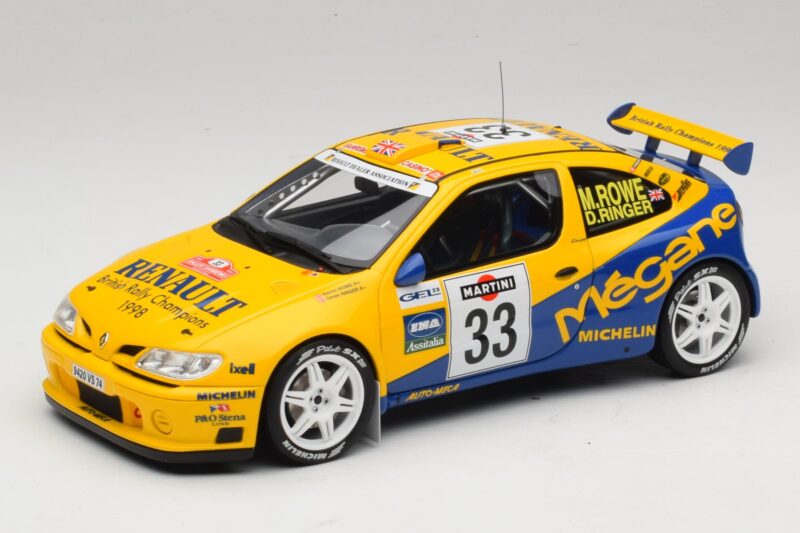
TL;DR: Otto's 1:18 resin Renault Mégane Maxi reproduces Philippe Bugalski and Jean-Paul Chiaroni's #33 car from the 1998 Rallye Sanremo, where the kit car beat every full World Rally Car on the entry list outright. The sealed one-piece resin body holds the Maxi's flared arches and rally livery sharp, a mid-tier resin piece marking one of rallying's genuine upsets.
Kit cars weren't supposed to beat full World Rally Cars outright, especially not on a rally that mattered. At the 1998 Rallye Sanremo, Philippe Bugalski and co-driver Jean-Paul Chiaroni did exactly that in a Renault Mégane Maxi, a result still cited as one of the category's defining upsets. Otto reproduces the winning #33 car in 1:18 resin.
The FIA's Kit Car category let manufacturers build two-wheel-drive rally cars with heavily modified bodywork and mechanicals on a mainstream road-car base, positioned as a cheaper alternative to full World Rally Cars for both makers and privateer teams. On tarmac rallies specifically, a lighter, well-balanced kit car could genuinely compete with the heavier, all-wheel-drive World Rally Cars, and Sanremo's mixed tarmac and gravel stages gave Bugalski's Renault the conditions to prove it. His overall win there remains one of the strongest results a two-wheel-drive car has managed against factory World Rally Cars in the championship's modern era.
Philippe Bugalski built his reputation specifically on tarmac performance, a driving style that suited kit cars far better than the loose-surface stages where all-wheel-drive traction mattered more. Jean-Paul Chiaroni called the pace notes for that Sanremo win, part of a partnership that ran across several of Bugalski's most notable results in Renault machinery through the late 1990s. Their success helped cement the Mégane Maxi's reputation as the benchmark kit car of its era, a status few rivals in the category ever matched.
Kit car regulations allowed dramatic bodywork modification, and the Mégane Maxi wore flared arches and a wider track that gave it a genuinely aggressive stance next to the road-going Mégane it was based on. Otto casts the model as a sealed, one-piece resin body, letting the finished piece focus entirely on that widened silhouette and the rally-specific aero addenda rather than any opening feature a purpose-built competition car never carried for spectators anyway. Resin's tighter tolerances hold the flared arch edges and the rally lighting pods mounted ahead of the grille sharper than a stamped diecast body typically manages.
Getting the #33 car's livery correct matters more on a subject this specific, since Bugalski ran different sponsor configurations across his career and a mismatched livery would misrepresent the actual winning car. Otto's decal work keeps the Renault Sport branding and event markings registered cleanly across the Maxi's flared bodywork, and under a raking display light the paint holds real depth rather than the flat look a less careful reproduction would show on a livery this graphically busy.
At 1:18, the Mégane Maxi's compact hatchback proportions come out to around 21 to 22 centimeters, noticeably smaller than the World Rally Cars it famously beat, a size difference worth keeping in mind when planning cabinet space. Displayed alongside a full World Rally Car from the same 1998 season, the size contrast itself helps tell the story of just how unlikely that Sanremo result actually was. Kit car era rally models remain a relatively specialized niche compared to the more heavily reproduced Group B or modern WRC eras, which gives a documented result like this genuine standing among collectors who track the sport's less obvious chapters rather than only its headline categories.
Most kit car results from this era faded from wider memory once the category was phased out in the early 2000s, but Sanremo 1998 remains an exception, still referenced whenever the conversation turns to underdog results in rallying. Otto's mid-tier resin build gives that specific result the kind of attentive reproduction a genuinely significant car deserves, sitting above mass-market diecast in finish while staying accessible next to the ultra-limited pieces some rally specialists produce. For a WRC-era shelf, this Mégane Maxi belongs less as a footnote and more as a genuine highlight.