Last one
This model is currently sold out. Enter your email and we'll let you know when it's back in stock.
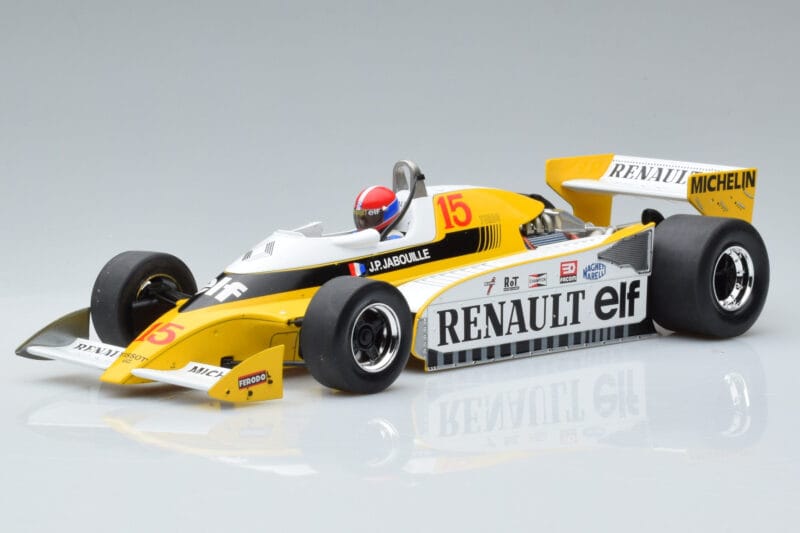
TL;DR: MCG's 1:18 diecast Renault RS10 reproduces Jean-Pierre Jabouille's #15 Elf-liveried car, winner of the 1979 French Grand Prix and Formula 1's first turbocharged race victory. The sealed body carries no opening panels. A genuine milestone subject for any turbo-era Formula 1 collection.
Renault's turbocharged engine program was widely mocked as unreliable before Jean-Pierre Jabouille's win at Dijon in 1979, a race that quietly opened the door to the turbo era that would come to dominate Formula 1 through the mid-1980s.
The RS10's wedge-shaped nose and side-mounted radiator pods reflect the aerodynamic thinking of the late 1970s, and MCG's diecast casting captures that low, purposeful profile with the density and sharp panel definition a metal build allows. The body is sealed, with no opening panels, so accuracy is judged entirely from the outside: how correctly the sidepod and radiator inlet shapes are proportioned, how crisply the yellow and black Elf sponsor livery is applied over the French team's colors, and how precisely the #15 number and period decals sit on the bodywork. Diecast construction gives this formula car a reassuring weight in the hand relative to its slender profile, and the tight cast tolerances hold up well along the narrow nose and low cockpit surround that define the RS10's silhouette.
This RS10 marks more than a single race win, it represents the moment turbocharging went from a punchline to a legitimate path forward in Grand Prix racing, which gives the model historical weight beyond its livery and shape alone. Displayed alongside other late-1970s Formula 1 subjects, particularly rival naturally-aspirated cars of the period, it illustrates the technological shift that was just beginning to take hold. The sealed body makes it simple to maintain, with nothing to inspect beyond paint consistency and livery sharpness. At roughly 20cm, its narrow formula-car footprint fits comfortably into a dense F1 display. For a collector tracing the roots of the turbo era, this French Grand Prix winner is genuinely significant.