New arrival

BMW 745i E23 Burgundy Red Metallic Touring Modelcars 1:18
Price:
114.00 €
Touring Modelcars models in this collection center on 1980s BMW executive sedans, cast in diecast at 1:18. The scale is large enough for stance, glazing and badge detail to be judged by eye, and the subject, the four-door BMW of the Eighties, suits a shelf built around one marque and one decade.

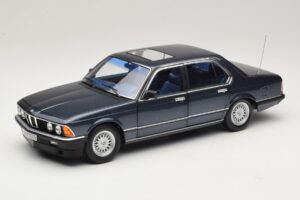

TL;DR: Touring Modelcars is a manufacturer collection of 1:18 diecast models centered on 1980s BMW executive sedans. Diecast brings heft and a durable body, while 1:18 gives about 25 centimeters of car for judging stance and finish. Check each product card for details such as opening parts, which vary model by model.
Touring Modelcars models give a shelf a narrow, deliberate focus: the four-door BMW of the 1980s, in 1:18 diecast. Executive sedans are the quiet side of the marque, cars defined by proportion, restraint and a low, planted stance rather than showy bodywork. That makes fidelity easy to judge and the finish impossible to hide.
The assortment here is tightly drawn. Everything in this collection is a 1:18 diecast model of a BMW executive sedan from the 1980s, a combination that works in a collector's favor because every piece shares a scale, a material and a design language. Side by side, differences in finish and stance show up fast, which is exactly how most hobbyists compare models.
The real cars explain the appeal. BMW's executive sedans of the decade favored upright proportions, slim pillars, generous glass and a clean, rectangular surface treatment. Those traits are forgiving in some ways and unforgiving in others. Flat panels and straight shut lines look right when a model is accurate, and they look wrong immediately when it is not.
This page describes what the collection holds, not the full output of the manufacturer. Touring Modelcars may offer more beyond this selection, and the product cards remain the authority on each model's specific details, including color, edition information and whether any panels open. Treat this as a focused corner of 1:18 collecting rather than a survey of a whole catalog.
Diecast means a body cast in zinc alloy, and the first thing a collector notices is mass. A 1:18 sedan lifts out of its foam insert with real weight, cool to the touch, and it feels like a solid object rather than a toy. That heft is a material trait, shared across diecast at every price tier.
Metal also shapes the finish. Paint sits on a hard shell, so gloss tends to read deep and even under a display lamp, and the body shrugs off the small knocks that chip lighter materials. The trade-off is casting tolerance. Metal is poured into a die, so edges run a shade softer and shut lines a shade wider than cast resin typically allows. Neither is a flaw. It is simply what the material does.
Ageing is kind to diecast. A metal body holds its shape through years on a shelf, and it tolerates being moved between displays. Rubber tires and thin plastic parts are the components to watch over time. Whether doors, hood or trunk open on a particular model is a per-product detail, so read each card instead of assuming. Collectors judge a sealed body by its paint and shut lines, and an opening one by how cleanly the seams close.
Collectors often ask where a manufacturer sits on the quality ladder. The honest answer comes from the pieces, not from a roster. At 1:18 diecast, the tiers differ in observable ways:
Entry-tier pieces trade some of that precision for accessibility, mid-tier pieces close much of the gap, and upper tiers add finer parts and tighter tolerances. Tier follows construction and price, not the material alone. This page does not rank Touring Modelcars against other manufacturers. Compare its models with a neighboring piece of the same subject and let the shut lines and paint settle it.
Start with stance. A BMW sedan of this era sits level and planted, with modest wheel arches and a visible but not extreme gap between tire and arch. A model that sits too high or leans nose-up reads wrong from across the room, before any detail registers. Check the side profile first, then the front three-quarter view.
Next, glass. Executive sedans of the decade carried large windows with thin pillars, so glazing thickness and fit are exposed. Look for clear, undistorted panes and clean edges where glass meets body. Then look at the grille, where the twin kidney shapes and their slats should be crisp and straight, and at the badges, which should be sharp and correctly positioned.
Finally, check the wheels. Design, size and offset shape the whole look, and the real car's wheel designs varied by trim. Compare against period photos of the actual car if you have them. These checks cost nothing and work the same on any 1:18 model, which makes them a reliable habit before any purchase.
A four-door sedan is long for its width, so a 1:18 piece typically measures a little over 25 centimeters nose to tail. That length drives shelf planning. Leave a few centimeters between cars, and give each model enough depth that the mirrors do not overhang the edge. Standard bookshelves usually work, though a glass-fronted vitrine keeps dust off open surfaces and fine details.
Compared with 1:43, the footprint is several times larger and the detail visibly richer. At 1:43 a sedan fits in the palm and a whole decade can share a shelf, but panel gaps and interior texture compress below what the eye resolves. 1:18 trades breadth for presence, which suits a focused one-marque display.
Light matters. Direct sunlight fades paint and yellows clear parts over time, so position the display away from windows. Dust with a soft brush, not a cloth that can snag mirrors and wipers, and keep original boxes and inserts for storage. Lift models by the base or the lower body, never by the mirrors or roof edges.
American collectors often specialize by marque, and a single brand across a single decade is a clean way to do it. The collection described here already supplies the spine: BMW executive sedans, 1980s, 1:18 diecast. Color then becomes the variable. Dark metallics, light silvers and solid colors of the era look different together, and a shelf with deliberate color balance reads as curated rather than accumulated.
Collectors extend a shelf like this in several directions:
Start with the sedan that matters most to you and see how the next one sits beside it. Buy for the shelf you want to look at, not for imagined resale gains; a model earns its place by how it looks in the room. Browse the range with a theme in mind and add one piece at a time.
Collectors who prefer depth over breadth: one marque, one era, one scale. The shared 1:18 diecast format makes comparison easy, and executive sedans reward close inspection of stance and finish. Those wanting hundreds of subjects on one shelf are usually better served by 1:43.
Look at stance and ride height from the side, then paint depth under a lamp, shut line consistency and wheel design. These four checks reveal a model's construction tier quickly, and none of them needs specialist knowledge or a reference book.
Read the product card. Opening features differ from model to model, in diecast as in any other material, so scale and brand cannot answer it. The listing is the authority, and a sealed body is judged on its paint and shut lines instead.
Keep them out of direct sunlight, leave a few centimeters between cars, and use a glass-fronted vitrine or regular soft-brush dusting. Hold each model by the base, and store original boxes and inserts for any future move or storage.