Last one
Used
This model is currently sold out. Enter your email and we'll let you know when it's back in stock.
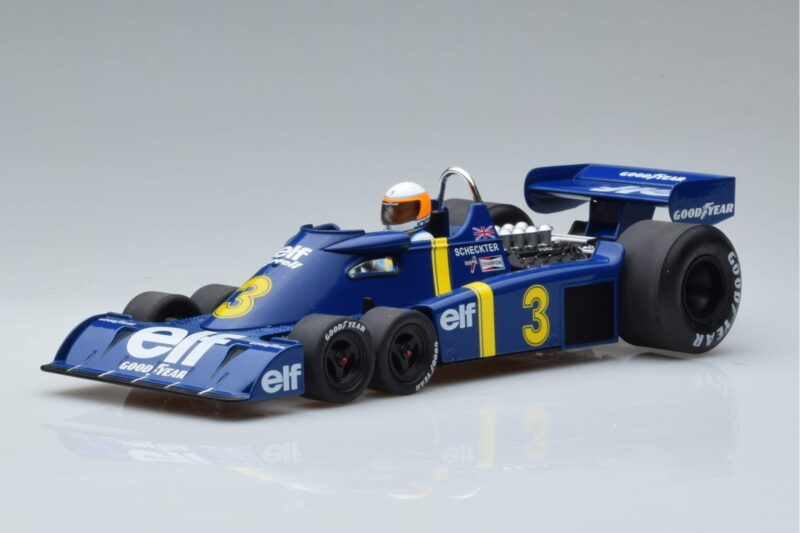
TL;DR: MCG's 1:18 diecast Tyrrell P34 reproduces Jody Scheckter's #3 Elf-liveried car that won the 1976 Swedish Grand Prix, Formula 1's only six-wheeled winner. The sealed body has no opening panels. A genuinely rare engineering subject for any 1970s Formula 1 display.
The Tyrrell P34 remains the only six-wheeled car to win a Formula 1 race, and Jody Scheckter's victory at the 1976 Swedish Grand Prix, with teammate Patrick Depailler finishing second for a Tyrrell one-two, is the moment that made this strange engineering experiment famous rather than forgotten.
The P34's four small front wheels, designed to reduce frontal drag while maintaining contact patch, are the defining visual feature any replica has to get right, and MCG's diecast construction gives the model the density and edge definition needed to hold that unusual wheel arrangement convincingly at 1:18 scale. The body is sealed with no opening panels, so the model's accuracy rests on its exterior: how correctly the four-wheel front axle is proportioned against the two-wheel rear, how sharply the Elf sponsor livery and Tyrrell blue are applied, and how crisply the #3 racing number and period decals are rendered. Diecast construction at this tier typically carries real heft for a formula car casting, and the narrow, aerodynamic nose and low cockpit surround benefit from the tight tolerances a metal casting can hold along such slender bodywork.
Few Formula 1 subjects generate the immediate recognition the P34 does, since its six-wheel layout is instantly identifiable even to casual observers, making it a strong conversation piece in any 1970s racing display. Paired with other Tyrrell cars from the era, or displayed alongside period rivals, it illustrates just how experimental Grand Prix engineering was before regulations tightened around unconventional wheel configurations. The sealed body keeps the piece simple to maintain, just a shape to inspect for livery accuracy and paint consistency. At roughly 20cm, its narrow formula-car footprint fits easily into a dense F1 shelf arrangement. For any collector building a 1970s Grand Prix history, this Swedish GP winner is a landmark addition.