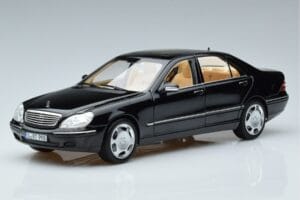
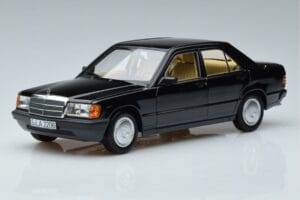
Mercedes S-Class W220 S600 Limited Edition Norev 1:18
Price:
91.00 €
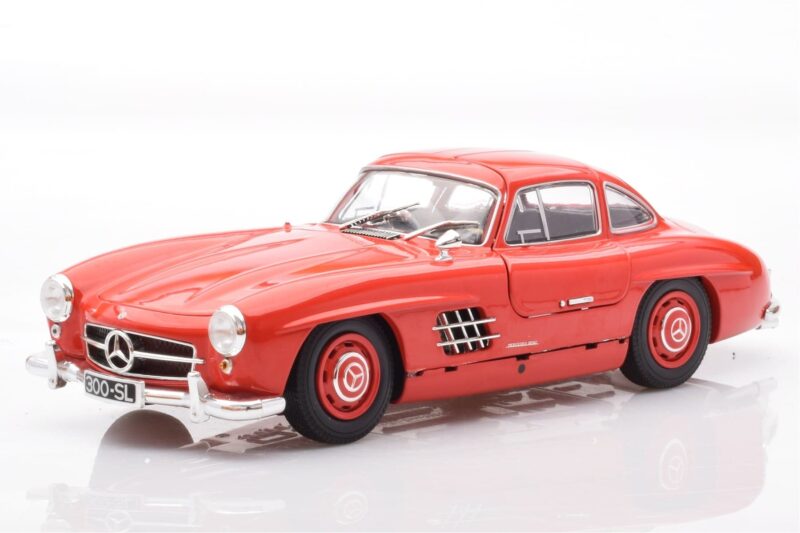
TL;DR: Minichamps' 1:18 diecast Mercedes-Benz 300 SL W198 reproduces the red Gullwing coupe, with doors that hinge upward exactly as the 1954-57 original required around its tubular spaceframe. Opening panels reveal a detailed cabin and engine bay. A recognizable anchor piece for a 1950s sports car collection at mid-tier diecast pricing.
No door mechanism in automotive history is as instantly recognizable as the 300 SL's upward swing, a solution born from necessity rather than styling. Minichamps carries that mechanism into 1:18 diecast, giving this red Gullwing the same upward arc collectors expect the moment the model comes out of its box.
Swing this Gullwing's door open and it travels through the same upward arc as the original, hinging from the roofline rather than a side pillar, a mechanism made necessary by the tubular spaceframe chassis running high along the sills. The hinge holds firm resistance rather than flopping open, and the zinc alloy body gives the model real heft when lifted clear of its display base. That weight, combined with the door's distinct motion, is the single detail that sells this casting as a Gullwing rather than a generic 1950s coupe. Resin versions of the same car, by contrast, must seal the doors shut to preserve casting precision, trading this signature opening motion for tighter panel lines elsewhere.
Behind the open doors sits a mapped dashboard with legible gauges and correctly shaped bucket seats, visible clearly once the door lifts clear of the sill. The red paint is applied evenly across the long hood and fastback roofline, with chrome bumpers, window surrounds, and the signature side vents picked out distinctly rather than left in a single tone. The wheels sit with the correct offset beneath the fenders, keeping the stance low and planted the way the original's chassis demanded.
The 300 SL's road-going W198 form traces directly back to the W194 racing car that Mercedes-Benz campaigned in the early 1950s, taking a class win at the Carrera Panamericana and an overall result at Le Mans. That racing spaceframe, engineered for lightness and rigidity, dictated the high door sills that made a conventional door impossible, and the upward-hinged solution followed as an engineering answer rather than a styling flourish. Few production cars carry that direct a line from race circuit to showroom floor.
When Mercedes-Benz launched the road car in 1954, it became the first production automobile fitted with direct fuel injection, a technology borrowed from the W194 racer and adapted for road use. That innovation, paired with the aerodynamic body and the doors that followed from the chassis design, made the 300 SL a genuine engineering statement rather than simply a fast-looking coupe. It remained in production only a few years before Mercedes-Benz moved to the roadster body, which adds to the coupe's standing among 1950s collectors today.
A red 300 SL reads as a genuine centerpiece rather than a supporting piece on most shelves, and its opening doors mean it deserves a display spot with clearance on both sides rather than a tight row. At roughly 22 centimeters in 1:18, it pairs naturally with contemporary European coupes from the same decade, and the doors alone justify displaying it open rather than closed. For collectors comparing diecast against sealed resin alternatives of the same car, the trade-off is straightforward: diecast delivers the functioning door mechanism that defines the subject, while resin trades that motion for sharper static shut lines.








You save 16.00 €
Lowest price in the 30 days before the reduction: 123.00 €




You save 29.00 €
Lowest price in the 30 days before the reduction: 147.00 €