Last one
This model is currently sold out. Enter your email and we'll let you know when it's back in stock.
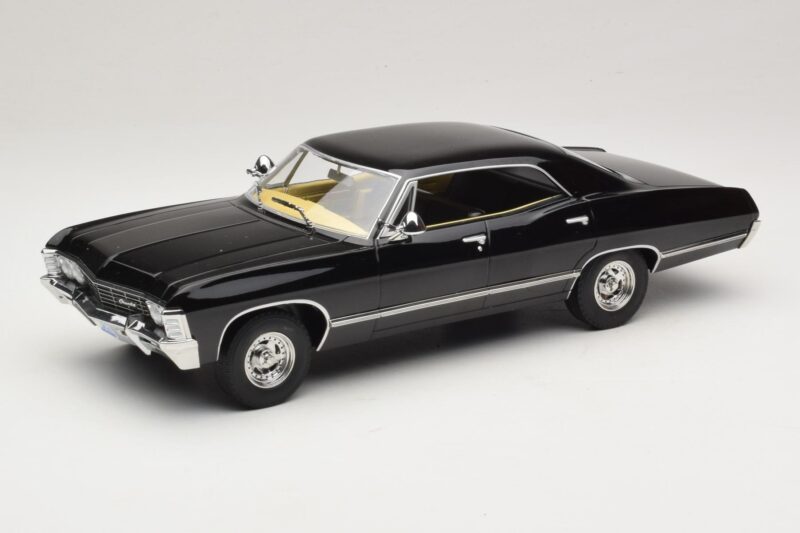
TL;DR: MCG's 1:18 diecast Chevrolet Impala reproduces the 1967 coupe in Black, a model year widely regarded as a high point in the Impala's full-size design history. Cast as a sealed one-piece body, the model keeps its long, low panel lines continuous across a shape built for genuine road presence.
Few American full-size coupes from the 1960s carry the same instant recognition as the 1967 Impala, a car whose clean, uncluttered lines have made it a fixture of both classic car shows and popular culture decades after production ended. MCG's 1:18 diecast reproduces it in Black, cast as a sealed body that lets the coupe's long roofline read as one continuous sweep.
By 1967, the Impala had matured into Chevrolet's flagship full-size model, a car built on genuinely generous proportions rather than the more compact designs that would follow as fuel economy and safety regulations reshaped the American market in the following decade. The 1967 model year is frequently cited by collectors as one of the cleanest designs in the Impala's run, trading some of the more ornate chrome detailing of earlier years for a simpler, more restrained look that has aged particularly well. That restraint is part of why the 1967 Impala has found lasting cultural presence well beyond typical classic car circles, appearing in film and television as a stand-in for the era's confident, road-dominating American design.
The Impala's design leans on long, uninterrupted body lines running from the front fender to the rear quarter panel, a shape that benefits from a casting process capable of holding those lines without a break. MCG casts this Impala as a sealed one-piece diecast body, meaning there are no hinge tolerances to plan around and the shutlines along the doors and trunk run as clean, continuous grooves rather than gaps that shift with a moving panel. Diecast's zinc alloy construction gives the model genuine weight in the hand, a density well suited to a full-size car whose real-world proportions were substantial even by 1960s American standards.
Black has always suited the Impala's clean 1967 lines particularly well, letting the coupe's simplified chrome trim and long roofline stand out without competing against a bright body color. Diecast handles the finish convincingly: paint sits on a hard metal shell, letting the black hold deep, even gloss across the car's large flat panels, with light traveling cleanly along the fender lines in a way that shows off the design's restraint rather than hiding it. Against chrome bumpers and trim typical of the era, the black creates a high-contrast presence that has become closely associated with how the 1967 Impala is remembered today.
At 1:18, the Impala measures roughly 26 centimeters long, one of the larger footprints among American classics of its era, so it benefits from a shelf slot with generous length. It pairs naturally with other full-size 1960s American coupes, building a display that captures the era before downsizing reshaped the American automotive landscape. The sealed body construction keeps the piece simple to display, with continuous lines that photograph cleanly from any angle.
No. The body is a sealed, one-piece diecast casting. The Impala's long, clean lines are captured entirely through continuous panel work and paint finish rather than an opening feature.
Collectors frequently cite 1967 for trading some of the earlier years' ornate chrome detailing for a simpler, more restrained look that has aged especially well compared to more heavily decorated model years.
The Impala measures approximately 26 centimeters long at 1:18, one of the larger footprints among American classics of its era, requiring a shelf slot with generous length.
Diecast zinc alloy. The construction gives the large, flat body panels genuine rigidity and lets the black paint hold a deep, even gloss across the coupe's long surfaces.