Used
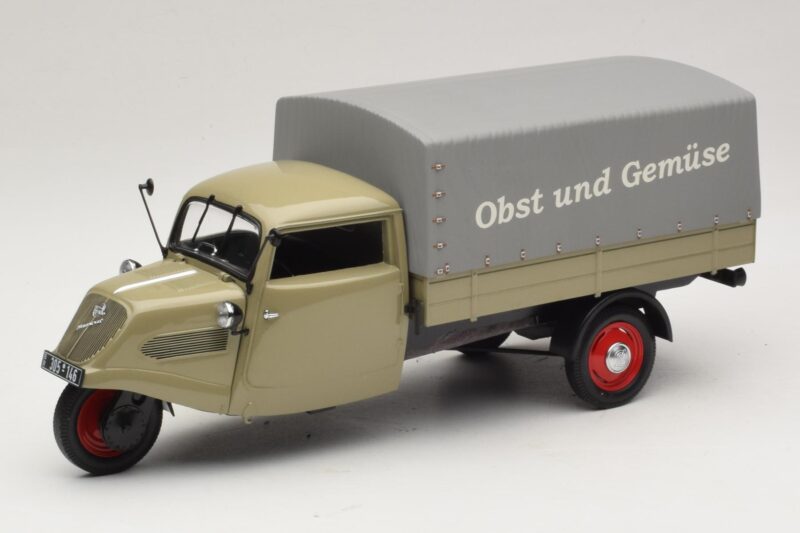
TL;DR: Minichamps' 1:18 diecast Tempo Hanseat pickup wears vintage 'Obst und Gemüse' produce signage on the three-wheeled delivery vehicle that served small German shops through the 1950s. The cab door opens on this zinc alloy build, and the compact proportions capture a genuine slice of post-war street commerce rarely seen in scale.
Tempo built the Hanseat for a Germany rebuilding one small business at a time, a three-wheeler compact enough for narrow streets and cheap enough for shopkeepers who needed a delivery vehicle, not a truck. This 1:18 diecast wears greengrocer signage and an opening cab door, putting a genuine piece of 1950s street commerce on the shelf.
Vidal & Sohn's Tempo-Werke built the Hanseat in Hamburg through the early 1950s, choosing a three-wheeled layout with a single steered front wheel over a conventional four-wheel chassis to keep the vehicle light, narrow, and cheap to license. The name nods to the Hanseatic League, the medieval trading network that made Hamburg a commercial power centuries before any engine existed, a fitting reference for a vehicle built entirely around local trade. A small two-stroke engine powered the Hanseat, enough for city speeds and short delivery runs but never intended to compete with a proper highway truck, and that modest ambition was exactly the point.
Germany's reconstruction economy ran on small, independent shops rather than large retail chains, and those businesses needed a delivery vehicle that could squeeze down a narrow street and park where a full-size truck could not. The Hanseat's tight turning circle and slim body solved that problem directly, and its lower operating costs kept it within reach of a single greengrocer or bakery rather than only larger firms. That practical role, more than any performance figure, is why so many Hanseats ended up wearing hand-painted shop signage rather than a manufacturer's plain delivery livery, a tradition this model continues in miniature.
The zinc alloy body gives this pickup real weight in the hand, a density that keeps it planted on a shelf despite its small footprint. The cab door opens, revealing a simple, period-correct interior scaled to the Hanseat's narrow single-seat cabin, and the open pickup bed shows off crate-like cargo detail rather than a bare, empty floor. Diecast construction favors exactly this kind of small commercial vehicle, where slightly wider panel gaps go unnoticed against the utilitarian bodywork, and the durability of metal construction matters more on a working vehicle replica than razor-sharp shut lines would.
The 'Obst und Gemüse' lettering across the sides follows the hand-lettered, sign-painter style that period shopkeepers actually used, rather than a slick modern graphic treatment that would look out of place on a 1950s delivery vehicle. Minichamps applies that signage with the same tampo printing precision used across its automotive range, so the lettering stays crisp under close inspection rather than smearing at the edges the way a lower-tier livery model sometimes does. That attention matters most here, since the signage rather than performance or rarity is what gives this particular Hanseat its identity on a shelf.
At 1:18, the Hanseat's tiny footprint, well under 20 centimeters given the real vehicle's compact dimensions, means it takes up less shelf space than almost any sedan or coupe in a typical collection, leaving room to group several period commercial vehicles together without crowding a cabinet. That scale disparity is part of the appeal: parked next to a full-size 1950s saloon, the Hanseat looks exactly as small and utilitarian as it did on a real street, a visual honesty that larger, more heroic models rarely offer. Collectors building a themed display around post-war German reconstruction often pair this produce pickup with other liveried Hanseats, using the different signage to represent a small townscape of period shops rather than a single company's fleet. The greengrocer livery in particular works well as an anchor piece in that kind of grouping, since fruit and vegetable delivery was one of the most common uses for a vehicle this size. Direct light across the cab roof shows the simple, rounded panel work Tempo used to keep manufacturing costs down, a detail that tells its own story about the economics behind this class of vehicle.
This is not a piece that anchors a display through sheer presence the way a hero sports car does. Its value comes from context: a genuine, correctly detailed representation of the small commercial vehicles that actually filled German streets during reconstruction, sold at a price point that sits comfortably within mid-tier diecast territory rather than premium collector pricing. Buyers assembling a period townscape, a commercial vehicle theme, or simply a shelf that tells a fuller story than road cars alone will find this produce-liveried Hanseat earns its place quickly. It pairs naturally with other Tempo variants in different liveries, letting a collector build a small fleet representing the shops and services of a single decade. For anyone who wants their 1950s display to include the ordinary alongside the extraordinary, this is exactly that ordinary, done with real care.
You save 12.00 €
Lowest price in the 30 days before the reduction: 89.00 €
You save 38.00 €
Lowest price in the 30 days before the reduction: 189.00 €



You save 16.00 €
Lowest price in the 30 days before the reduction: 123.00 €

You save 22.00 €
Lowest price in the 30 days before the reduction: 109.00 €