Last one

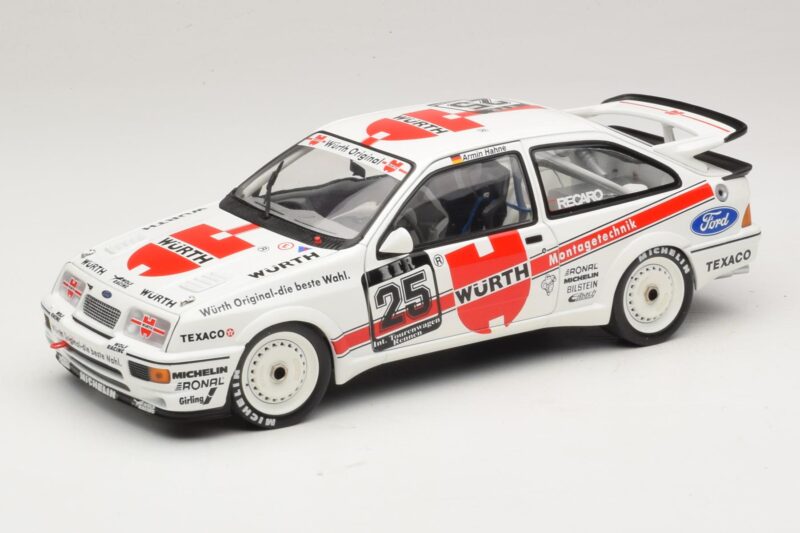
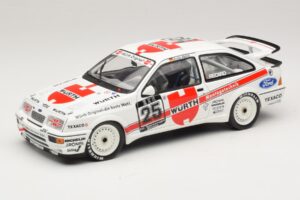
TL;DR: Minichamps' 1:18 diecast Ford Sierra RS500 reproduces Armin Hahne's Zakspeed-run car from a 1988 Nurburgring DTM victory, capturing one of the most dominant Group A touring cars of the decade. The zinc alloy body carries the RS500's flared arches and whale-tail spoiler, and doors open onto a stripped, roll-caged cockpit built for German touring car competition.
Ford built just enough Sierra RS500 Cosworths to satisfy Group A homologation rules, and the model instantly became the touring car to beat across European circuit racing in the late 1980s. Zakspeed ran a factory-backed program in German touring car competition, and Armin Hahne piloted this #25 entry to a win at the Nurburgring in 1988, a result that came during the RS500's peak years of near-total Group A dominance.
The RS500 existed purely to satisfy Group A homologation, a minimum production run requirement that let Ford legally race a more extreme version of the Sierra Cosworth on circuits. Under the hood, the turbocharged 2.0-liter YB engine, uprated with a larger turbo, bigger fuel injectors, and reinforced internals, could be tuned to output figures that dwarfed anything the road car officially claimed, and that tuning headroom is exactly why Group A teams across Europe gravitated toward the RS500 almost the moment homologation was confirmed, sidelining rival manufacturers who had not built anything capable of matching its combination of power and reliability under racing conditions.
Visually, the RS500 is instantly identifiable by its double-decker rear spoiler, nicknamed the whale-tail, and the aggressively flared wheel arches needed to cover the wider racing rubber Group A rules permitted. Those arches weren't cosmetic; they existed specifically to legalize the wider track and tire combination that gave the car its cornering advantage over rivals still running narrower, more conservative bodywork. The combination of that spoiler and those arches became one of the most recognizable silhouettes in 1980s touring car racing, instantly readable even to spectators with only a passing interest in the sport.
Zakspeed built its reputation running factory-backed Ford programs across German and European circuit racing, and the team's livery work, sponsor placement, number panels, and color division, required exacting reproduction to read as authentic rather than approximate. Minichamps casts the RS500's flared arches and whale-tail spoiler in zinc alloy, giving the model the weight and structural presence a genuinely raced Group A car deserves. The stance sits low and wide, wheels pushed out to the arch extensions the way a real Group A Sierra actually ran on race-spec suspension, rather than the higher, softer ride height a road-going Sierra carried.
The doors open onto a cockpit stripped for competition: a roll cage, a single racing seat, and a dashboard reduced to essential gauges rather than the full trim of a road-going Sierra. That bare presentation matches how Group A regulations actually allowed teams to build these cars, removing anything not required for the car to function on track. Tampo-printed sponsor decals and the #25 number panel carry the same precision Minichamps applies across its broader touring car catalog, holding sharp edges that a peeling decal alternative would struggle to match over years of display.
By 1988, German touring car racing, soon to formalize into the DTM as most enthusiasts remember it, was becoming one of the most competitive and closely watched circuit racing series in Europe, and the Nurburgring carried particular prestige as a round given its history and difficulty. Armin Hahne's win in the Zakspeed-run RS500 came during a period when the model dominated grids so thoroughly that rule-makers eventually moved to curb its advantage, clear evidence of how effectively Ford and its partner teams had exploited Group A's homologation loophole. Reproducing that specific #25 entry, tied to a documented result at a specific circuit in a specific season, gives this diecast a provenance that a generic RS500 livery cannot match. Collectors focused on DTM and Group A history tend to value that kind of specificity precisely because the RS500's competitive life was relatively short before regulation changes and newer cars moved the front of the grid elsewhere, which makes documented wins from its genuine peak years, like this one, particularly meaningful entries in a touring car collection built around that exact period.
At 1:18, the Sierra RS500's flared bodywork translates to a model around 22 centimeters long, wide enough in the arches to stand out visually against narrower period rivals even before the whale-tail spoiler enters the comparison. Diecast construction gives this piece the durability to anchor a growing Group A or DTM shelf without the fragility concerns a resin casting might raise over years of handling. Few touring cars from the 1980s carry as much recognition or as documented a competitive record as the RS500, which makes a specific, race-winning livery like this Zakspeed entry a strong foundation piece for anyone building a German touring car collection around the era's most dominant machine.

You save 16.00 €
Lowest price in the 30 days before the reduction: 123.00 €



You save 13.00 €
Lowest price in the 30 days before the reduction: 66.00 €
You save 38.00 €
Lowest price in the 30 days before the reduction: 189.00 €

You save 22.00 €
Lowest price in the 30 days before the reduction: 109.00 €

You save 29.00 €
Lowest price in the 30 days before the reduction: 147.00 €