Used
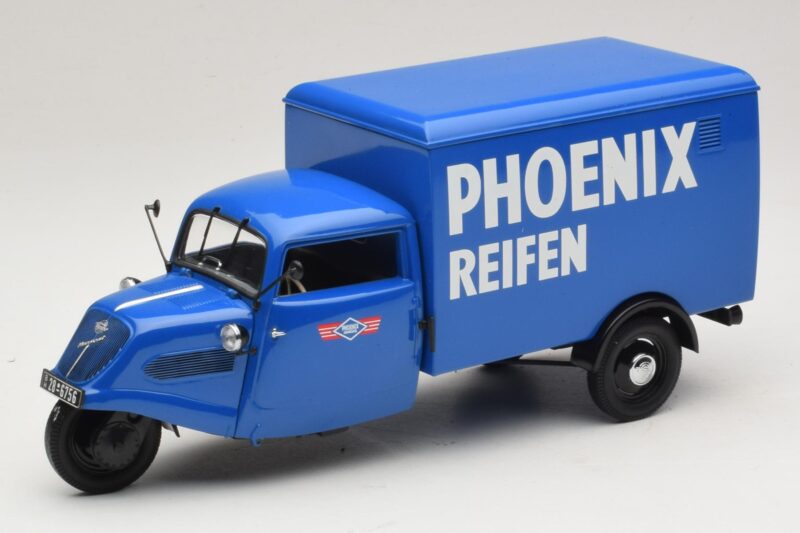
TL;DR: Minichamps' 1:18 diecast Tempo Hanseat three-wheeler box van wears plain Phoenix Blue paint, letting the vehicle's distinctive single-front-wheel engineering stand without any company livery. The rear cargo door opens on this zinc alloy build, offering a clean, unbranded look at genuine 1950s German commercial vehicle design.
Strip away the company signage that usually decorates a Hanseat and what remains is genuinely interesting engineering: a single steered front wheel, a narrow two-stroke-powered chassis, and a boxy cargo body built for cheap, practical delivery work. Minichamps' Phoenix Blue example leaves that design to speak for itself, opening at the rear cargo door for a closer look.
Most three-wheeled commercial vehicles of the period used a single rear wheel with two wheels up front, but Tempo built the Hanseat the other way around, steering through one front wheel while the rear axle carried two. That layout simplified the steering mechanism and kept the front end narrow, letting the Hanseat squeeze through gaps a conventional four-wheel truck could not manage, an advantage that mattered more in a crowded post-war city street than raw stability at speed ever would. It was a deliberate engineering choice suited to a specific job, not a stripped-down compromise forced by material shortages, even though material costs certainly shaped the vehicle's overall simplicity.
A small two-stroke engine powered the Hanseat, a choice that favored low cost and mechanical simplicity over the smoothness and durability a four-stroke unit could offer. That trade-off suited the vehicle's intended role perfectly: short delivery runs within a single town rather than long-distance hauling, where a two-stroke's shorter service life would have mattered far more. The resulting vehicle was cheap enough for a small business to buy outright, simple enough for a shop owner to maintain without specialist mechanics, and capable enough for the job it was actually built to do.
This box van's zinc alloy body delivers real weight for its compact size, the kind of density that makes even a small commercial vehicle model feel substantial rather than like a lightweight filler piece on a shelf. The rear cargo door opens onto the enclosed load space that defined this body style, scaled to the narrow proportions of the real vehicle rather than widened for display convenience. Diecast construction handles this simple, boxy shape well, and without any livery artwork competing for attention, the quality of the panel fit and the depth of the Phoenix Blue paint carry the entire visual impression on their own.
Not every collector wants a shelf full of company advertising, and a plain-liveried commercial vehicle like this one offers an alternative: the shape, the engineering, and the color, without a story attached to a specific brand. That makes it a natural fit for collectors who value the Hanseat's engineering on its own terms, or who prefer to build their own narrative around a vehicle rather than inherit one from a printed livery. It also tends to age better visually, since a solid color never looks dated the way an outdated advertising style eventually can.
At 1:18, this box van's compact dimensions place it well below the footprint of any contemporary sedan, making it an easy addition to a shelf already carrying several liveried Hanseat variants without visual competition for attention. Because it carries no company signage, this piece works particularly well as a visual anchor in a themed row of branded delivery vehicles, giving the eye a place to rest between busier liveries the way a plain sedan sometimes grounds a row of race cars. Collectors who want to compare liveries side by side often keep an unbranded example specifically for this purpose, using it as a baseline against which the printing quality of branded variants can be judged. The Phoenix Blue finish itself photographs cleanly under direct light, its even coverage across the flat box panels showing off the diecast paintwork without any lettering to interrupt the color field. For a buyer newly discovering the Hanseat platform, this unbranded version also makes an efficient starting point, establishing the vehicle's shape and engineering before expanding into liveried examples that build on that same foundation.
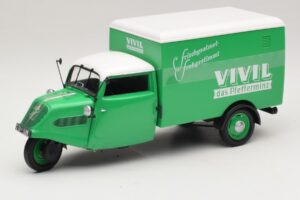
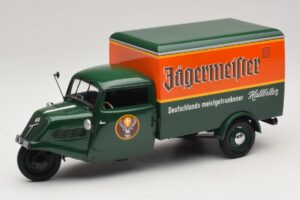
This box van will not draw attention through a recognizable brand name the way its liveried siblings can, and for some buyers that is exactly the appeal. It offers the Hanseat's genuine engineering story, its three-wheeled layout and boxy commercial body, without any company history attached to distract from the vehicle itself. Priced within familiar mid-tier diecast territory, it works well both as a standalone piece for collectors interested purely in commercial vehicle design and as a foundation piece for a themed fleet built up gradually with liveried examples from the same Minichamps range. Set beside a Jägermeister or Kühne and Nagel liveried Hanseat, it becomes the quiet baseline that lets those branded variants stand out even more. For a collection built around honest engineering rather than advertising, this Phoenix Blue example earns its place on its own terms.
You save 12.00 €
Lowest price in the 30 days before the reduction: 89.00 €

You save 38.00 €
Lowest price in the 30 days before the reduction: 189.00 €



You save 16.00 €
Lowest price in the 30 days before the reduction: 123.00 €

You save 22.00 €
Lowest price in the 30 days before the reduction: 109.00 €