Last one
Used
Back in stock
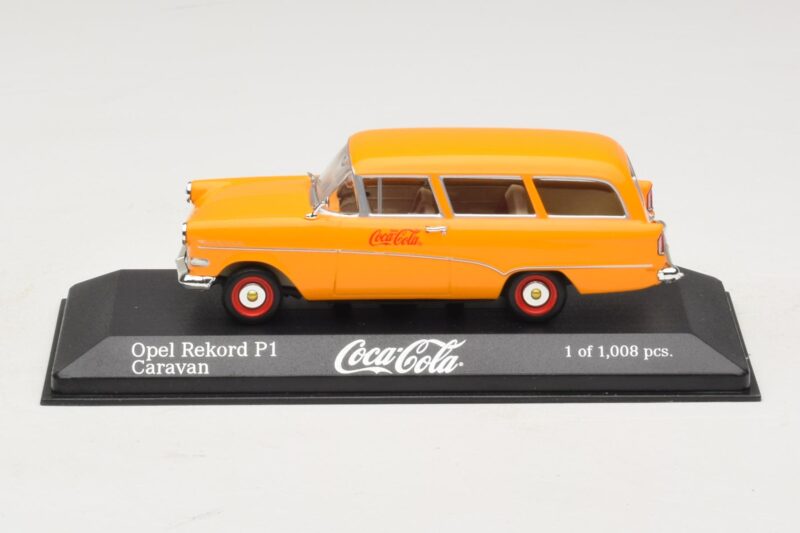
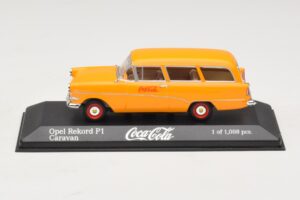
TL;DR: Minichamps' 1:43 diecast Opel Rekord P1 Caravan wears a Coca-Cola livery, pairing a 1958 German wagon with one of the most recognized commercial brands on the road. Cast as a sealed one-piece body, the wagon's proportions and the printed livery detail carry the model, with no opening panels to distract from either.
Livery collectibles occupy a crossover niche between automotive and brand memorabilia collecting, and few brands cross over as cleanly as Coca-Cola. Minichamps applies that livery to a 1958 Opel Rekord P1 Caravan, the wagon body of Opel's mid-range family car, giving buyers a delivery-fleet-style piece that reads as both a period German automobile and a slice of commercial branding history.
The Rekord P1 arrived in 1957 as Opel's answer to a growing German middle class eager for family transportation that wasn't quite as large or as expensive as the senior Kapitan line. It replaced the Olympia Rekord and introduced a cleaner, more American-influenced body, with a wraparound windshield and a notchback profile that looked modern against the more rounded Opels it succeeded. Opel offered the P1 as a two-door sedan, a four-door sedan, and this Caravan wagon body, the estate variant built for buyers who needed cargo space without stepping up to a commercial van.
Power came from a straightforward four-cylinder engine tuned for economy and durability over outright speed, which suited both a family hauler and, as this livery suggests, light commercial duty. The Caravan's proportions stretch the notchback sedan's roofline rearward into a flat load area, a reshaping that changes the car's whole visual balance without altering the front end Opel had already settled on. Minichamps reproduces that wagon body specifically, not the more common sedan, which is worth noting for anyone assembling a Rekord P1 collection across body styles.
Commercial liveries on 1950s European wagons form their own corner of the diecast hobby, appealing equally to automotive collectors chasing a specific model and brand-memorabilia collectors who care more about the logo than the chassis underneath. A Coca-Cola scheme on a Rekord P1 Caravan sits squarely in that overlap. The company's red-and-white branding was already a globally recognized visual language by the late 1950s, applied across countless delivery vehicles worldwide in whatever body style local fleets actually used.
A German-market wagon like this one fits that pattern of local adaptation rather than a single standardized truck. For a buyer building a themed shelf around vintage advertising and branded vehicles, this piece offers a genuinely different silhouette than the delivery vans and box trucks that dominate that niche. For an Opel collector, it offers a color-scheme variant of the P1 Caravan that a plain factory-color example simply can't provide. Either angle makes the model worth a second look.
Minichamps casts this Rekord as a sealed one-piece diecast body, with no doors, hood, or tailgate that open, which puts the full weight of the model's credibility on its exterior surfaces. That is where a wagon body either reads correctly or doesn't: the roofline has to carry the right proportion of glass to metal running back to the tailgate, and the shut lines around that tailgate, even as painted or molded detail rather than a functioning seam, need to sit exactly where the real car's panel break fell. Zinc-alloy diecast holds that kind of line cleanly, and the metal body gives the model real heft for its 1:43 size, a density buyers notice the moment they pick it up. The Coca-Cola livery itself depends on tampo printing precision rather than paint alone, since the logo and any secondary graphics need crisp edges and consistent color saturation to read as authentic rather than a decal applied by hand. A sealed body works in this livery's favor: without hinge lines interrupting the surface, the printed graphics run cleanly across the whole side panel exactly as they would on a real liveried delivery vehicle.
At 1:43, the Rekord P1 Caravan comes out small enough to build an entire shelf of period commercial liveries without the space demands larger scales require, which is part of why this scale dominates the promotional-diecast niche. Pair this piece with other branded wagons and vans from the same era, or set it alongside a standard-color Rekord P1 sedan to show how dramatically a livery changes a car's identity on a shelf. Minichamps' diecast sits at a solid mid-tier finish level for the scale, well suited to a display that rewards close inspection of the printed graphics rather than mechanical detail, and the sealed body is the right choice for a livery piece where uninterrupted paintwork matters more than an opening trunk. It's a genuinely specific piece, appealing less broadly than a plain-color classic but rewarding exactly the buyer who wants it.


You save 38.00 €
Lowest price in the 30 days before the reduction: 189.00 €


You save 16.00 €
Lowest price in the 30 days before the reduction: 123.00 €