Last one
Used
Back in stock
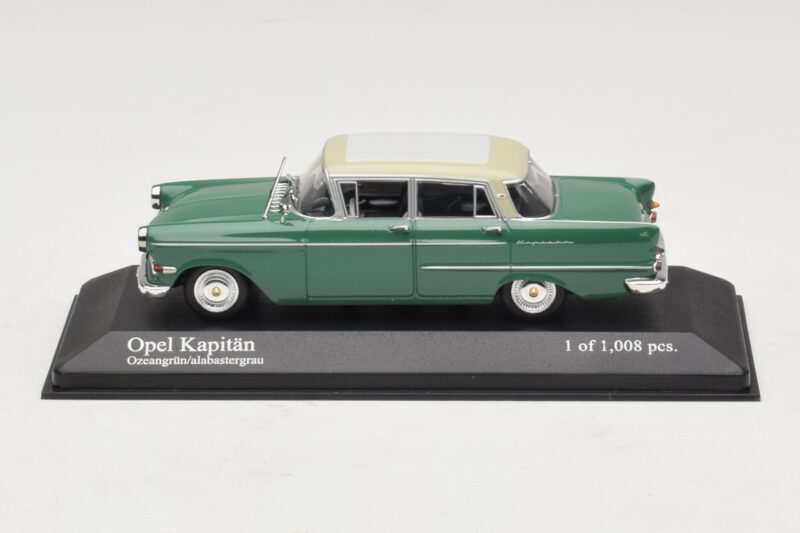
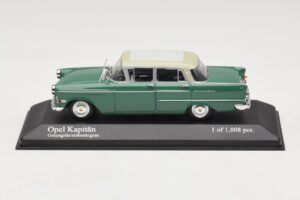
TL;DR: Minichamps' 1:43 diecast Opel Kapitan A reproduces the 1964 senior Opel sedan in green, the six-cylinder base model of the shared KAD body that also underpinned the Admiral and the V8 Diplomat. Cast as a sealed one-piece diecast body, the sedan's formal proportions and paint depth carry the model, with no opening panels.
Opel restructured its senior model range in 1964, replacing separate Kapitan and Admiral bodies with a single shared platform, badged and equipped differently to span three price points under one body. Minichamps' 1:43 diecast reproduces the entry point of that structure, the six-cylinder Kapitan A, in a period green that suited a car built for respectability rather than flash, the tier below the V8 Diplomat that topped the same body.
Opel's senior model strategy through 1963 had been to run the Kapitan and Admiral as distinct nameplates with their own bodies, an approach that made sense when the two cars targeted different budgets but that also duplicated tooling and engineering costs unnecessarily. The 1964 redesign consolidated both onto a single body, commonly referred to by collectors and historians as the KAD platform after its three trim levels: Kapitan, Admiral, and the range-topping Diplomat.
The Kapitan A sat at the entry point of that structure, powered by a straightforward inline-six rather than the V8 that gave the Diplomat its performance credentials, but sharing the same generous body dimensions, formal upright grille, and broad, confident stance that defined Opel's flagship ambitions in the mid-1960s. For buyers who wanted the size and presence of a senior Opel without the Diplomat's price, the Kapitan A offered nearly the same car for meaningfully less money, making it the volume seller of the KAD family.
Green wasn't an unusual choice for a car like the Kapitan A. Opel's senior sedans of this era leaned toward colors that projected stability and seriousness rather than sportiness, and this particular shade sits comfortably in that period palette, distinct from the brighter greens that would show up on smaller, younger-skewing Opels later in the decade. On a body this large, a solid color has real presence, giving the paint an uninterrupted canvas to read from across a room.
The sedan's proportions matter as much as the color here. A KAD-body car needs to read as substantial and upright, with a greenhouse that sits high enough to convey formality without looking top-heavy, and Minichamps' casting captures that balance correctly rather than compressing the roofline to fit a generic sedan template. The chrome trim along the beltline and around the formal grille catches that same light cleanly, another small detail confirming careful attention beyond the paint alone.
Minichamps casts this Kapitan A in zinc-alloy diecast as a sealed, one-piece body, meaning nothing on this particular model opens. That construction choice puts the full weight of authenticity on the exterior: panel lines, glazing fit, chrome trim crispness, and how evenly the green paint sits across a body with as much flat surface area as this one has. Diecast at 1:43 brings genuine heft, a density that signals metal the instant it leaves the box, though that mass comes with casting tolerances a touch wider than resin would allow, a trade that's simply the nature of the material rather than a shortcoming specific to this piece. A sealed body works particularly well on a formal sedan like the Kapitan A, where the visual language is about long, unbroken lines rather than aggressive creases or vents, and without hinge clearances to plan around, Minichamps holds those long horizontal lines running the full length of the body without interruption. Buyers who want to inspect the inline-six under the hood or explore the cabin in detail will need to look toward a larger scale or an opening-panel alternative, and that's a reasonable trade for anyone chasing an accurate KAD-body silhouette rather than mechanical interaction. This piece rewards a considered shelf placement under even light rather than close handling.
At 1:43, the Kapitan A's genuinely large real-world footprint translates into a model with real presence relative to its scale-mates, larger than most contemporary compact Opels and a natural companion piece to the Admiral or Diplomat from the same shared body. Minichamps' diecast execution sits at a dependable mid-tier finish, appropriate for a car whose whole identity was built on solid, unflashy competence rather than headline performance. Displayed beside a V8 Diplomat Coupe from the same KAD generation, the Kapitan A makes the range's internal hierarchy obvious: same basic body, very different ambitions. For a collector building a picture of 1960s German senior sedans, this is the honest, accessible entry point into that story.



You save 38.00 €
Lowest price in the 30 days before the reduction: 189.00 €




You save 16.00 €
Lowest price in the 30 days before the reduction: 123.00 €