Last one
Used
Back in stock
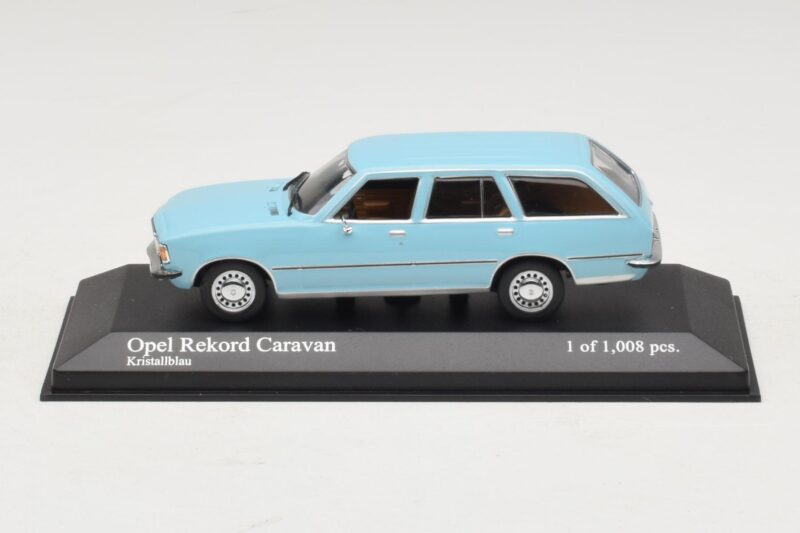
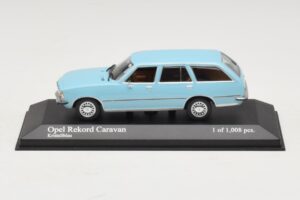
TL;DR: Minichamps' 1:43 Opel Rekord D Caravan in light blue reproduces one of the most common factory colors for this mid-1970s German estate wagon, cast in diecast with a sealed one-piece body. The pastel tone and long, level roofline capture the Rekord D Caravan the way most buyers actually saw it, in contrast to the bolder red version from the same range.
Light blue was never a statement color, and that is exactly why it suited the Rekord D Caravan so well. Most family wagons of the mid-1970s left German showrooms in restrained pastels rather than bold statements, and Minichamps' casting in this shade sits closer to how buyers actually encountered the car than the brighter red variant does.
Opel built the Caravan by extending the Rekord D sedan's roofline rearward into a flat, load-friendly shape and replacing the trunk lid with a near-vertical tailgate, a formula shared across most European manufacturers converting a sedan platform into a wagon during this period. The result carried more cargo volume than the sedan without requiring an entirely separate chassis or drivetrain, keeping costs down for a car aimed squarely at family buyers rather than enthusiasts. Roof rails were a common factory or dealer-fitted option on Caravans of this era, useful for the kind of camping and touring trips that made wagons popular family transport before purpose-built minivans existed.
Light blue, along with beige and pale green, dominated the actual color mix Rekord D Caravans left the factory wearing, chosen for practical reasons as much as taste: pastel tones showed road dust and minor scuffs less readily than darker or brighter finishes on a car expected to work for a living. Minichamps' choice of this shade for one Caravan variant in its range, alongside the deliberately bolder red already covered elsewhere in the lineup, gives a collector the option of representing either how the car typically looked or how it could look with a less common factory or aftermarket color choice.
The wagon's long, level roofline is the single hardest line on this casting to get right, since any warp or waviness across that span is immediately visible in a way it would not be on a shorter sedan roof. Minichamps casts this Caravan with no working tailgate, hood, or door, keeping that entire roofline as one continuous, sealed surface from the windshield header back to the rear glass. The extended greenhouse, with its larger rear side windows, holds its proportions consistently because there is no hinge point anywhere along the body to introduce a gap or a step where the design calls for an unbroken line.
Light blue behaves differently from red on this casting, carrying less visual weight and letting the wagon's flat, simply creased panels recede rather than announce themselves, which is period-accurate for a car that was never meant to draw attention. Because the body is a single sealed shell, the color runs evenly across the extended rear quarter panel and the tailgate with no seam to interrupt it, matching the smooth, uninterrupted paint job the real factory wagons carried. Under direct light the pale finish shows a soft sheen rather than metallic sparkle, consistent with the non-metallic pastels Opel commonly applied to this body style.
At 1:43, this light blue Caravan shares its roughly eleven-centimeter footprint with the red version from the same range, and displaying the two together illustrates how differently a common factory color and a deliberately bold one can present an identical casting. Pastel colors are chronically underrepresented across scale model ranges generally, since manufacturers understandably favor colors that photograph dramatically for their catalogs, which makes an accurately restrained shade like this one a genuinely useful addition for a collector trying to represent a period fleet realistically rather than selectively. Detail resolution at 1:43 simplifies elements like the roof rail mounting points and window trim into fine surface relief, a normal trade-off at this scale that the wagon's simple geometry absorbs well. Collectors assembling a realistic snapshot of 1970s European family transport, rather than a highlight reel of the boldest colors any manufacturer happened to offer, get more genuine value from a piece like this than from a flashier repaint, and the level roofline remains the first detail worth checking against reference photos when judging how faithfully any Caravan casting reproduces the real car's proportions, a small but telling test of accuracy at this scale.
This light blue Caravan does something the bolder red version cannot: it shows the Rekord D wagon the way the overwhelming majority of them actually looked, a useful corrective for anyone building a collection meant to represent a period accurately rather than dramatically. Set alongside the red Caravan, the blue sedan, and the green coupe from the same generation, it rounds out a genuinely diverse view of one model line across colors that ranged from showroom-typical to deliberately uncommon. That kind of range coverage rewards a collector's patience more than a single flashy purchase ever could. At this scale and diecast price point, adding the ordinary alongside the eye-catching costs little and tells a more complete story for anyone willing to look past the obvious choice. It is a quiet piece, and that quietness is exactly the point of collecting a full period fleet rather than just its highlights.


You save 38.00 €
Lowest price in the 30 days before the reduction: 189.00 €


You save 16.00 €
Lowest price in the 30 days before the reduction: 123.00 €