Last one
Used
Back in stock
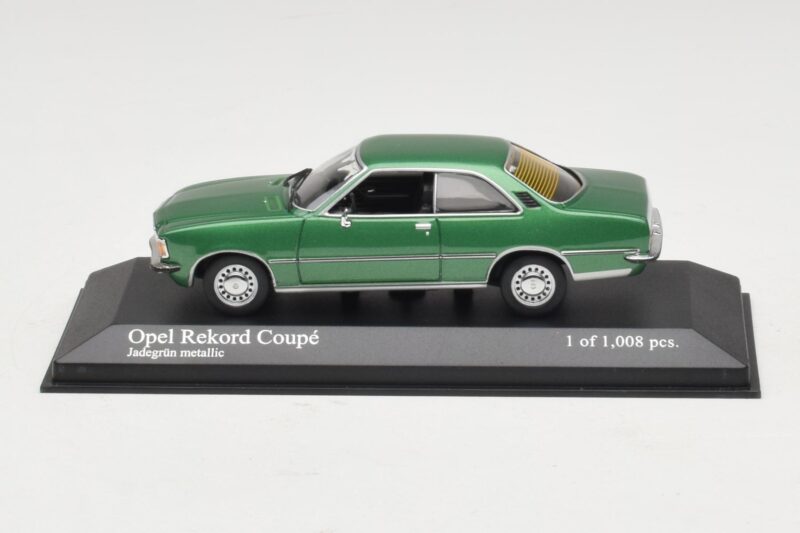
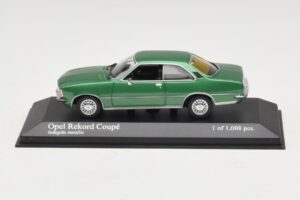
TL;DR: Minichamps' 1:43 Opel Rekord D Coupe in green metallic reproduces the sportiest two-door body style in GM Germany's mid-1970s family range, cast in diecast with a sealed one-piece body. Its lower roofline and tighter greenhouse set it apart from the sedan and Caravan wagon built on the same platform, and the green metallic finish gives it a bolder shelf presence.
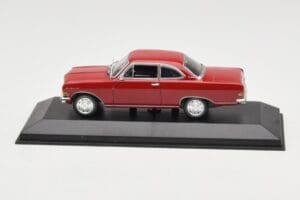
Every family car range needed a sportier two-door to sell alongside its sedans and wagons, and the Rekord D's Coupe filled that role without pretending to be something it wasn't. Minichamps casts this example in green metallic, and the sealed diecast body keeps the Coupe's lower, tighter roofline distinct from the boxier sedan and Caravan built on the same underpinnings.
Opel built the Rekord D Coupe on the same basic platform as the sedan and Caravan, but lowered the roofline and tightened the greenhouse to give the two-door a visually sportier stance without the cost of a genuinely separate model program. This was standard practice for mainstream European manufacturers of the period, offering a sportier body style to buyers who wanted a bit more visual flair without stepping up to a dedicated performance car or a different marque entirely. The Coupe's window line runs noticeably slimmer than the sedan's, and its roof sits perceptibly lower, differences immediately obvious when the two body styles are set side by side despite sharing every mechanical component underneath.
Green metallic was a genuinely period-correct choice for the sportier end of a mainstream range like the Rekord D, favored by buyers who wanted their coupe to read as slightly more adventurous than the sedan's typical blues and the wagon's practical earth tones. Minichamps' casting captures that intent, giving the Coupe a shade with more visual energy than its more conservative range-mates while still staying within the restrained, honest color palette that defined GM Germany's mainstream cars rather than reaching for anything genuinely flamboyant. It is a shade that suits the Coupe's role precisely: sporty by the standards of a family car range, but never actually sporty in the way a genuine performance model would demand.
Casting the Coupe's lower, tighter roofline as a sealed one-piece shell keeps that sportier proportion honest, since there is no hinge tolerance anywhere to introduce a gap that would visually raise the roofline or interrupt the slimmer window line that distinguishes this body style from the sedan. Minichamps builds this Coupe without a working hood, door, or trunk, letting the character line running from the front fender through the door and into the rear quarter panel stay continuous across the car's full length. That continuity matters more on the Coupe than on the boxier sedan, since the whole point of this body style is a sleeker, more unified profile.
Green metallic catches light differently across the Coupe's slightly more sculpted surfaces than it would on the flatter sedan panels, with the flake showing more variation along the character line where the body's subtle curvature changes the paint's apparent depth. Because the body is a single sealed casting, that color runs unbroken from the front fender through the door and rear quarter to the tail, with no seam breaking the coupe's longest visual line. The result is a finish that flatters the Coupe's sportier intentions more than a flat, non-metallic color would, without overstating what was still, underneath the styling, a mainstream family car.
At 1:43, the Coupe measures close to ten centimeters, slightly shorter overall than the sedan despite sharing the same wheelbase, since the two-door's proportions were tightened rather than stretched. Displaying this Coupe alongside the sedan and Caravan from the same range makes the platform-sharing immediately obvious, with identical hoods, grilles, and taillights sitting beneath three genuinely different rooflines, a design exercise most manufacturers no longer bother with today. Detail resolution at 1:43 simplifies trim elements like the Coupe's slimmer window surrounds into fine relief rather than separately molded parts, a normal compromise that a design this straightforward absorbs without losing its identity. Collectors interested in how a single mainstream platform can be stretched into a sedan, a wagon, and a genuinely sportier coupe find the Rekord D a compact, affordable case study, one that costs a fraction of assembling the same three-body-style comparison in 1:18 or full-size form. Judging this casting's fidelity starts with the roofline height relative to the sedan and the tightness of the rear quarter window, the two details that most clearly separate a genuine Coupe from a two-door sedan, a distinction worth checking before adding this piece to a body-style survey.
This green metallic Coupe finishes a genuine four-way body-style survey of the Rekord D range, joined by the blue sedan and the two Caravan wagons already covered elsewhere in this lineup, a completeness few manufacturers offer across their mainstream models. The Coupe's sportier roofline and bolder color give it more shelf presence than its practical range-mates, making it a natural focal point when the full set sits together. For a collector who has already committed to the sedan or wagon, adding this Coupe rounds out the picture of what Opel actually offered mid-1970s buyers across a single, shared platform. At this scale and diecast price point, the full set costs little more than a single 1:18 hero piece elsewhere in a collection, making genuine range completeness an achievable goal rather than an expensive aspiration, a rare kind of shelf satisfaction that most single-model collections never reach.


You save 38.00 €
Lowest price in the 30 days before the reduction: 189.00 €


You save 16.00 €
Lowest price in the 30 days before the reduction: 123.00 €