Last one
Used
Back in stock

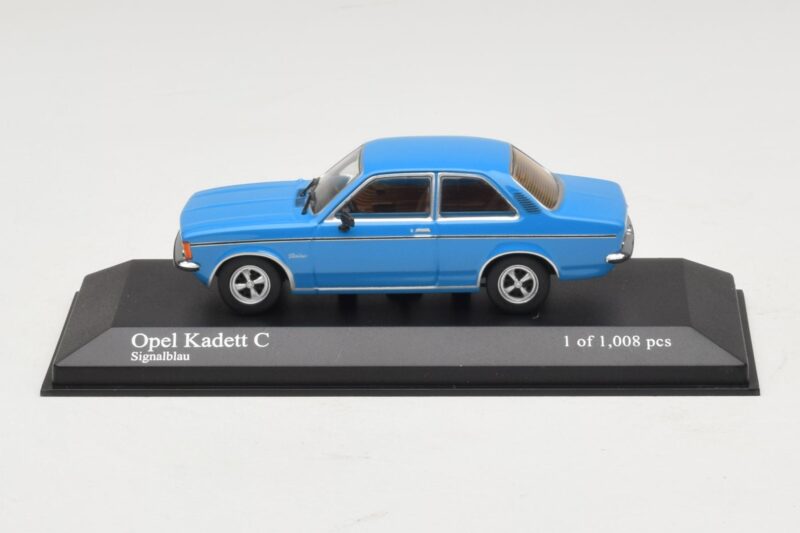
TL;DR: Minichamps' 1:43 diecast Opel Kadett C reproduces the 1978 sedan body in blue, the notchback volume seller of a platform GM built worldwide as the T-car. Cast as a sealed one-piece diecast body, the sedan's compact proportions and paint depth carry the model, with no opening panels.
Where the Caravan wagon widened the Kadett C's appeal to cargo-minded buyers, this notchback sedan was the volume seller, the version most Germans actually drove to work every day through the late 1970s. Minichamps' 1:43 reproduction captures that ordinary, honest sedan in blue, a color that suited the car's unpretentious character better than anything flashier, on the same T-car platform GM exported worldwide.
While the Kadett C's mechanical layout became internationally significant through GM's T-car program, feeding platforms to the Chevrolet Chevette, the Isuzu Gemini, and Vauxhall's own Chevette, the sedan body sold in Germany was the version that actually built the model's everyday reputation at home. A conventional four-door notchback with a short trunk and upright greenhouse, it competed against Volkswagen's contemporaries and other compact European sedans on the strength of straightforward engineering rather than any single standout feature.
Buyers chose it because it was reliable, affordable to run, and easy to service, qualities that don't generate headlines but that sustained genuinely strong sales across the model's production run. Opel offered the C generation in two-door and four-door sedan configurations alongside the hatchback, coupe, and Caravan wagon body, giving the range genuine breadth without expensive engineering divergence. This sedan represents the version most likely to have actually been someone's first car during the late 1970s.
Blue suited the Kadett C's honest, unpretentious character in a way that suited the car better than a louder color might have. On the sedan's shorter, more compact body compared to the Caravan, that blue reads as a tighter, more cohesive shape, the notchback's short deck and upright rear glass giving the paint a smaller but no less carefully finished canvas than the wagon's extended flanks.
Minichamps holds the color consistent across the whole body, with gloss depth even from the front fenders through the doors and back to the trunk lid. The trunk needs to sit at the right height relative to the rear window to preserve the notchback silhouette that distinguished this body from both the hatchback and wagon versions, and Minichamps' casting gets that balance right. The chrome bumpers and trim, picked out cleanly against the blue, confirm care extended past the paint alone.
This Kadett C sedan is cast in zinc-alloy diecast as a sealed one-piece body, with nothing that opens on this particular model. That construction places the full weight of accuracy on exterior surfaces: shut lines, glazing fit, wheel proportion, and how cleanly the blue paint sits across the casting. Diecast at 1:43 brings genuine weight for its size, a density that comes from metal casting tolerances a shade wider than resin permits, a trade every buyer at this price point accepts for the durability metal provides over years of handling and display. A sealed body suits a small, simple sedan like this one well: without hinge clearances to design around, Minichamps holds the trunk and door lines tight and consistent, and the blue paint runs unbroken across the whole side profile rather than interrupted by a functioning seam. Buyers who want to inspect the four-cylinder engine or the cabin in detail will need a larger scale or an opening-panel alternative, a fair trade for anyone chasing an accurate small-sedan silhouette over hands-on mechanical access. This piece is built for a shelf viewed at a glance, and that's exactly the role a modest, everyday sedan like the Kadett C is meant to play.
At 1:43, this Kadett C sedan pairs naturally with the Caravan wagon from the same generation, and setting the two side by side shows how differently Opel's engineers reshaped a single mechanical platform to serve two very different buyers. Minichamps' diecast execution sits at a dependable mid-tier finish, well matched to a car whose real appeal was always about honest, affordable competence rather than styling drama. For a collector assembling a picture of everyday 1970s European motoring rather than only its headline sports cars, this sedan is exactly the kind of piece that fills in the real story. It's a small, unglamorous car reproduced with the same care as anything flashier in the range, and that consistency of treatment is worth recognizing on its own terms.



You save 38.00 €
Lowest price in the 30 days before the reduction: 189.00 €




You save 16.00 €
Lowest price in the 30 days before the reduction: 123.00 €