Last one
Used
Back in stock

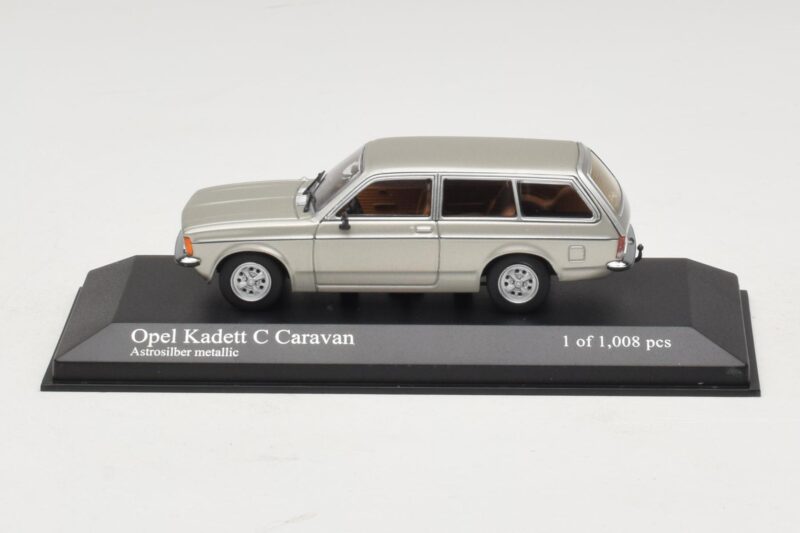
TL;DR: Minichamps' 1:43 diecast Opel Kadett C Caravan reproduces the 1978 wagon body in Silver Metallic, the estate variant of a platform GM sold worldwide under names from Chevette to Gemini. Cast as a sealed one-piece diecast body, the metallic paint and wagon roofline carry the model, with no opening panels.
The Kadett C did more than sell well in Germany. Its underpinnings became the basis for GM's global T-car program, reappearing as the Chevrolet Chevette in the United States and the Isuzu Gemini in Japan, among others. Minichamps' 1:43 Caravan wagon captures the estate body that rounded out the German lineup, finished in Silver Metallic, a shade that shows off the diecast body's paint depth better than most solid colors.
Opel launched the Kadett C in 1973 as a conventional, rear-wheel-drive small car, and within GM's engineering structure it became something more significant: the template for the corporation's T-car program, a shared platform strategy meant to give multiple divisions around the world an affordable small car without each one designing from scratch. The Chevrolet Chevette sold in the United States rode on that same basic architecture, as did the Isuzu Gemini in Japan and Vauxhall's own Chevette in the UK, each reskinned for its local market but sharing the Kadett C's mechanical DNA underneath.
That global reach is easy to overlook when looking at a single German-market wagon, but it's part of what makes the Kadett C historically significant beyond its home market sales figures. In Germany, Opel offered the C generation across sedan, hatchback, coupe, and this Caravan estate body, with straightforward four-cylinder engines tuned for economy rather than performance. The Caravan specifically served buyers who needed genuine cargo capacity in a package still compact enough for city streets.
Silver Metallic is a color that rewards a well-executed diecast finish more than almost any other shade, because metallic flake shows every inconsistency in a way flat colors simply hide. On the Caravan's flat wagon flanks, that finish has more surface area to prove itself than it would on the shorter sedan body, and Minichamps holds the flake consistent from the front fenders back across the extended roofline to the tailgate.
The wagon's proportions are the real test of a Kadett C Caravan reproduction: the roofline needs to run level and slightly higher than the sedan's trunk line to preserve genuine cargo volume, and the rear glass angle has to match the estate's more upright tailgate rather than the sedan's sloped rear window. Minichamps gets that roofline geometry right, and under direct light the Silver Metallic shows a cool, slightly blue-grey undertone rather than the warmer pewter some period repaints substitute. That extra visual weight matters on a subject whose real-world appeal was always practical rather than flashy.
This Kadett C Caravan is cast in zinc-alloy diecast as a sealed one-piece body, with no doors, hood, or tailgate that open on this particular model. That construction decision shifts the entire fidelity question onto the exterior: shut lines, glazing fit, wheel proportion, and how cleanly the metallic paint sits over the casting's surface. Diecast brings genuine weight to a 1:43 model, a density that signals metal construction the instant it's lifted, and that weight comes at the cost of the wider casting tolerances metal requires compared to resin, a trade every diecast buyer at this price point accepts knowingly. A sealed body actually plays to this construction's strengths: without hinge clearances to engineer around, Minichamps holds the tailgate's shut lines tight and consistent, and the Silver Metallic paint runs unbroken across the whole rear three-quarter view rather than interrupted by a functioning seam. Buyers looking to inspect an engine bay or open a tailgate for interior detail will find that experience elsewhere, and that's a fair trade to acknowledge honestly. This model rewards a shelf viewing distance rather than hands-on interaction, and that's precisely the audience Minichamps built it for.
At 1:43, the Kadett C Caravan takes up little shelf space, making it easy to pair with Opel's own sedan version of the same generation or with contemporary wagons from Volkswagen and Ford to build a themed 1970s European estate lineup. Minichamps' diecast execution sits at a dependable mid-tier finish level, appropriate for a car whose real appeal was always practical rather than glamorous. Displayed next to a Kadett C sedan, the Caravan makes the platform's versatility obvious at a glance, two very different silhouettes built from the same underlying small car. For a collector tracing GM's global small-car strategy through the 1970s, this wagon is a quietly important piece, more significant historically than its modest looks suggest.



You save 38.00 €
Lowest price in the 30 days before the reduction: 189.00 €




You save 16.00 €
Lowest price in the 30 days before the reduction: 123.00 €