Used

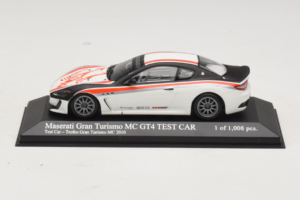
Maserati GranTurismo MC GT4 #6 Goldstein / Sumberg Trofeo GranTurismo 2010 Minichamps 1:43
Only 2 left
Price:
37.00 €
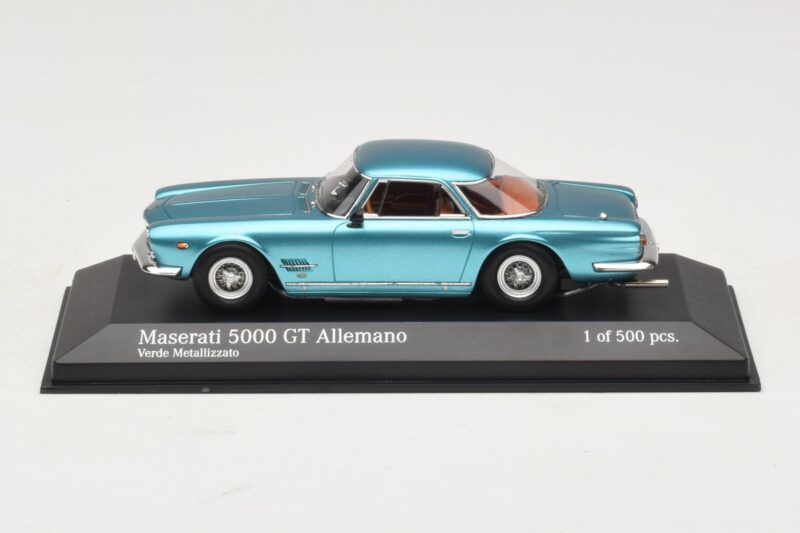
TL;DR: Minichamps' 1:43 diecast Maserati 5000 GT in metallic green reproduces the Allemano-bodied 1962 grand tourer, one of Maserati's rarest bespoke commissions of the era. Cast as a sealed zinc-alloy shell with no opening panels, it favors tight shut lines and deep green paint over cabin access, a scaled tribute to a genuinely hand-built original.
Few road cars start with a head of state's personal order. The Maserati 5000 GT began that way, commissioned initially for the Shah of Iran and built afterward in tiny numbers for a small circle of European industrialists and royalty. Minichamps renders the Allemano-bodied version in metallic green, a color that suits the coachbuilder's slab-sided, understated profile better than a brighter shade would.
Maserati built the 5000 GT for Mohammad Reza Pahlavi, the Shah of Iran, who wanted a road car with genuine competition pedigree beneath its bodywork. Rather than commit to a single design, Maserati let several coachbuilders body the chassis for different clients, so no two 5000 GTs are quite identical. Allemano built the largest share of the run, giving the model its most recognizable, if still rare, silhouette. Each car was effectively a private commission rather than a catalog purchase, built to the buyer's specification in a way few production Maseratis of any era can claim, and that bespoke origin is why surviving examples now command serious attention.
Under the hood, the 5000 GT carried a 5-liter V8 developed from the engine that powered Maserati's 450S sports racer, a rare case of genuine competition hardware finding its way into a road-going grand tourer of this period. Allemano's body kept the lines simple and slab-sided rather than flamboyant, a restrained approach that let the car's proportions carry the design rather than ornamentation. That restraint is part of what makes the 5000 GT a connoisseur's Maserati rather than a poster car, a subject that rewards someone who already understands the marque's history rather than someone discovering it for the first time.
The zinc alloy build gives this 1:43 piece real density in the hand, noticeably heavier than a resin model of comparable size, and that mass reads as quality the moment the model comes out of its case. Minichamps casts the 5000 GT as a single sealed shell, with no door, hood, or trunk panel that opens. Removing hinge clearances from the design lets the shut lines run tight and continuous around the body, tracing Allemano's slab-sided profile without a single interrupted gap. For a coachbuilt original this rare, a faithfully continuous line down the flank matters more than an opening door ever could.
Metallic green is a demanding finish to get right at small scale, since flake density and undertone both have to read correctly under a spotlight or the color drifts toward either mud or neon. Minichamps holds a consistent, even metallic grain across the Allemano body's flat panels, and because those panels carry no opening seams, the green reads as one continuous field from the leading edge of the hood to the tail. Under a single directed light, that unbroken depth is exactly what separates a careful diecast reproduction from a flatter, mass-market repaint.
At 1:43, the 5000 GT measures close to 10 centimeters, small enough to sit three or four abreast on a single cabinet shelf without crowding, which matters for a subject this genuinely rare in period. Few collectors will ever see an original 5000 GT in person, since surviving examples across every coachbuilder number only in the dozens worldwide, so the replica is often the only practical way to study Allemano's proportions up close. Judging a small-scale coachbuilt subject like this one starts with the same checks that apply to any 1:43: does the glazing sit flush, do the wheels carry the right offset and diameter for the era, does the badge work read crisply rather than as a blurred transfer. Minichamps has built a long track record on exactly these fundamentals across its classic-era Maserati range, and the 5000 GT asks for the same scrutiny as any other subject in that lineup, just applied to a shape most collectors have never handled before this model existed. A sealed body suits a subject built for static display and study rather than interior access, and that is precisely the case here.
Where the Ghibli and Mexico were catalog cars built to a fixed specification, the 5000 GT sits apart as something closer to bespoke coachwork, a status that changes how it functions on a themed shelf. Placed alongside a production-era Maserati like the Indy or Mistral, the 5000 GT reads as the outlier: the car built for one buyer's taste rather than a broader market. Minichamps' 1:43 diecast makes that rarity approachable at a fraction of what any original commission would cost today, without compromising the proportional accuracy that a coachbuilt subject demands. For a collector already assembling a Maserati road-car chronology, the 5000 GT in metallic green is the piece that adds genuine depth rather than simply more volume.





You save 38.00 €
Lowest price in the 30 days before the reduction: 189.00 €





You save 16.00 €
Lowest price in the 30 days before the reduction: 123.00 €