Used

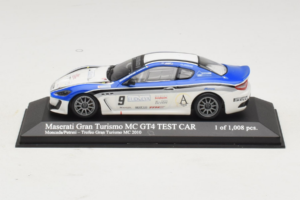
Maserati GranTurismo MC GT4 #6 Goldstein / Sumberg Trofeo GranTurismo 2010 Minichamps 1:43
Only 2 left
Price:
37.00 €
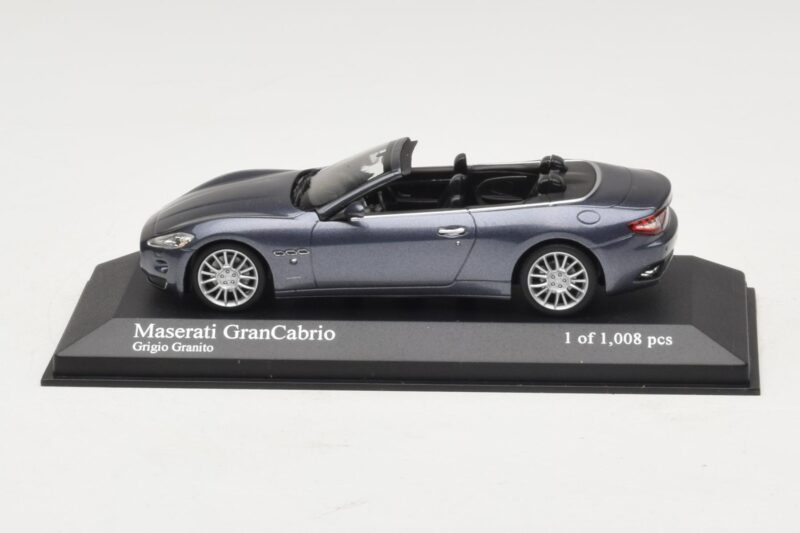
TL;DR: Minichamps' 1:43 Maserati GranCabrio in grey metallic reproduces the modern four-seat convertible GT introduced in 2010, cast in diecast with a sealed one-piece body. Pininfarina-influenced lines and deep metallic paint carry cleanly at this compact scale, positioning it as a contemporary counterpoint to Maserati's vintage Bertone and Frua-styled coupes.
Maserati's convertible lineup skipped the wind names that define its coupes, and the GranCabrio's modern proportions make that break obvious at a glance. Minichamps casts this four-seat cabrio in grey metallic, a finish that reads as understated next to the brighter reds common across the marque's back catalog, and the sealed diecast body keeps its lines uninterrupted from windshield to tail.
Maserati introduced the GranCabrio in 2010 as the open-top companion to the GranTurismo coupe, built on a shortened version of the Quattroporte sedan's platform. That underpinning is why the GranCabrio seats four adults rather than the strict two-plus-two of Maserati's classic GTs from the Khamsin and Mistral era. A naturally aspirated V8 sits up front, driving through a conventional front-engine, rear-drive layout that keeps the long hood and short deck proportions Maserati has favored since the Frua-bodied coupes of the 1960s. The GranCabrio widened that formula into a genuine four-seat convertible, a segment Maserati had not seriously contested since folding roofs went out of fashion decades earlier.
Pininfarina's design studio shaped the GranCabrio's surfaces in collaboration with Maserati's own design team, giving the car a lower beltline and a longer tail than the sedan it borrows its chassis from. Minichamps carries that silhouette into 1:43 with a roofline that reads correctly with the top down, the fabric top itself molded closed on this casting rather than left open, since the body is a sealed single shell. The trident badge sits crisply at the nose, and the character line running from front fender to taillight stays continuous, unbroken by any panel gap a working door or trunk would otherwise introduce at this scale.
Diecast at 1:43 means zinc alloy poured into a die, a process that gives the model real heft relative to its size and a structural rigidity that survives years of handling on a shelf. Minichamps builds this GranCabrio as a one-piece body, so there is no hood, door, or trunk lid to hinge open. That decision is a construction choice rather than a shortcoming, and it pays off in the shut lines: the seam between fender and door reads as a single fine groove rather than a gap wide enough to catch dust, and the windshield surround sits flush against the body rather than floating on a separate hinge point.
The grey metallic finish carries a fine flake that only shows its texture under a direct light source, appearing nearly flat grey under diffuse room lighting and shifting to a subtle sparkle when a shelf spotlight crosses the hood. That behavior is a genuine paint property, not a scale artifact, and it separates a well-finished diecast from a matte repaint. Because the body is sealed, the paint runs as one continuous coat from nose to tail with no break where a panel edge would otherwise interrupt the color, letting the metallic grade show consistently across every surface rather than pooling differently where hinges or gaps would sit.
At 1:43, the GranCabrio comes out to roughly ten centimeters long, small enough to line up a dozen Maserati generations across a single cabinet shelf without crowding. That compactness is the scale's whole appeal: where a 1:18 GranCabrio would demand its own display footprint, this casting sits comfortably among Minichamps' other European road cars, and the convertible profile stands out against the closed-roof coupes typically found at this scale. Detail resolution at 1:43 is necessarily coarser than at 1:18, so fine elements like the trident grille mesh and door handles read as suggestion rather than fully separate parts, a trade-off every 1:43 buyer accepts in exchange for the format's density on a shelf. The sealed body actually helps here, since a fixed convertible top holds its shape under handling in a way a hinged panel at this small scale sometimes cannot. Collectors who build a themed Maserati wall, mixing 1960s Frua coupes with a modern cabrio like this one, get a compact, low-cost way to bridge six decades of the marque's design language in a single row. Minichamps prices this segment above mass-market toy-grade diecast without reaching into hand-built resin territory, a middle ground that rewards the collector comparing paint accuracy and casting sharpness across several manufacturers before committing to one Maserati era.
The GranCabrio earns its spot as the contemporary bookend of a Maserati collection built around older Bertone and Frua coupes. Where the Khamsin and Mistral carry the marque's wind-naming tradition and a straight engineering lineage back to the 1960s, the GranCabrio breaks from both, built on Quattroporte mechanicals and named for what it literally is rather than a desert or coastal wind. That contrast is part of what makes it worth owning alongside the older cars rather than instead of them. Grey metallic keeps the piece understated next to brighter reds elsewhere in a Maserati lineup, a deliberate choice for a collector who wants variation in tone across a shelf rather than a wall of matching Rosso. At 1:43 and diecast, the price sits well below a 1:18 hand-built alternative, making it a sensible way to add a modern Maserati chapter without disturbing a collection's budget built around vintage pieces.


You save 38.00 €
Lowest price in the 30 days before the reduction: 189.00 €





You save 16.00 €
Lowest price in the 30 days before the reduction: 123.00 €