Used

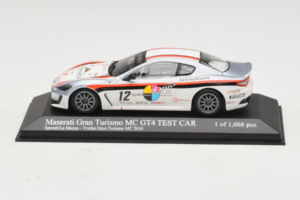
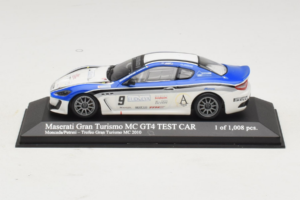
Maserati GranTurismo MC GT4 #6 Goldstein / Sumberg Trofeo GranTurismo 2010 Minichamps 1:43
Only 2 left
Price:
37.00 €
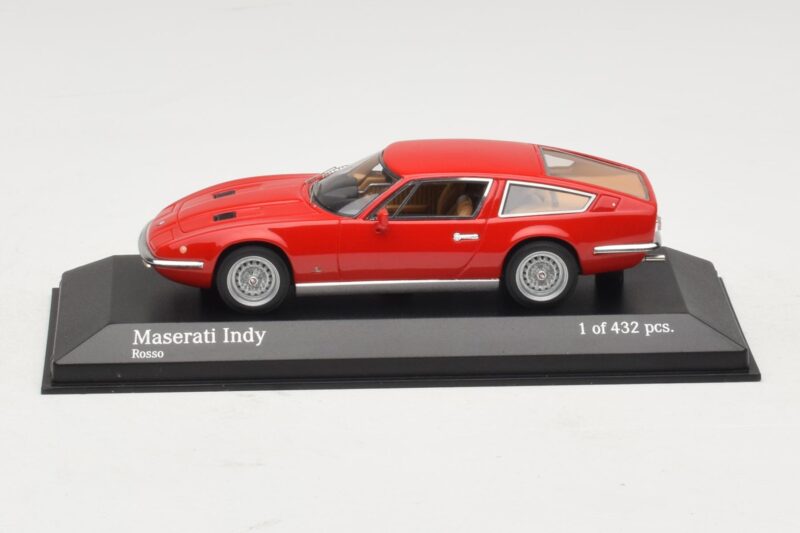
TL;DR: Minichamps' 1:43 Maserati Indy in red reproduces the 2+2 grand tourer Maserati named for its Indianapolis 500 victories in 1939 and 1940, cast in diecast with a sealed one-piece body. Styled through the Vignale studio, the Indy's four-seat layout set it apart from the strictly two-seat Ghibli it shared a shortened platform with.
Most Maserati road cars carry wind names, but the Indy commemorates something more specific: Wilbur Shaw's back-to-back Indianapolis 500 wins in a Maserati 8CTF in 1939 and 1940. Minichamps' red casting keeps that competition heritage visible on the badge alone, since the Vignale-styled body itself, sealed and cast as one piece, presents a thoroughly civilian 2+2 grand tourer.
Long before the Indy road car existed, Maserati's 8CTF single-seater won the Indianapolis 500 in both 1939 and 1940, driven by Wilbur Shaw in what remains one of the marque's most celebrated competition achievements outside of Europe. That success gave Maserati a genuine claim to American motorsport credibility decades before the Indy grand tourer arrived in 1969, and naming a road car after the event rather than a wind broke sharply from the naming convention that gave the marque the Ghibli, Mistral, and later the Khamsin. It is one of the few Maserati model names tied directly to a specific, documented racing result rather than an evocative geographic reference.
The Indy's styling came through the Vignale studio, credited largely to Giovanni Michelotti, and its underpinnings were a shortened version of the Ghibli's platform reworked to accommodate genuine rear seating rather than the Ghibli's strict two-seat layout. That extra practicality made the Indy a more usable everyday grand tourer than its two-seat sibling, trading some of the Ghibli's low, dramatic proportions for a slightly taller greenhouse that could actually carry four adults. A V8 sat up front in the same general configuration Maserati used across its GT range at the time, keeping the Indy mechanically conventional even as its body style filled a genuinely different role in the lineup.
The Indy's slightly taller roofline, necessary to fit genuine rear seating, gives this casting a different silhouette challenge than a low two-seat coupe like the Ghibli would present, and Minichamps handles it with the same sealed, one-piece construction used across its Maserati range. No working hood, door, or trunk interrupts the greenhouse's proportions, letting the roofline read at its correct height relative to the hood and beltline rather than risking a hinge line that could visually lower or distort the cabin's actual scale. That fixed body keeps the 2+2's less dramatic but more honest proportions intact.
Red on this Indy does double duty, functioning as both a classic Italian GT color and a quiet nod to the marque's Indianapolis racing heritage that gave the model its name, even though the road car itself never competed. Because the body is sealed and cast in one piece, the red runs unbroken from the Vignale-shaped nose through the longer cabin to the tail, with no seam interrupting the color across the car's less dramatic but genuinely practical proportions. The finish carries enough depth under direct light to distinguish it from a flat, single-tone repaint, consistent with a well-finished diecast at this scale.
At 1:43, the Indy comes out slightly longer than a two-seat Ghibli at the same scale, a difference that becomes obvious once the two castings sit side by side, with the Indy's taller greenhouse and slightly less rakish roofline reflecting its genuinely different mission as a family-usable grand tourer rather than a two-seat statement piece. That distinction matters to a collector trying to represent Maserati's full early-1970s range rather than just its most photogenic two-seaters, since the Indy filled a real gap in the lineup that the Ghibli, Khamsin, and Mistral all left open. Detail resolution at this scale renders the Vignale-styled grille and rear lamp cluster as fine relief rather than fully separate parts, the usual trade-off at 1:43 that a design this restrained handles without losing its identity. Anyone judging this casting against reference photos should start with the greenhouse height and the rear seat area's proportion relative to the front cabin, since those two elements are what genuinely separate an Indy from a shortened Ghibli. The red finish also photographs distinctly against the cooler greys and blues common elsewhere in a Maserati coupe lineup, giving this Indy genuine visual separation on a crowded shelf.
The Indy occupies an unusual position in a Maserati collection: a road car whose name commemorates a specific, documented racing triumph, Shaw's twin Indianapolis 500 wins, while the car itself pursued comfort and practicality rather than performance bragging rights. That contrast makes it a genuinely interesting counterpoint to a Ghibli or Khamsin nearby, both of which lean harder into low-slung, two-seat drama. Red ties the casting back to that competition heritage even as the body itself stays firmly in grand tourer territory. At this scale and diecast price point, adding the Indy alongside its two-seat siblings completes a more accurate picture of what Maserati's early-1970s range actually offered buyers who wanted four seats rather than two, a detail easy to overlook without a piece like this one on the shelf, and a reminder that not every grand tourer needs to sacrifice practicality for style.

You save 38.00 €
Lowest price in the 30 days before the reduction: 189.00 €




You save 16.00 €
Lowest price in the 30 days before the reduction: 123.00 €