Used

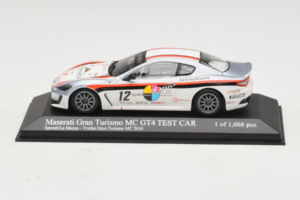
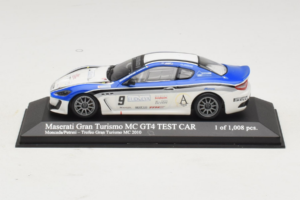
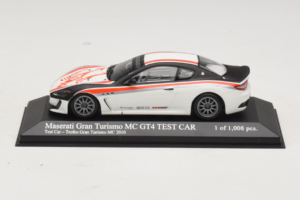
Maserati GranTurismo MC GT4 #6 Goldstein / Sumberg Trofeo GranTurismo 2010 Minichamps 1:43
Only 2 left
Price:
37.00 €
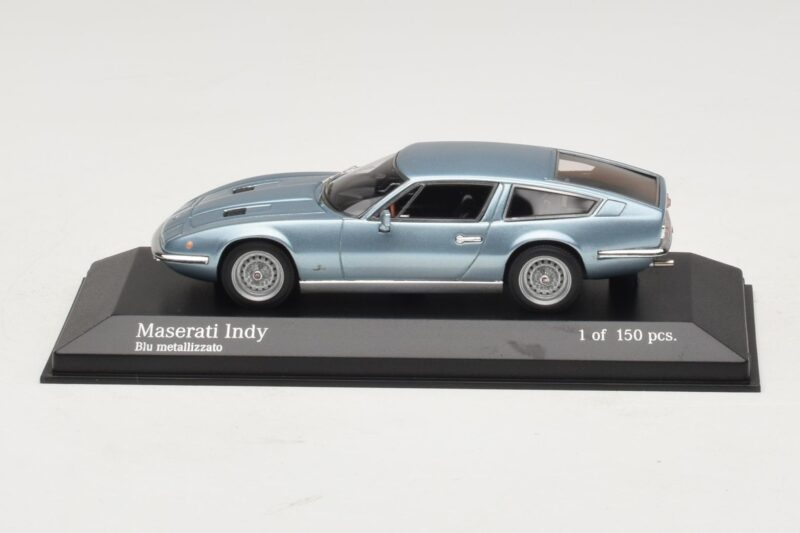
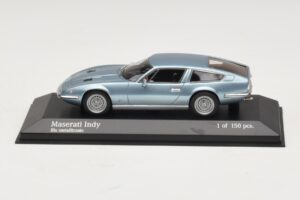
TL;DR: Minichamps' 1:43 diecast Maserati Indy in blue metallic reproduces the 1970 Vignale-styled 2+2 grand tourer, a front-engine GT named after Maserati's Indianapolis 500 wins. Cast as a sealed zinc-alloy shell with no opening panels, the metallic finish and tight, continuous shut lines carry the model rather than any opening feature.
Blue metallic asks more of a small-scale casting than a solid color does, since flake orientation shifts the shade from panel to panel under changing light. Minichamps' Indy shows that shift cleanly across the Vignale-styled fastback roof and long hood, holding a consistent grain rather than drifting toward purple or grey in the shadows. The coupe underneath carries its own story, a name borrowed from Maserati's Indianapolis 500 racing history rather than the city itself.
Metallic blue is genuinely harder to reproduce accurately than a flat color, because the flake has to sit at a consistent density across every panel or the shade will read differently depending on the angle of the light. Minichamps holds that consistency across the Indy's long hood and fastback roof, so the blue reads true whether the model sits under a bright spotlight or the softer ambient light of a cabinet shelf. The zinc alloy body underneath adds real weight to the piece, denser in the hand than a resin casting of the same size, and that mass is part of what makes a small-scale diecast satisfying to pick up and turn under the light.
Minichamps casts the Indy as a single sealed body, with no door, hood, or trunk panel that opens on this piece. That construction choice removes hinge tolerances entirely, and the payoff shows in the shut lines: the door creases and roof seam read as continuous grooves rather than gaps, tracing Vignale's long fastback taper from the windshield pillar to the tail without a single interrupted line. For a design defined by that unbroken roofline, a sealed body is arguably the more faithful choice than one built to open, since nothing breaks the sweep the original coachbuilder drew.
The Indy takes its name from Wilbur Shaw's Indianapolis 500 victories in 1939 and 1940, driven in a Maserati 8CTF at a time when European marques rarely competed at the Brickyard at all. Maserati revived that memory decades later for its new front-engine 2+2, a road car with no direct engineering connection to the race but every reason to borrow its prestige. Giovanni Michelotti drew the body while working for coachbuilder Vignale, giving the Indy a long fastback roof and a lower, wider grille than Maserati's earlier Frua and Touring-bodied cars, distinct enough to stand on its own within the marque's catalog.
Unusually for Maserati, the Indy used a steel monocoque rather than the tubular chassis underpinning the two-seat Ghibli, a construction choice that made room for a genuine four-seat cabin without sacrificing rigidity. That extra practicality gave the Indy a different mission from its siblings: long-distance touring for a small family rather than a solo grand tourer built purely around performance. The V8 sat well back in the bay, and the resulting balance gave the car a more relaxed character than the Ghibli or Bora, a genuine four-seat GT rather than a two-seat statement piece.
At 1:43, the Indy comes out to roughly 10 centimeters long, a footprint that lets a collector build an entire Maserati road-car chronology across several models in the space a single 1:18 grand tourer would occupy alone. The compact scale asks the model to carry its case on proportion and finish rather than interior detail, since a casting this size simply cannot reproduce cabin trim with the same resolution a larger scale allows. Judging fidelity here means checking the same fundamentals that apply to any 1:43 subject: does the glazing sit flush against the roofline, do the wheels carry a diameter and offset appropriate to a 1970 grand tourer rather than a modern wide-track look, does the badge work read crisply rather than as a soft transfer. Minichamps has built its reputation on precisely these details across a wide range of classic-era subjects, and the Indy in blue metallic asks for the same scrutiny as any flagship in the lineup. Displayed under a single directed light, the metallic depth and the unbroken shut lines are what a practiced eye checks first, well ahead of any question about opening features.
Collectors who already own the black Indy have a genuine reason to add the blue metallic alongside it: the two finishes show the same Vignale body under entirely different light, one absorbing shadow along its flanks and the other throwing back a shifting metallic sheen. Displayed together, they make the case for the Indy's proportions better than either could alone, since the eye reads the shape twice under two different treatments. Minichamps' 1:43 diecast keeps both variants at a price well below any 1:18 equivalent, without sacrificing the proportional accuracy that a small-scale grand tourer needs to earn its shelf space. For a Maserati chronology built by generation rather than by color, the blue Indy slots in exactly where the black one does, just with a different story to tell under the light.

You save 38.00 €
Lowest price in the 30 days before the reduction: 189.00 €




You save 16.00 €
Lowest price in the 30 days before the reduction: 123.00 €