Last one

You save 5.00 €
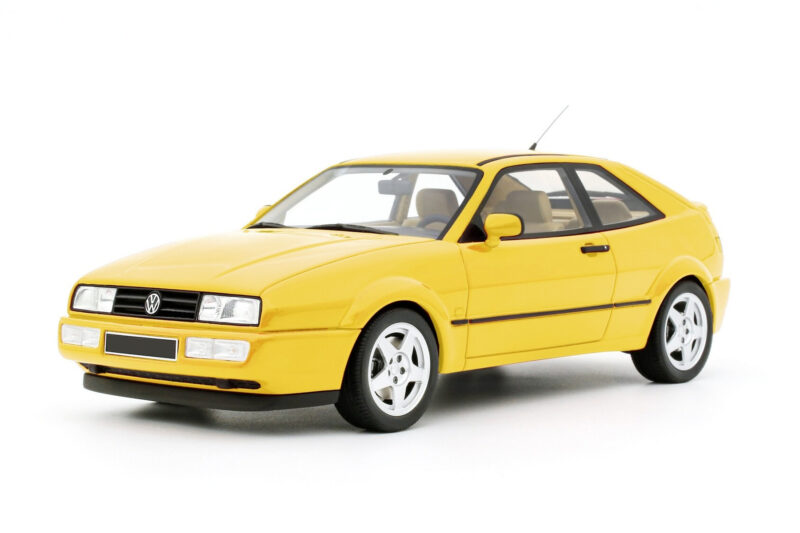
TL;DR: Otto's 1:18 resin VW Corrado G60 reproduces the 1988 launch-engine coupe in Yellow Nugget, powered by VW's supercharged G-Lader four-cylinder before the later VR6 arrived. Cast as a sealed one-piece body, it captures the liftback's wedge shape and its automatically deploying rear spoiler as a fixed sculpted detail.
VW positioned the Corrado above the Golf GTI when it launched in 1988, giving it styling sharp enough to still look modern decades later and an engine nobody else was building quite the same way. Otto's Yellow Nugget G60 captures the earliest, purest version of that formula, before the VR6 arrived and changed what people expected under a Corrado's hood.
The G60 designation refers to VW's G-Lader supercharger, a scroll-type forced-induction unit unlike the Roots or centrifugal designs most manufacturers favored, spiraling air through an eccentric scroll chamber rather than compressing it between meshing rotors. Bolted to a 1.8-liter inline-four, it pushed output to roughly 160 horsepower, a healthy figure for a small-displacement engine in 1988 and enough to make the Corrado meaningfully quicker than the contemporary Golf GTI it shared showroom space with. The G-Lader design proved mechanically complex and eventually gave way to the naturally aspirated VR6 in 1992, which makes the earlier G60 cars a distinct engineering chapter rather than a stepping stone toward the engine most people associate with the Corrado today.
The Corrado effectively replaced the Scirocco in VW's lineup, though the two models briefly overlapped in production. Built on a heavily reinforced version of the Golf Mk2 platform, it carried a liftback body style that split the difference between a coupe and a hatchback, with a steeply raked rear window and a hidden hatch opening rather than a conventional trunk lid. VW positioned it as a genuine halo car, priced and equipped above the GTI, and the G60's supercharged four gave early buyers a reason to choose it over a naturally aspirated alternative from a rival brand.
The Corrado's liftback profile, with its steeply angled hatch glass and short rear deck, is a genuinely complicated shape to cast well, since the transition from roof to glass to hatch has to flow as one continuous surface rather than reading as separate panels stitched together. Otto builds this model as a sealed one-piece body, with no doors or hatch that open, which suits a shape defined almost entirely by its surfacing rather than by mechanical details underneath. Resin's tighter tolerances let the caster hold the Corrado's tricky beltline crease and the pinch above the rear wheel arch with more precision than a stamped and hinged body would typically allow.
The real Corrado's rear spoiler deployed automatically once the car passed roughly 45 miles per hour, retracting again below that speed, a party trick that made the car instantly recognizable in period road tests. On this sealed casting, the spoiler is molded as a fixed sculpted element rather than a moving part, capturing its shape and mounting point accurately without replicating the mechanism that raised and lowered it on the original. That's a reasonable trade for a display piece: the spoiler's silhouette is correct, even if it won't rise from its resting position the way the real car's did at speed.
Yellow Nugget is a striking, period-correct color choice that few Corrado owners chose over the more common reds and blacks, which makes it a genuine standout on a shelf of 1980s VW models. On resin, the shade holds a bright, saturated depth under direct light, with none of the seam lines a stamped body would introduce across the hood and roof to interrupt the color's flow. The Corrado's wedge-shaped proportions, a low nose rising toward a higher tail, were considered sharp for a compact coupe when the car launched, and at 1:18 the body measures roughly 22 to 23 centimeters, a compact footprint that fits comfortably alongside other late-1980s hatchback and coupe subjects. Period-correct alloy wheels, smaller in diameter than what a modern coupe would wear but proportionally right for the era, fill the arches without the oversized look a wrong wheel choice would create. The G60 badge sits correctly on the tailgate, a detail that separates this specific variant from the later VR6 cars that carried different badging. Fixed headlights and a simple, uncluttered front bumper reflect VW's restrained design language of the period, a contrast to the more aggressive front-end treatments that would come to define performance coupes in the following decade of hot hatches.
A G60 Corrado occupies a specific place in a VW collection, positioned above the Golf GTI it was built to outshine and predating the VR6 that most people remember when the Corrado name comes up. Displaying this Yellow Nugget example beside a period Golf GTI tells the story of VW's early move toward a proper halo coupe, while pairing it with a later VR6 Corrado shows how quickly the naturally aspirated six made the supercharged four feel like a transitional engine. Resin construction keeps this piece in the mid-premium tier, appropriate for a subject niche enough that mainstream diecast lines rarely tool it at all. For anyone building a comprehensive 1980s Volkswagen shelf, a G60 in a color this bold is worth adding before it disappears from Otto's catalog. It's a small, specific piece of modern-classic VW history that rewards someone who already knows why the Corrado name still gets debated among enthusiasts decades later.


You save 36.00 €
Lowest price in the 30 days before the reduction: 180.00 €
You save 36.00 €
Lowest price in the 30 days before the reduction: 180.00 €