Back in stock
You save 5.00 €
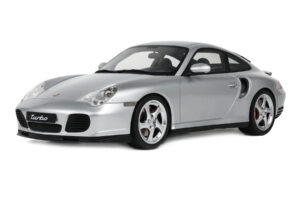
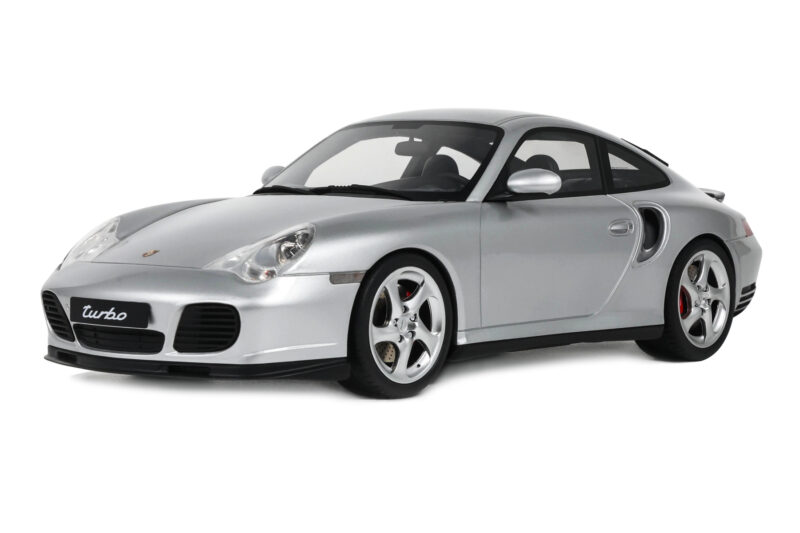
TL;DR: GT Spirit's 1:18 resin Porsche 911 996 Turbo reproduces the 2001 model in Polar Silver, the first water-cooled 911 Turbo, cast as a sealed one-piece body with the model's wide rear haunches and side intakes. A classic-sports subject built for shut-line precision rather than opening panels.
The 996 Turbo carries a distinction every subsequent 911 Turbo has followed: it was the first to trade the air-cooled flat-six for water cooling, a shift that split enthusiast opinion at the time it happened. GT Spirit's 1:18 resin reproduction, finished in Polar Silver, puts that transitional car on a shelf in one of its most correct period colors.
When Porsche introduced the 996 generation in 1998, it gave the entire lineup, base Carrera through Turbo, the same oval headlight design, a decision that drew criticism from purists who felt the Turbo deserved a more distinct face. What set the 996 Turbo apart visually was everything below those headlights: wider rear haunches to cover a broader track, front and rear bumpers with larger intakes to feed the twin-turbo flat-six, and a fixed rear wing. The shared headlights read as a compromise from a distance, but the wide-body proportions underneath make the Turbo unmistakable once you know what to look for, and GT Spirit's casting gets that width right.
Polar Silver was one of the more common Porsche shades through the early 2000s, a cool, slightly blue-tinted silver that reads differently under light than the warmer GT Silver Metallic that followed it in later Porsche generations. On the 996 Turbo specifically, the color does real work showing off the car's surfacing: the crease running along the door and into the rear fender catches highlight differently in silver than it would in a solid color, making the widebody shape more legible from a distance. It is a period-correct choice rather than a flashy one.
GT Spirit casts this 996 Turbo as a sealed, one-piece resin body, with no doors, hood, or trunk built to open. That construction matters more on this particular car than on a narrower design, because the rear haunch line, the character line that swells out to cover the wider rear track, has to stay continuous from the door to the taillight without a seam interrupting it. A sealed body lets the casting hold that curve as one uninterrupted surface, and the shut lines that do exist read as tight, even grooves rather than gaps with visible shadow.
The 996 Turbo's rear-quarter intakes, cut into the bodywork just ahead of the rear wheels, are small but structurally important on the real car, feeding air to the intercoolers behind the engine. Resin holds fine, sharply defined cutouts like these better than diecast typically manages at this scale, since the material's tighter casting tolerances allow crisper edges around a small opening without the surrounding surface distorting. GT Spirit's casting keeps those intakes sharp rather than softened into a vague depression.
The 996 Turbo occupies an interesting position in 911 history: respected for its engineering, the first water-cooled Turbo and a genuinely quick car for its era, but often overshadowed in collector attention by the air-cooled 993 that preceded it and the more visually distinct 997 that followed. That makes it an interesting anchor for a collector building a generational Turbo lineup, since it marks the actual inflection point in the model's cooling technology rather than just another styling update. At 1:18, the car comes out to roughly 22 centimeters, a manageable footprint that leaves room for wider companions on the same shelf. Displaying it next to a narrower base 996 Carrera makes the width difference obvious in a way photographs rarely capture. Judging the fidelity of a 996 Turbo reproduction means checking the rear wing's deployed angle, the width of the rear fender relative to the front, and whether the oval headlight shape reads correctly rather than too rounded or too narrow.
For a collector assembling a Turbo generation lineup, from 930 through 993 and on to the 996 and beyond, this model fills a specific and often underrepresented slot: the car that made the technical leap everyone remembers arguing about at the time. GT Spirit's resin build sits at a reasonable mid-tier price point, well below the hand-built metal specialists working the same subject and above mass-market diecast, with finish quality that holds up to close inspection. Polar Silver is arguably the more honest choice than a flashier color, since it was genuinely common on cars like this rather than a rare special-order shade dressed up for display purposes.
You save 29.00 €
Lowest price in the 30 days before the reduction: 147.00 €