BMW X6M F86 Red Norev 1:18
Price:
94.00 €
You save 5.00 €
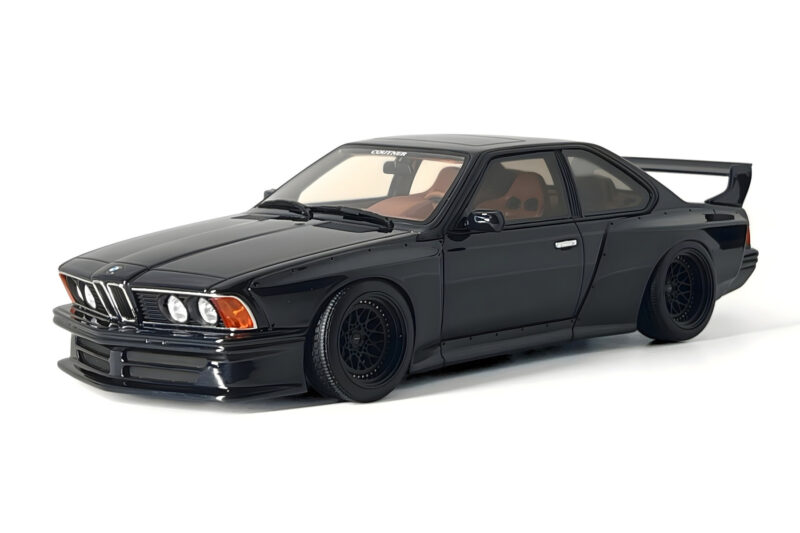
TL;DR: Otto's 1:18 resin BMW E24 635 CSi reproduces a 2021 Coutner widebody build over the classic 1980s coupe shape, finished in Deep Blue Metallic. The sealed one-piece body carries flared arches and tight shut lines, positioning this as a modern tuner interpretation of BMW's six-cylinder flagship coupe rather than a factory-stock replica.
The E24 6 Series arrived in 1976 as BMW's flagship coupe, its long low nose and Paul Bracq-influenced lines making the 635CSi a fixture of European Touring Car grids through the 1980s. Four decades later, a widebody treatment credited to Coutner reimagines that shape for a modern audience, flaring the arches wide over larger wheels while keeping the greenhouse and roofline unmistakably E24.
Paul Bracq penned the E24's long hood and low beltline while working at BMW in the mid-1970s, and the shape proved flexible enough to carry both the luxury 635CSi and the homologated race cars that competed in the European Touring Car Championship through the decade. That dual identity, refined road car and capable racer, is part of why the E24 still draws attention from collectors who never saw one new. The chassis stayed in production for thirteen years with only modest updates, a rare run for a flagship coupe, and it is that long-lived, well-proportioned body that a modern widebody kit like this one has to work with rather than against.
The E24's narrow original arches leave real room for a flare without breaking the car's proportions, which is part of why tuners keep returning to this shape decades after production ended. Coutner's kit pushes the fenders outward over a wider track, and on the real car that width is functional, not just visual, accommodating a wider wheel and tire setup than BMW ever offered from the factory. Reproducing that at 1:18 means the model's stance has to read as genuinely planted rather than simply stretched, and it is the arch line, not the paint, that proves whether the widebody kit was scaled correctly.
Casting the E24's widened arches as a one-piece resin body is the more demanding path, because every flare, vent, and gap between the fender and the door has to be right without a hinge to hide behind. Resin's tighter tolerances than diecast let Otto hold sharp, continuous lines around the widebody flares, and the lack of opening panels means the shutlines along the doors and trunk stay as narrow and consistent as the original design intended, even where the bodywork itself has been reshaped.
Deep Blue Metallic is the kind of finish that rewards a spotlight rather than flat ambient light. Held under a directed lamp, the metallic flake in the paint reads with real depth across the hood and roof, catching differently at the arch flares than on the flatter door panels. That paint sits on a resin shell that carries less mass than diecast at the same size, but the tradeoff buys the crisper body lines a widebody conversion needs to look convincing rather than bolted-on.
A widebody E24 sits in an odd but interesting spot in a themed display. It isn't a period-correct 1980s BMW, and it isn't a brand-new car either, it's a 2021 interpretation of a chassis that stopped rolling off the line in 1989. That makes it a strong contrast piece next to a stock 635CSi or an M6 from the same generation, showing two very different answers to what the E24 shape can become. Collectors who build around tuner and modified-car themes, rather than strict factory chronology, are the natural audience here, since the appeal rests on the widebody execution rather than historical accuracy to any specific factory trim. Otto's resin format at 1:18 keeps the model in step with most other BMW coupes on a typical shelf, so it slots easily into a mixed E24 lineup without needing its own display case. Next to a genuine period 635CSi, the differences in stance and arch width become the whole point of the comparison, and that side-by-side is arguably the most interesting way to display a piece like this.
This is a model built for a specific kind of collector, one who follows contemporary widebody and tuner culture as closely as classic BMW history. It doesn't try to be a factory-accurate 635CSi, and treating it as one misses the point. What it offers instead is a well-executed resin interpretation of a real modern build, with a sealed body that holds the flared arches cleanly and a metallic finish that photographs well under display lighting. At 1:18, it pairs naturally with other tuner-focused pieces rather than a strict E24 model-year lineup, and that flexibility is its strength. For a shelf built around modified classics rather than period-correct restorations, this widebody 635CSi earns its spot on execution rather than historical pedigree.



You save 28.00 €
Lowest price in the 30 days before the reduction: 142.00 €