Used
Back in stock

McLaren 12C GT3 #82 Russian Team A. Vasiliev / D. Vasiliauskas / M. Asmer / B. Spengler Spa 24 Hours 2014 Minichamps 1:43
Only 2 left
Price:
46.00 €
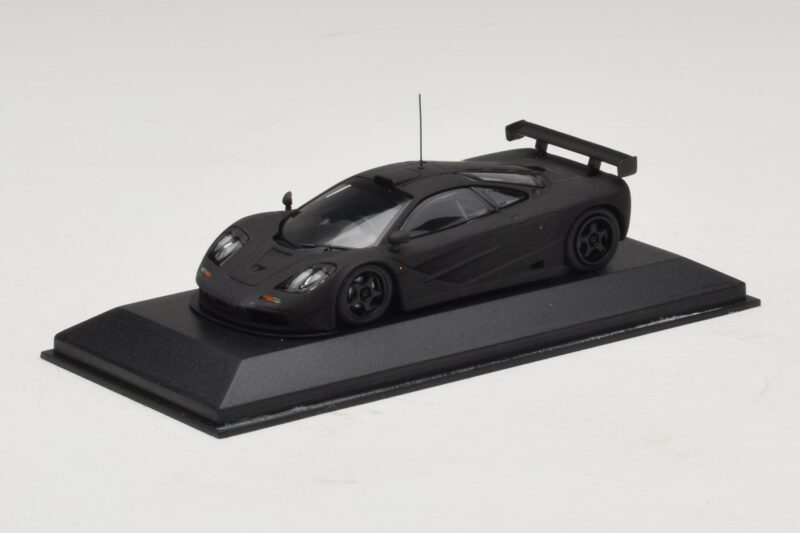
TL;DR: Minichamps' 1:43 McLaren F1 GTR reproduces the racing prototype in matte black with black wheels, skipping any sponsor livery entirely. Diecast construction, sealed one-piece body, 1996-era GTR bodywork with full wide-body aero. A subject built around raw shape rather than race graphics, suited to collectors who value form over decals.
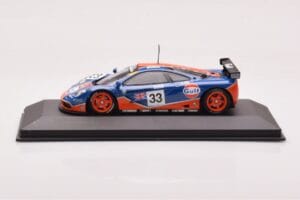
Most McLaren F1 GTR models chase a race weekend: the orange Gulf scheme, the Ueno Clinic yellow, the Harrods livery from Le Mans. This one chases the car itself. Minichamps strips away the sponsor graphics and presents the GTR in unbroken matte black, the wide-body aero and race-bred proportions doing the talking without a single decal to distract from them.
The McLaren F1 GTR began life as a factory answer to a customer request: turn the road-going F1 hypercar into something that could race. Gordon Murray's team widened the bodywork, added a rear wing and a deeper front splitter, and kept the naturally aspirated BMW V12 that had already made the road car famous. In 1995, on its competition debut, the GTR swept the podium at the 24 Hours of Le Mans, taking the overall win against purpose-built prototypes, a result still cited whenever the conversation turns to production-based race cars beating dedicated ones. Most replicas of that car lean on the result, reproducing one of the liveries that crossed the line first. This Minichamps version does the opposite. Finished in matte black with black wheels and no sponsor graphics at all, it reads as a development or test-day car, the kind that exists before a team assigns colors and decals to a chassis. The wide-body flares, the louvered rear deck, the deep front splitter all sit exposed with nothing to distract from them. For a collector who already owns a liveried GTR, or who simply wants the shape without the noise of sponsor logos, this is the version that puts the engineering first, a quieter way to own one of the most consequential GT racing cars of the 1990s.
At 1:43, Minichamps casts the GTR as a single sealed shell rather than an opening-panel model, and for a subject built around aggressive wide-body surfacing, that is the right call. A one-piece diecast body holds tight, consistent lines across the flared arches and the rear wing mounts, areas where a hinge would otherwise force a compromise in the surfacing. Matte black is a harder finish to execute well than gloss, since it shows every imperfection in the casting rather than hiding it under reflection, and the panel transitions here read clean under direct light without the orange-peel texture budget matte paints sometimes carry. The black wheels match the body tone rather than contrasting against it, which keeps the whole car reading as one continuous shape from nose to tail, exactly the effect the prototype livery is going for. Zinc alloy diecast at this scale brings real heft for its size, noticeably denser in the hand than a resin piece of the same footprint, and that mass helps the model sit solidly on a shelf rather than feeling like a toy. The scale itself is worth weighing against 1:18: a 1:43 GTR occupies a fraction of the shelf space a larger casting would need, which matters for anyone building a run of 1990s GT cars rather than dedicating a whole shelf to one hero piece. Detail resolution is necessarily simplified compared to 1:18, but on a car this aerodynamically busy, the proportions do most of the work.
A matte black, delivery-spec McLaren F1 GTR works best alongside its liveried siblings rather than instead of them, functioning as the baseline against which the race colors make sense. Collectors building a 1990s GT racing shelf often want at least one car that shows the raw architecture before sponsor decisions covered it, and this is that piece. It also stands on its own as a design study: the F1 GTR's proportions, born from Gordon Murray's road car, are unusual enough to reward a plain finish. Anyone weighing this against a liveried version should think about what the display is trying to say. A wall of race colors tells a season's story; one black prototype among them tells the engineering story, and that is a different kind of collection to build.






You save 16.00 €
Lowest price in the 30 days before the reduction: 123.00 €