Used
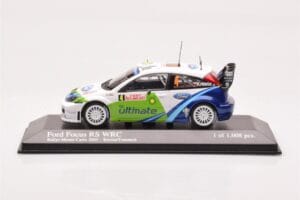
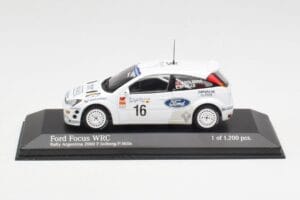
Ford Focus RS WRC #4 R. Kresta / J. Tomanek Rally Monte Carlo 2005 Minichamps 1:43
Only 2 left
Price:
103.00 €
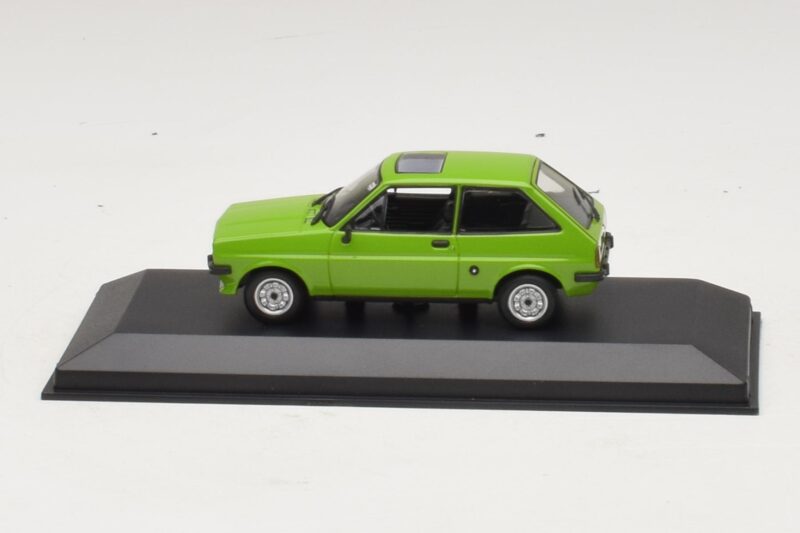
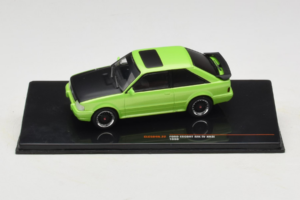
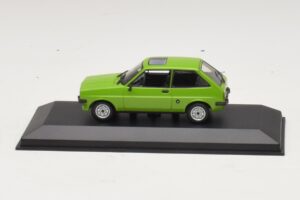
TL;DR: Maxichamps' 1:43 diecast Ford Fiesta Mk1 reproduces the 1976 hatchback in Light Green, Ford's first front-wheel-drive subcompact, cast as a sealed one-piece body under Minichamps' accessible diecast line. The Fiesta had a brief US run during the fuel-crisis years, making this a discovery piece for most American collectors.
Most American collectors know the Fiesta as a modern subcompact, if they know it at all. The original Mk1, though, arrived in Europe in 1976 as a genuine engineering departure for Ford, and its brief, awkward stint in US showrooms during the fuel-crisis years makes this Light Green example a curious footnote rather than a familiar face.
Maxichamps casts the Fiesta Mk1 as a sealed one-piece body, the standard construction at this accessible tier of Minichamps' diecast range, and on a small hatchback the approach suits the subject well. The Fiesta's compact proportions, short overhangs, a stubby nose, and a tail that drops almost vertically, depend on the body holding a consistent line from bumper to bumper, and a one-piece casting achieves that more reliably than a shell with hinge tolerances built into the door and hatch openings.
Zinc alloy diecast gives the small model real weight in the hand, a density that plastic toys at this size cannot match, and that heft is part of what separates a diecast collectible from a children's toy despite the similar footprint. The Light Green paint sits on the metal shell with an even, consistent gloss, and the color itself was a genuinely common period choice across small European Fords rather than a modern reinterpretation. Window surrounds and the hatchback's rear glass sit flush rather than proud, and the wheels, small by necessity at 1:43, still carry defined spokes rather than a molded blank disc. This is not a detail-dense premium casting, but the fundamentals of stance, proportion, and paint consistency are handled competently enough that the little Fiesta reads correctly on a shelf.
The Fiesta Mk1 mattered to Ford in a way its small size belied. Launched in Europe in 1976, it was Ford's first front-wheel-drive production car, built to compete in a small-hatchback segment that European buyers had already embraced and that Ford had been slow to enter. The engineering was genuinely new for the company, a transverse engine and gearbox package that Ford would carry forward into most of its small cars for decades afterward.
Ford brought the Fiesta to the United States starting in 1978, timed to catch the tail end of the era's fuel-price anxiety, when small, efficient hatchbacks briefly looked like a serious answer to gas lines and rising prices at the pump. The US version sold reasonably at first, but American buyers' appetite for genuinely small cars faded faster than Ford expected once fuel prices eased, and Ford withdrew the Fiesta from US showrooms by 1980, only reviving the nameplate decades later with an entirely different car. That short window is exactly why this Mk1 registers as unfamiliar territory for most US collectors: it existed here, briefly, then vanished for a generation.
At 1:43, the Fiesta Mk1 takes up almost no shelf space, which makes it an easy addition to a European small-car lineup without crowding out larger pieces. It pairs naturally with other Maxichamps and Minichamps castings from the same period, particularly other Ford of Europe subjects, rather than standing as an isolated curiosity. American muscle-car or racing collectors will find nothing here to connect with, and that is fine: this piece serves a narrower audience tracing Ford's global small-car lineage rather than its performance history. For a collector building out the Fiesta nameplate from its 1976 origin forward, this Light Green Mk1 is a solid, honestly executed starting point.