Used
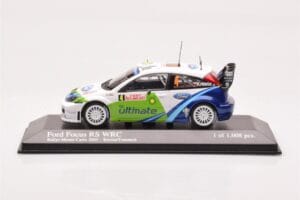
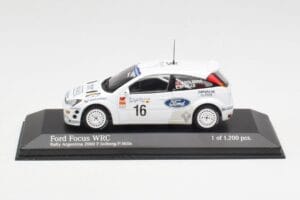
Ford Focus RS WRC #4 R. Kresta / J. Tomanek Rally Monte Carlo 2005 Minichamps 1:43
Only 2 left
Price:
103.00 €
This model is currently sold out. Enter your email and we'll let you know when it's back in stock.
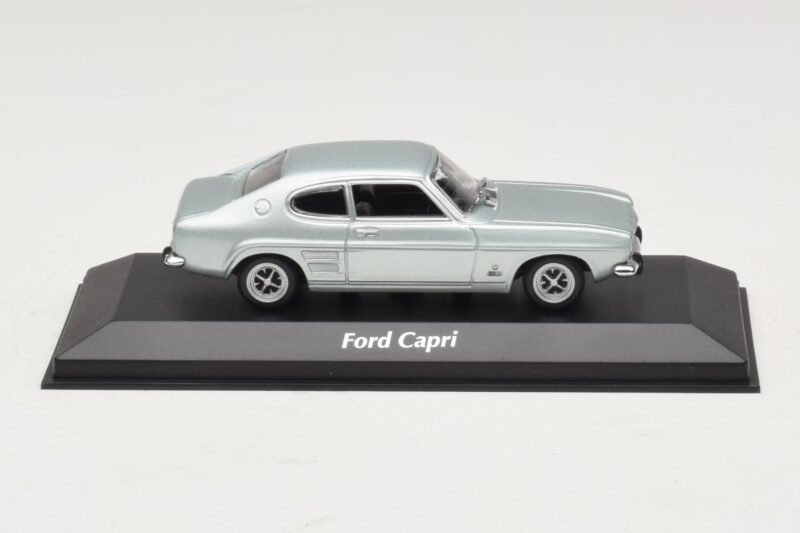
TL;DR: Maxichamps' 1:43 Ford Capri I in Light Blue Metallic is a sealed-body diecast of Ford's 1969 European pony car, its one-piece shell holding the long hood and short deck proportions without opening doors or hood. Built at an accessible tier, it pairs naturally with American muscle car models on the same shelf.
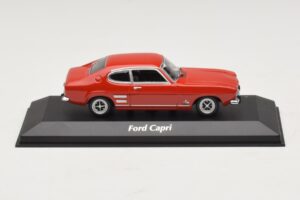
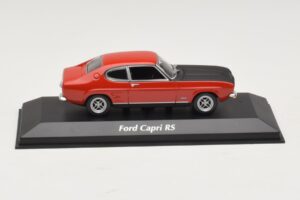
Ford built the Capri for European buyers who wanted Mustang proportions without a Mustang-sized engine bill, and the formula worked well enough to outsell nearly everything else in its class. Maxichamps casts this Mk1 in Light Blue Metallic, a sealed-body model that puts the emphasis on the coupe's long hood and fastback profile rather than on features a shelf display never uses anyway.
The Capri's whole visual case rests on its proportions: a hood long enough to suggest a big engine up front, a fastback roofline sloping back to a short trunk, and a greenhouse that sits low over the doors. Maxichamps casts all of that as one sealed shell, which keeps those long panel lines running straight and uninterrupted from the front fender to the rear quarter without a hinge gap breaking up the silhouette anywhere along the way. The wheel arches hold the correct fastback stance, sitting closer to the ground than a sedan of the same period would, and the character line running down the door reads as a single crisp groove rather than a soft, rounded edge. It is a shape that depends on clean lines more than on any single feature, and a one-piece casting is well suited to delivering exactly that.
Light Blue Metallic sits well on a shape this simple, letting the flake catch light along the hood and roof without competing against heavy chrome trim. The Capri script and period Ford badging are picked out crisply on the nose and rear panel, small details that separate a well-finished budget casting from one that cuts corners where nobody is supposed to notice. Chrome window surrounds and bumpers stand out cleanly against the blue, and the interior visible through the glazing carries enough seat and dashboard texture to hold up under a close look, even on a car this size.
Ford launched the Capri in 1969 with a tagline promising buyers "the car you always promised yourself," and it built the coupe in both West Germany and Britain to serve the whole of its European market at once, something the company rarely did with a single model line. That dual production let Ford offer the Capri with everything from small, economical four-cylinder engines up to a 3.0-liter V6, so the same fastback shape could serve a budget commuter buyer and a performance-minded one from the same showroom floor. This particular Light Blue Metallic example represents that accessible end of the range, the version most Capri buyers actually drove rather than the rare high-output variants that get most of the attention today.
Underneath that everyday image, the Capri built a genuine competition record in European Touring Car racing through the 1970s, where its light weight and long hood made it a natural platform for larger engines and aggressive bodywork. That racing pedigree helped the Capri earn a reputation well beyond what its modest base-model pricing suggested, the same way a Mustang's track success colored how Americans saw an ordinary six-cylinder coupe. None of that competition history changes what this Light Blue Metallic model represents, a standard road car, but knowing the Capri's dual identity as both a value buy and a racer explains why the shape still gets attention decades later.
At 1:43, the Capri takes up little room next to a full-size American muscle car model, which makes the pairing an easy one: same pony-car formula, different continent, different scale of engine under the long hood. For hobbyists who already run a Mustang or Camaro lineup, adding the European answer to that formula fills a gap most American diecast shelves never cover. The sealed body keeps the price accessible without sacrificing the details that matter most on a shape this dependent on clean lines, the stance, the character line, and the fastback roof. Set beside a Mustang, the resemblance in proportion is obvious even at a glance across the room.