Used

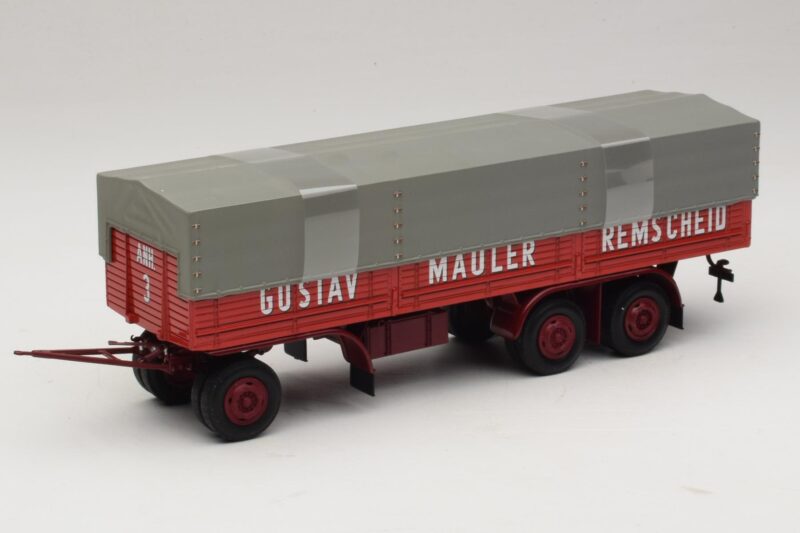
TL;DR: Minichamps' 1:43 diecast reproduces a Kässbohrer flatbed semi-trailer in the 'Mauler' haulage livery from Remscheid, a 1960s heavy-transport subject rather than a powered truck. The sealed zinc alloy body carries the frame and deck detail as one fixed casting, with the operator's name tampo-printed along the flank.
Heavy haulage rarely gets its own model, since a trailer without the tractor pulling it looks incomplete on a shelf. Minichamps treats this Kässbohrer flatbed as a subject in its own right, built to pair with any period-correct tractor unit rather than assuming one specific truck.
Kässbohrer built its reputation on trailers and specialist bodywork rather than complete trucks, a distinction that matters to anyone assembling a period-correct haulage fleet. Through the 1960s the company supplied flatbed and low-loader trailers to operators across West Germany, equipment built to be coupled behind whichever tractor unit a haulage firm already ran. That specialization is why Kässbohrer trailers appear behind a wide range of tractor brands in period photographs rather than exclusively behind one manufacturer's own trucks, and it is exactly the flexibility this model preserves by being sold as a trailer alone. That behind-the-scenes role is also why Kässbohrer rarely appears as a headline name in general diecast catalogs, despite its trailers being everywhere on period roads.
Remscheid earned its reputation as a center of German tool and cutlery manufacturing, an industrial base that depended on heavy road freight to move raw steel in and finished tools out. A flatbed trailer working out of that region would have carried exactly the kind of oversized, awkward-shaped loads that steel fabrication generates, cargo that a closed van body could never accommodate. The 'Mauler' livery on this model ties the trailer to a specific operator working that corridor, grounding what could otherwise be a generic haulage subject in a real regional industry. Collectors chasing that kind of grounded regional detail get more from this subject than from a repainted generic trailer.
Minichamps casts the trailer as a fixed one-piece body, with the flatbed deck, chassis rails, and axle assemblies molded as a single unit rather than as separate opening or folding parts. That construction suits a subject whose entire appeal is structural: the exposed frame rails, the deck's plank-line detail, and the axle spacing all read clearly because nothing needs a hinge to hide behind. Zinc alloy gives the whole assembly real weight, which matters for a trailer meant to be coupled and displayed alongside a separately purchased tractor unit rather than standing alone. Wheel and tire detail carries through at the correct multi-axle spacing a real flatbed trailer needs to distribute heavy loads.
The 'Mauler' operator lettering and Remscheid address, if carried on the model, run in tampo-printed registration along the trailer's side rails, sharp-edged text that would silver or lift with age on a lesser waterslide transfer. A flatbed's long, uninterrupted flank is actually a demanding livery surface precisely because there is nowhere for a printing flaw to hide behind a panel break. The sealed casting keeps that surface consistently flat from end to end, which is the honest advantage a fixed body offers on exactly this kind of subject. That flat consistency is worth more here than it would be on a car body with curves to break up any printing inconsistency.
On its own, a flatbed trailer is a supporting piece rather than a centerpiece, and it earns its place on a shelf by being paired with a period-correct tractor unit rather than displayed in isolation. At 1:43, that pairing works cleanly with most European truck ranges built to the same scale, letting a collector assemble a complete rig rather than settling for a truck alone. For anyone building a West German commercial-vehicle theme, a named regional operator like 'Mauler' out of Remscheid adds a layer of specificity that a generic, unbranded trailer never could. Judge the trailer by its frame detail and livery crispness, not by scale of ambition, and it earns its keep on a shelf built around real haulage history.



You save 16.00 €
Lowest price in the 30 days before the reduction: 123.00 €