Last one
New arrival
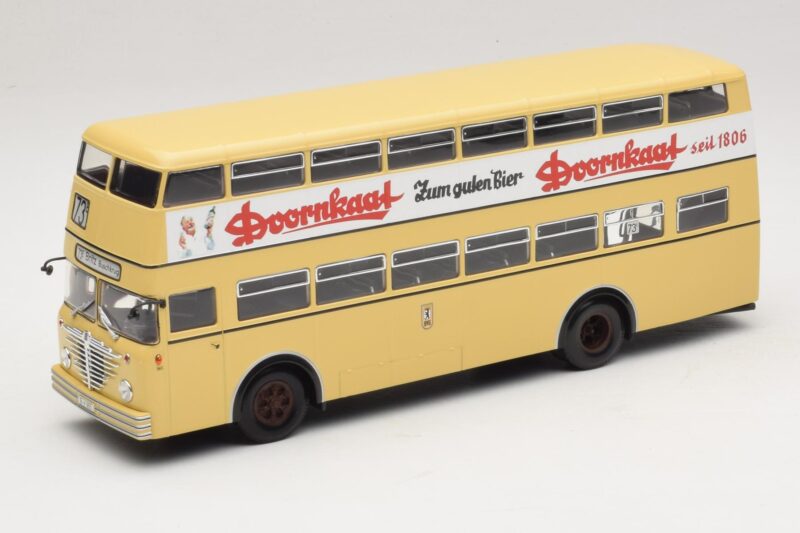
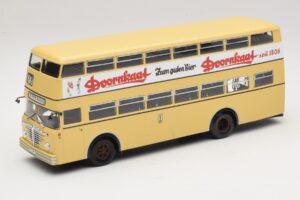
TL;DR: Minichamps' 1:43 diecast reproduces the Büssing D2U transit bus in its rear-entrance Heckeinstieg layout, carrying the Doornkaat spirits brand's advertising livery from the mid-1960s. The sealed zinc alloy body holds the window band and side panels as one fixed casting, with the branding tampo-printed along the flank.
German city buses of the 1960s often doubled as rolling billboards, their flanks leased out to local businesses in a way that turned a municipal transit fleet into a visible slice of regional commerce. This Büssing D2U carries exactly that kind of advertising, promoting the Doornkaat spirits brand along its full length.
Büssing built buses and trucks as an independent German manufacturer through the 1960s, right up until financial pressure pushed it into a merger with MAN in 1971 that ended the Büssing name as a standalone brand. The D2U dates from that final independent decade, a period when Büssing still competed directly against Mercedes-Benz and other German builders for municipal transit contracts. That independence is part of what makes surviving D2U buses, and models of them, a distinct branch of German bus history rather than an early chapter in MAN's later story. Minichamps' decision to reproduce a Büssing rather than the more commonly modeled Mercedes bus of the same era reflects genuine niche interest in the marque's own history.
Heckeinstieg describes a specific door layout, boarding from a single door at the rear of the bus rather than the front-and-middle arrangement that became standard later. That configuration reflected an older approach to fare collection, typically with a conductor stationed near the rear door rather than the driver handling payment, and it was gradually phased out as transit operators moved toward driver-only operation through the 1960s and 1970s. A rear-entrance D2U like this one therefore captures a specific, dateable moment in how German cities actually ran their bus routes. Collectors who know to look for that detail read more into a rear-entrance bus than a casual buyer ever would.
Minichamps casts the D2U as a sealed one-piece body, and the Doornkaat lettering runs across that shell in continuous tampo-printed registration, uninterrupted by any door seam along the flank. Advertising liveries like this one depend entirely on that continuity: a brand name broken across a panel gap loses legibility exactly where it matters most, at a glance from across a street. The flat, uncomplicated body panels of a 1960s transit bus actually suit this kind of printing well, giving the graphic a clean, wide surface to run across.
The D2U's window band sits in flush glazing rather than proud of its frame, and the boxy, upright body style of the period comes through in flat, consistent panels rather than the rounded corners later buses adopted. Zinc alloy gives the casting real weight for its length, and the rear boarding door area, molded rather than functional, still carries the correct step and handrail detail a Heckeinstieg layout needs to read correctly. That fixed construction is the standard, sensible choice at this scale and price point, not a shortfall against a pricier alternative, and the roofline and destination signage carry their own printed detail to round out the shell.
Advertising buses form their own small but devoted corner of commercial-vehicle collecting, prized for preserving brand histories that outlived the routes the buses themselves once ran. At 1:43, this D2U sits well alongside other mid-1960s German transit subjects, its rear-entrance layout offering a genuine point of contrast against later front-door buses in the same collection. Doornkaat's survival as a brand into the present day gives this particular livery an unusual staying power compared to fuel or postal liveries tied to companies that no longer exist, and that continuity is worth something to a collector chasing German commercial history with a living thread back to today.


You save 16.00 €
Lowest price in the 30 days before the reduction: 123.00 €