Last one

This model is currently sold out. Enter your email and we'll let you know when it's back in stock.
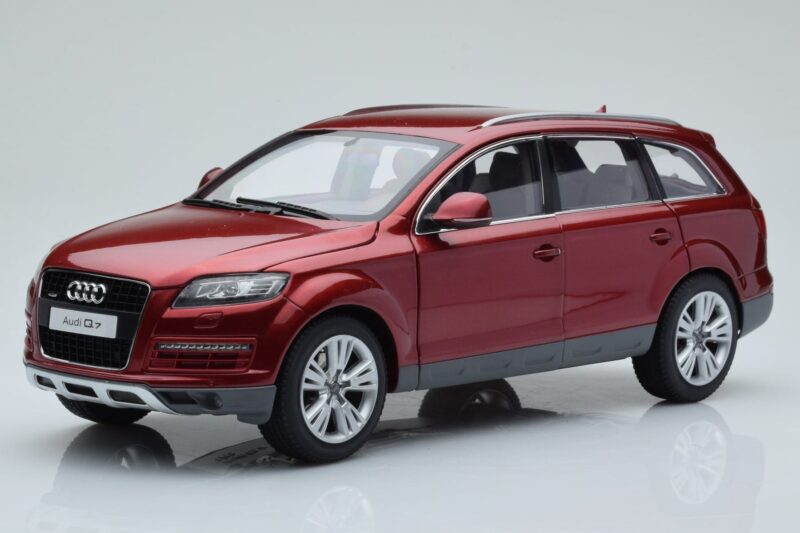
TL;DR: Kyosho's 1:18 diecast reproduces the Audi Q7 4L in garnet red, the model that launched Audi into the luxury SUV segment in 2005 on a platform shared with the Volkswagen Touareg and Porsche Cayenne. It is a practical, well-mapped choice for a modern German SUV shelf.
The Q7 was Audi's first SUV, a bold expansion into a segment the brand had skipped for decades, and this garnet red Kyosho diecast captures the 4L generation that made the case for it in showrooms.
Getting a full-size SUV right at 1:18 means holding tall, boxy proportions without the model looking bloated or top-heavy on a shelf, and Kyosho keeps the Q7's roofline, wheel arches, and Audi's signature single-frame grille in believable scale relative to each other. The garnet red finish carries decent depth across the large, flat hood and door panels, surfaces that show up paint inconsistencies more readily than a curvier sports car body would. Chrome-effect trim around the grille and window surrounds adds the contrast the Q7's design relies on to avoid looking like a plain box.
Doors and the tailgate open on metal hinges, showing off a cabin laid out for the Q7's three-row, seven-seat configuration, a genuine differentiator from the two-row luxury sedans Audi built its reputation on. The dashboard carries mapped switchgear and a molded infotainment screen consistent with mid-2000s Audi interior design, and the second and third-row seating is represented rather than left as a blank cargo floor. For an SUV subject, that seating detail matters more than it would on a two-seat sports car, since the Q7's whole appeal was space and versatility.
Audi launched the Q7 in 2005 as its first SUV, a significant strategic shift for a brand that had built its identity on sedans, wagons, and coupes through the 1980s and 1990s. The move followed BMW and Mercedes into an SUV segment that was rapidly becoming essential to any full-line luxury manufacturer, and the Q7's size and seven-seat capacity positioned it as a genuine alternative to American and Japanese full-size SUVs rather than a compact crossover testing the waters.
Underneath its Audi-specific styling and interior, the 4L Q7 shared its underlying platform with the Volkswagen Touareg and, in modified form, the Porsche Cayenne, a piece of Volkswagen Group engineering strategy that let three different brands split development costs across genuinely different-feeling vehicles. That shared-platform approach is common across the group's history, and the Q7 remains one of its more visible examples: three distinct luxury and off-road personalities built from a common foundation most owners never noticed.
An SUV like the Q7 was never a low-volume specialty build, and that changes the calculus around material choice compared to a limited-run supercar or a works rally car. Sealed resin makes more sense for subjects where sharp panel lines and paint depth justify skipping opening features entirely, but on a family SUV, the interior layout and cargo versatility are central to what the real car actually offered buyers, and a diecast body that opens to show all three rows respects that. The trade-off is the same one seen across diecast generally: slightly wider panel gaps around the doors and tailgate than a sealed resin shell would show, visible mainly on close inspection rather than from normal shelf distance. For a practical subject like this, that trade is the right one.
This Q7 won't carry the mystique of a limited-edition supercar, and it does not need to. At around 26 centimeters given its full-size SUV proportions, it commands real shelf presence next to smaller sedans and coupes, and the garnet red finish adds warmth to a lineup that can otherwise skew heavily toward silver and black German cars. Collectors tracing Audi's model-range expansion through the 2000s, or simply wanting a well-detailed everyday luxury vehicle alongside flashier pieces, will find this a solid, honestly priced addition rather than a showpiece. Entry-level and mid-tier diecast both have genuine roles, and a family SUV is exactly where that accessible tier makes the most sense.