Last one

This model is currently sold out. Enter your email and we'll let you know when it's back in stock.
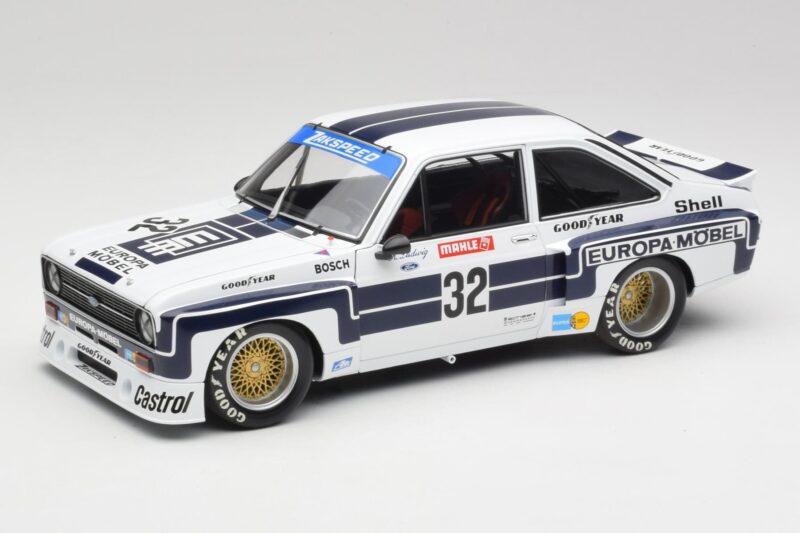
TL;DR: Minichamps' 1:18 diecast Ford Escort II RS1800 #32 reproduces Klaus Ludwig's circuit-racing touring car, winner at the Nürburgring in 1976. Built for tarmac circuit competition rather than rough rally stages, this Escort wears lower ride height and circuit-spec wheels distinct from its rally-liveried siblings.
The same Escort RS1800 that dominated forestry rally stages also raced on tarmac circuits, and this Nürburgring winner shows the touring-car side of that dual identity, tuned for grip rather than ground clearance.
Ford's Escort RS1800 competed on two very different stages through the mid-1970s: rough, unsealed rally roads and smooth touring-car circuits, and the same 1.8-liter Cosworth BDA engine that gave the rally cars their pace did the same job on tarmac. German touring car racing, contested through what was then the Deutsche Rennsport Meisterschaft, gave circuit-prepared Escorts a serious national stage, and the Nürburgring's demanding Nordschleife layout tested chassis balance as thoroughly as any rally stage did.
Circuit-spec preparation dropped the ride height that rally cars needed for rough-road clearance, fitted wider tarmac-compound tires within tighter bodywork, and often added subtle aerodynamic aids a rally car would have no use for. That dual-purpose engineering, one chassis serving two disciplines, was common Ford practice through the decade and helped justify the RS1800's homologation cost across multiple programs.
Set beside a rally-liveried RS1800, this circuit version sits noticeably lower and tighter, with narrower wheel arches housing circuit-compound tires rather than the flared bodywork a rally car needed. Minichamps carries the number 32 and period sponsor graphics with flat, sharp printing, registered cleanly along the car's character lines.
The diecast body holds consistent, tight shut lines around the opening doors and hood, and the interior, visible once opened, reflects the stripped, roll-caged cabin a circuit racer of this era actually carried. Kept out of direct light, the printed graphics hold their sharpness far longer than under a sunlit window display.
Klaus Ludwig built the foundation of a career that would later include Le Mans victories and championship titles in German touring car racing, and his early 1970s outings in Ford machinery were part of that long apprenticeship. German touring car fields of the mid-1970s were deep with talent, and a win at a circuit as demanding as the Nürburgring against that field carried genuine weight. Displayed beside a rally-liveried RS1800 from the same era, the two cars sharing an engine and chassis while racing in completely different ways tell a fuller story of the Escort's competition versatility.