Last one
Back in stock

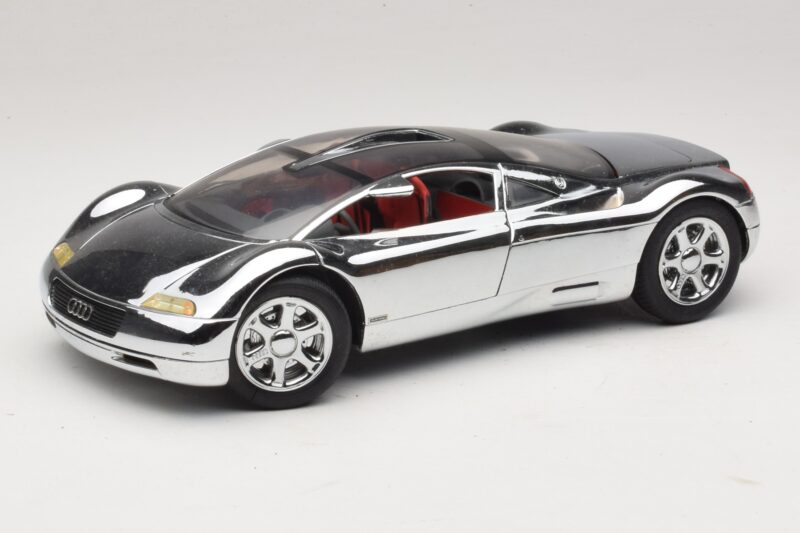
TL;DR: Revell's 1:18 diecast Audi Avus Quattro reproduces the 1991 polished-aluminum concept car in chrome silver, with opening doors that reveal the W12-powered design study's cabin. Named for Berlin's AVUS circuit, the Avus previewed aluminum construction ideas that later shaped Audi's production space-frame engineering.
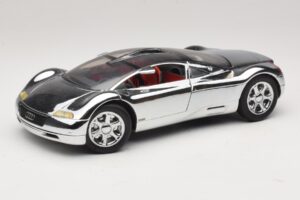
Audi built the Avus Quattro as a design study rather than a production prospect, wrapping a twelve-cylinder engine concept in unpainted polished aluminum to argue that lightweight metal construction could be beautiful rather than purely functional. Revell's 1:18 replica captures that argument directly, finishing the body in a chrome-toned silver that mimics the concept's bare-metal surface and opening its doors to the cabin beneath.
Revell gives this Avus functioning doors, a detail that matters more on a concept car than it would on a conventional production subject, since part of the Avus's design argument was that its structure, not just its skin, deserved to be seen. The doors swing open with honest resistance and settle cleanly, letting a collector inspect the cabin treatment beneath rather than taking the interior on faith behind closed bodywork.
Reproducing the Avus's signature finish, polished bare aluminum rather than any painted color, is the model's real technical challenge, and Revell approaches it with a chrome-toned silver that reads as reflective, bright metal rather than a flat gray paint standing in for the real thing. That finish has to carry the entire visual impact of the car, since the Avus wore no graphics, no two-tone treatment, and no badging beyond its name, so every curve and crease in the bodywork is thrown into sharp relief by how the light plays across a bright metallic surface. Panel gaps around the opening doors run a touch wider than a sealed casting would allow, a fair trade for being able to access the cabin on a subject built to be examined closely.
Audi unveiled the Avus Quattro in 1991, naming it after the AVUS race circuit in Berlin, and used it as a rolling argument for two ideas at once: a W12 engine concept combining narrow-angle cylinder banks into a compact powerplant, and a body built from unpainted, polished aluminum to show off what lightweight metal construction could achieve visually as well as structurally. Neither idea was aimed at immediate production, which freed Audi's designers to pursue a shape built purely to make the engineering argument as dramatically as possible.
Both ideas eventually reached customers in different forms. The W12 engine layout influenced later production engines used across the Volkswagen Group, including Audi's own flagship sedans, and the lightweight aluminum construction philosophy fed directly into Audi's production Space Frame technology that debuted on the A8 later in the decade. The Avus itself never left concept-car status, but tracing a line from this one show car to engines and chassis technology that reached actual showrooms is exactly the kind of story that makes a design study worth collecting.
At 1:18, the Avus's dramatic proportions and reflective finish stand out on any shelf, contrasting sharply with painted production cars in a way that signals its status as a pure design exercise rather than a road car. It pairs naturally with other concept and show cars from the same era, building a themed display around the ideas manufacturers tested before committing them to production. The opening doors add a genuine interactive element that a sealed concept-car replica would lack, useful for a collector who wants to handle a piece rather than only display it.