Last one
Back in stock

This model is currently sold out. Enter your email and we'll let you know when it's back in stock.
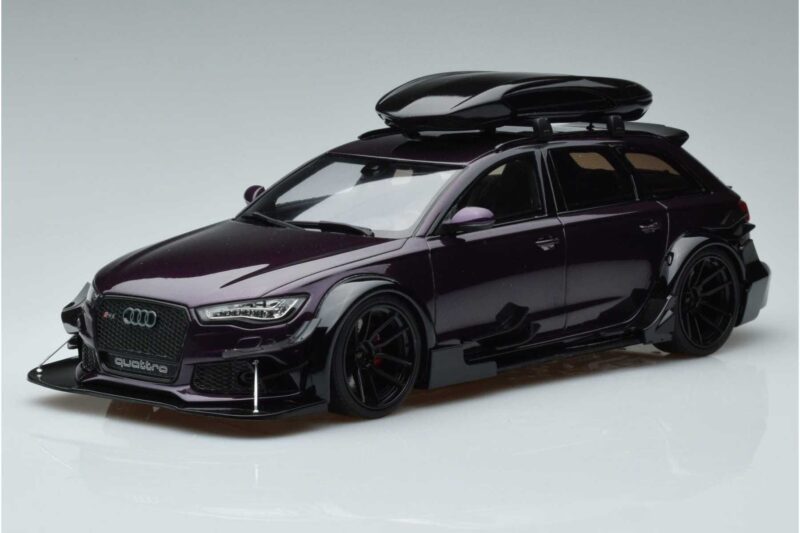
TL;DR: GT Spirit's 1:18 resin Audi RS6 C7 Avant wears a purple finish and a widebody kit that pushes the wagon's fenders well past stock. The body is a sealed one-piece casting. A tuner-specials piece for collectors who want Audi's fast wagon dressed beyond factory spec.
The RS6 Avant has long argued that a wagon can outrun a sports car, and this GT Spirit rendition pushes that argument further with a widebody kit most owners never fit.
GT Spirit works almost exclusively in resin for its tuner and special-edition subjects, and the material suits a widebody conversion better than diecast would. Cast resin holds the flared arches and add-on splitters as one continuous shell, so the transition between factory sheet metal and aftermarket bodywork reads as a single clean line rather than a series of bolted-on panels. This copy's body is sealed, with no opening doors, hood, or trunk, which means the entire story plays out on the exterior: the depth of the purple paint under direct light, the width of the fender gaps, the stance over the wheels. At this scale, a sealed shell also protects the widebody kit's thin extensions, which would be vulnerable to stress at hinge points. Weight in the hand stays lighter than a comparable diecast piece, consistent with resin's lower density, and the paint carries a factory-grade finish rather than an unfinished test shade.
The RS6 Avant sits in an unusual niche: a performance wagon that competes with two-door supercars on paper. Displayed among tuner and modified-car pieces, a widebody example like this one makes the case visually rather than through spec sheets, its flared hips reading as deliberately aggressive rather than accidental. It pairs naturally with other German performance wagons or with tuner-house Audis from the same era, building a themed row around the idea that practicality and speed are not mutually exclusive. Collectors newer to resin should expect the lighter weight and factory-applied color as normal traits of the material, not shortcuts, and judge the piece on its shutline crispness and paint depth rather than heft alone.