Audi SQ5 FY TFSI Ultra Blue Otto 1:18
Price:
95.00 €
This model is currently sold out. Enter your email and we'll let you know when it's back in stock. We'll also send you news about new models. Unsubscribe anytime.
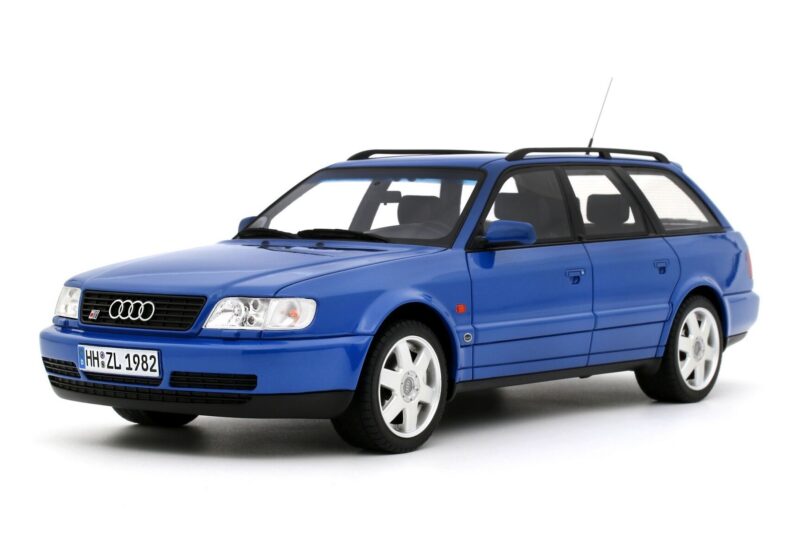
TL;DR: The Otto Audi S6 Plus C4 Avant 1:18 is a resin model of Audi's 1990s performance estate in Nogaro Blue Pearl, built as a sealed one-piece body with no opening panels. Its appeal sits on the outside: a long roofline, narrow shut lines, and pearl paint depth. It suits sleeper-wagon and 1990s Audi shelves.
Some cars hide their intent behind a roofline built for groceries. The Audi S6 Plus Avant was one of them, a family estate with a performance badge and quattro grip. Otto's 1:18 resin version in Nogaro Blue Pearl keeps that understated menace, and this Audi S6 Plus C4 Avant rewards a slow walk around the shelf.
The C4 generation began as the Audi 100, and in 1994 the range was renamed A6, with the performance S4 becoming the S6. Permanent quattro all-wheel drive is part of the S6 recipe. The Plus tag marks the most potent version of the C4 S6, which is why it draws attention among fans of Audi's fast wagons. The Avant body adds a long roof and a tall tailgate, and the result is a shape that looks calm until you notice the wheels, the stance, and the badging.
Nogaro Blue Pearl is a blue with a pearl effect, and the name echoes the French racing circuit. On a wagon it is a strong choice: dark enough to look serious, with a shimmer that shows up only when light hits the roof and tailgate at an angle. Resin takes this sort of paint well. A fine pearl needs an even, thin application over a smooth casting, and the body here has few surface breaks to disturb it. Hold a lamp low and to one side and the blue should shift in tone across the long roofline.
An estate body is the longest panel run a 1:18 casting has to hold straight. The sealed shell here has no opening panels, so the door seams, tailgate cut, and roof edges stay as fixed grooves rather than hinged joints. Because nothing has to swing, the casting can hold those seams narrow and consistent from front wing to rear light. A fingertip drawn down the rear door line should meet nothing but a clean groove. Glazing matters just as much here, since an Avant's large side windows and rear glass leave little room to hide a poor fit. That consistency is the first thing to check, and the reason a long wagon makes such a revealing test of a one-piece body.
Resin is cast, not pressed, so it picks up thin pillars, crisp creases, and small cast-in details that a zinc die tends to soften. The cost is toughness: a dropped resin model can chip where a metal one would only scuff, and the mass is lower in the hand than a diecast of the same size. Over years of display, a resin body keeps its shape, so the shut lines you buy are the shut lines you keep.
Stance decides a performance wagon. Compare ride height and the gap between tire and arch, then look at wheel size and offset against reference photos of a C4 S6. A model that sits too high looks like a standard A6; one that sits right looks as purposeful as the real car.
Next, the details that separate an S6 from lesser Avants: bumper and grille treatment, badge sharpness, and the way the tailgate edge meets the rear lamps. Resin handles fine badge relief and thin window frames well, so soft lettering or thick pillars would be a flag. Then step back. A good Avant casting should show one long, unbroken highlight along the shoulder, and any wobble in that line points to a surface fault.
Scale adds context. At 1:18 an estate of this length comes out at roughly 26 centimeters, one of the longer pieces in a typical cabinet row, which is exactly why the format suits it: a long body gives the eye more surface to inspect. A 1:43 version would shrink that to a fraction, trading inspection depth for the ability to line up many cars on one shelf.
Do the check under the lighting you will actually use. Cabinet LEDs can flatten pearl finishes, while a single warm lamp placed to one side brings out the flake; a model that looks good under both has a well-applied finish.
The S6 Plus Avant fits naturally beside other 1990s performance sedans and estates, where its long roofline gives a shelf row a different silhouette. Collectors who focus on one marque can set it among other Audi models and see the shape language shift across generations; those who collect by theme can use it as the sleeper-wagon anchor. At this size it also works as a bridge piece between compact hot hatches and full-size sedans in a chronological 1990s row. Keep the model out of direct sunlight, dust it with a soft brush, and leave a little clearance around the body so the pearl finish can catch side light. Anyone planning to buy this Avant should weigh the trade plainly: no panels open, so the appeal is surface, stance, and paint. For buyers who value those, the format puts its strengths exactly where the eye goes.