Last one
Used

This model is currently sold out. Enter your email and we'll let you know when it's back in stock.
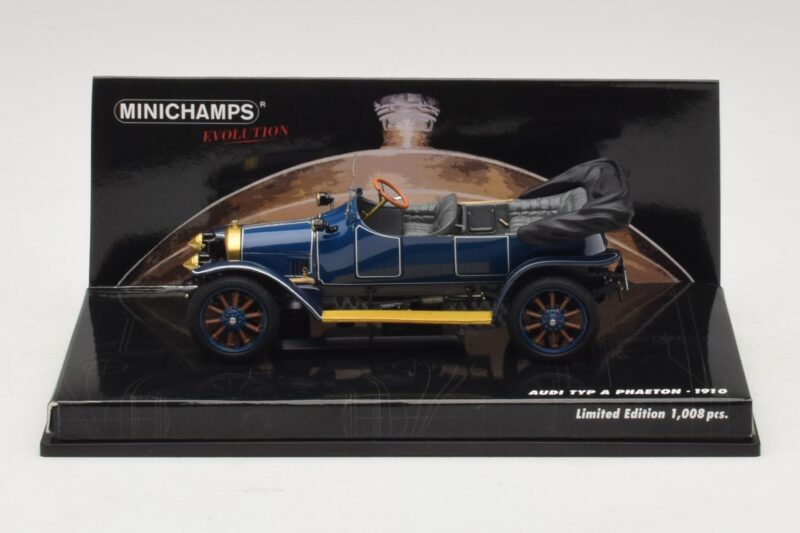
TL;DR: Minichamps' 1:43 Audi Typ A Phaeton in Blue reproduces the very first car to wear the Audi name, built in 1910 after founder August Horch left his own company and adopted the Latin translation of his surname. The diecast body is a sealed, one-piece casting of an open-top brass-era touring car.
August Horch had already built one automobile company bearing his own name before a dispute with the board forced him out. Rather than step away from the industry, he founded a second firm and translated his surname into Latin: Audi, meaning listen. The Typ A Phaeton, launched in 1910, was that new company's first car.
When August Horch left the company that carried his own name in 1909, German trademark restrictions meant he could not simply reuse it for a new venture. According to the often-repeated story, a colleague's son studying Latin suggested the translation of Horch, meaning to listen or hark, into the Latin imperative Audi. Whatever the precise origin, the name stuck, and the four-ring badge that eventually grew from that company remains one of the most recognized in the industry today. The Typ A was the first product to carry that new name into the market, making it more than just an old car. It is the literal starting point of the Audi brand as it exists now.
The Typ A wore a Phaeton body, an open, typically four-seat touring configuration common across the brass era before enclosed cabins became standard. High wheels, exposed brass fittings, and a straightforward upright radiator were typical of automobiles built in this window, reflecting engineering that was still working out fundamentals like reliable ignition and braking that later decades would take for granted. Audi's early cars, including the Typ A, competed in reliability trials of the period, a common way for young manufacturers to prove their engineering to skeptical buyers who had many competing brands to choose from before any single design language dominated the market.
Minichamps casts the Typ A in zinc alloy, giving the Blue finish a deep, even gloss across the car's tall, narrow bodywork. The casting is a sealed, one-piece body with no doors or hood that open, a construction choice well suited to a subject whose brass-era proportions depend more on correct wheel size, radiator shape, and seating position than on interior detail a buyer would ever see through an open panel. Brass-toned trim around the headlamps and radiator surround is picked out distinctly from the body color, giving the small-scale casting the visual contrast the real car's polished brass fittings would have shown against dark paint.
Reproducing a 1910 automobile at 1:43 presents different challenges than a modern coupe: the tall, narrow proportions, large-diameter wheels, and minimal bodywork leave little surface for the sculptor to hide behind, so every dimension has to read correctly at a glance. Minichamps holds the wheelbase and seating position true to the period silhouette, and the exposed mechanical elements, the visible springs and the straightforward chassis rails, carry enough detail to read as a genuine brass-era car rather than a generic old-timer. Collectors familiar with early automobiles will look first at the radiator shape and wheel proportions, since brass-era castings live or die on those two details.
For a collector building an Audi lineage rather than a general vintage classics shelf, the Typ A occupies a unique position: it predates the four-ring badge by more than two decades and represents a brand that did not yet look anything like the Audi of later years. Displayed beside a DKW, Wanderer, or Horch subject from the same Auto Union family tree, it tells the origin half of a story that most modern Audi collecting never touches. The Blue finish also distinguishes it cleanly from the more common black brass-era castings other manufacturers produce. It is a small, quiet start to a badge most collectors only ever see in its modern form.