Used
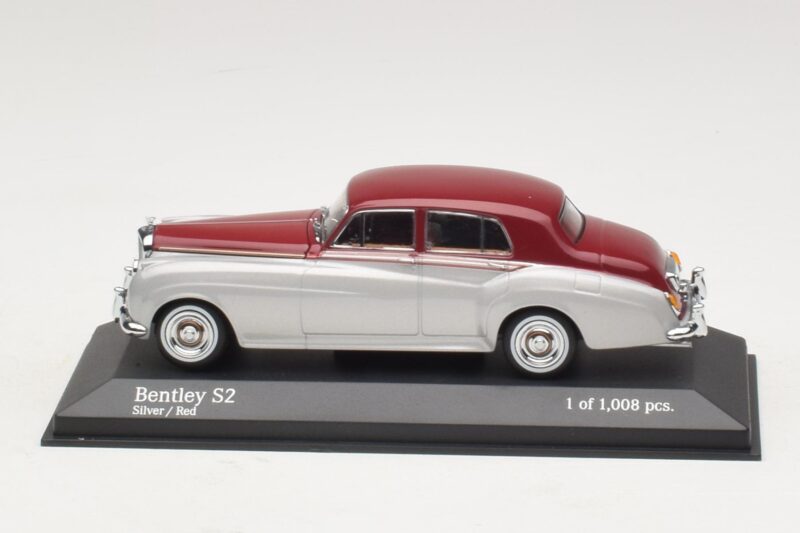
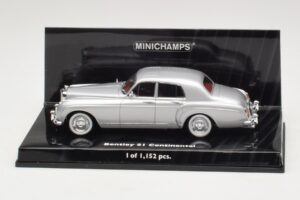
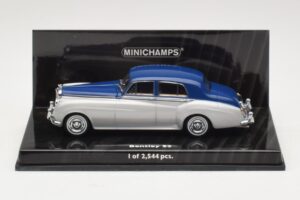
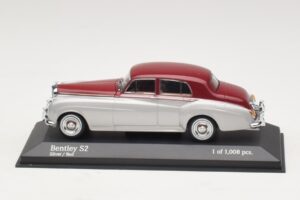
TL;DR: Minichamps' 1:43 Bentley S2 reproduces this early-1960s British luxury sedan in a silver-over-red two-tone finish, cast as a sealed zinc-alloy body. Chrome-look trim, correctly proportioned formal glazing, and crisp panel lines carry genuine period luxury presence at a compact display scale for a vintage British collection.
Bentley's S-series sedans carried a quiet formality that competed with Rolls-Royce on presence rather than flash, built for owners who wanted understated luxury over show. This S2, finished in silver over red, represents the marque's early-1960s output before Bentley's later shift toward more overt performance branding.
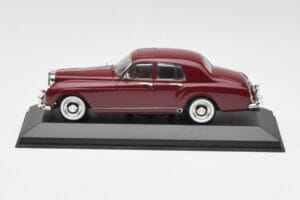
Minichamps casts the S2 as a single zinc-alloy shell, and the formal sedan shape suits a fixed body naturally: long, flat door panels, an upright greenhouse, and a low, wide grille all read as continuous, well-proportioned surfaces without needing opening panels to demonstrate craftsmanship. The roofline holds the correct formal height relative to the body, avoiding the too-low stance that can make a luxury sedan replica look sportier than the original. Weight sits solidly in the hand, appropriate for a full-size luxury sedan reduced to this scale, and the casting keeps consistent panel-line width across the long doors and rear quarters.
The silver-over-red split follows a coachwork pattern the S-series wore in period, upper body in silver with the lower panels and wheel arches finished in red, a combination that reads as genuinely upscale rather than a novelty color choice. Paint transitions between the two tones sit along a clean waistline rather than bleeding into each other, and the chrome-look trim around the grille, headlamp surrounds, and bumpers carries enough brightness to suggest real plated metal under a display lamp. Window surrounds separate cleanly from the body color, and the formal glazing proportions, tall and upright rather than raked, match the original car's dignified stance.
The S-series sedans shared engineering roots with contemporary Rolls-Royce models, built under the same corporate ownership but marketed toward buyers who wanted comparable luxury without quite the same badge prestige or price. That positioning gave Bentley a distinct identity through the 1950s and into the early 1960s, one built on understated competence rather than ostentation. The S2 specifically introduced a V8 engine to the range, a shift toward more modern power delivery while keeping the formal coachwork styling largely unchanged from its predecessor.
This era predates Bentley's later repositioning toward a more overtly sporting identity, making the S2 a useful anchor point for a collector tracing the brand's evolution. It represents Bentley at its most conservative, a car built for chauffeured comfort rather than driver engagement, which stands in useful contrast against later Bentley performance models on the same shelf.
This S2 works best alongside other formal luxury sedans from the same period, Rolls-Royce, Jaguar, and Mercedes-Benz subjects from the early 1960s, where its scale and formal proportions read consistently against similar company. At 1:43, the S2 takes a modest shelf footprint for a car that, in real life, was among the largest luxury sedans of its era, letting a collector display several formal saloons together without the display case a 1:18 lineup would demand. Checking fidelity comes down to the grille shape, the waistline where the two-tone paint splits, and the wheel arch profile against period photographs, since the S-series body changed only subtly across its production run. For a collector building a considered picture of post-war British luxury rather than chasing a single headline marque, this is a solid, honestly detailed choice.