BMW X6M F86 Red Norev 1:18
Price:
94.00 €
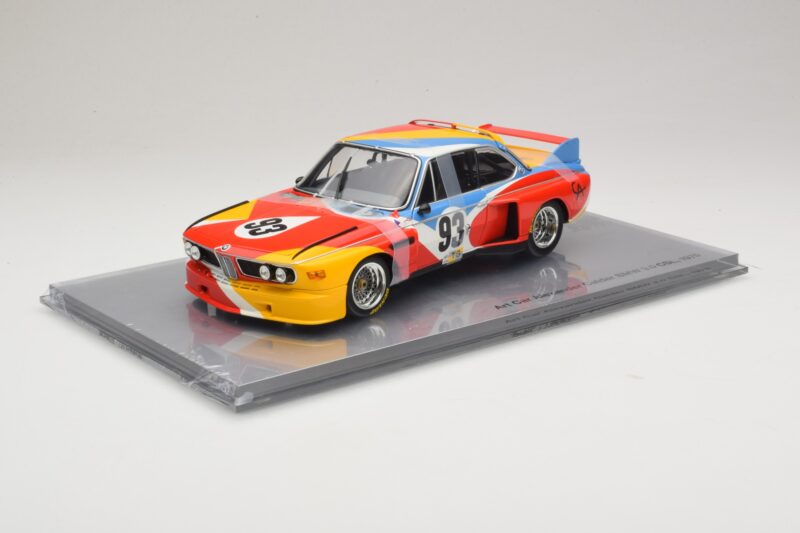
TL;DR: Minichamps' 1:18 diecast BMW 3.0 CSL reproduces car #51 from the 1975 24 Hours of Le Mans, the first BMW Art Car, painted by Alexander Calder and driven by Herve Poulain, Sam Posey and Jean Guichet. Doors, hood and trunk open, and the model captures Calder's hand-painted livery across the CSL's long-nose bodywork.
Of the dozens of race liveries BMW has worn, none carries more weight in art-world circles than this one. Calder's loops of red, yellow and blue turned a homologation racer into a rolling sculpture, and Minichamps treats that distinction seriously, right down to the number 51 roundels and the Le Mans scrutineering stickers.
Minichamps builds this CSL in zinc alloy diecast, and the heft is obvious the moment it clears the packaging, a density no resin casting at this scale matches. The doors, hood and trunk all open, exposing a stripped race cockpit with roll cage, a single racing bucket seat and the long-nose aerodynamic extension the 3.0 CSL wore in its final homologation form. Panel gaps around the opening sections sit tighter than most diecast at this price point manages, and the hinges hold their panels open rather than drooping shut under their own weight.
Calder's design was never a pattern applied to a production shape. He painted it directly onto the car's panels in Paris in May 1975, and Minichamps' print work follows the same irregular, almost hand-drawn edges rather than smoothing them into a repeating graphic. Red, yellow, blue and green fields wrap the hood, doors and rear deck in Calder's loose, organic shapes, broken by the factory roundel and the number 51 door plates run for the race. For a livery this visually complex, color registration matters more than on a solid-paint road car, and the transitions between Calder's color blocks stay sharp rather than bleeding at the edges.
The car's story begins with Herve Poulain, a French auctioneer and amateur racer who asked his friend Alexander Calder to paint a BMW he planned to enter at Le Mans. Calder, already known for his mobiles and stabiles, treated the 3.0 CSL as a three-dimensional canvas rather than a livery brief. The result became the first car in what BMW now calls its Art Car Collection, a program that later included works by other major contemporary artists on different chassis.
At the 1975 24 Hours of Le Mans, Poulain shared driving duties with American road racer Sam Posey and Frenchman Jean Guichet, running car number 51 in the CSL's long-nose Group 5 specification. The 3.0 CSL earned its nickname, the Batmobile, from the factory aero package of front air dams, roof spoiler and rear wing BMW Motorsport developed for European Touring Car Championship competition earlier in the decade, and that silhouette is exactly what gives Calder's painted panels their canvas. This entry is remembered less for its finishing position than for pairing a serious endurance racer with serious contemporary art.
At 1:18, this CSL anchors a BMW motorsport shelf or an art-car theme on its own, standing apart from conventional single-color liveries by design. Minichamps' mid-tier diecast positioning means livery accuracy and interior detail carry the piece rather than ultra-fine photo-etched parts, a fair trade at this price point. Collectors judging fidelity should check the color registration around the roofline and rear wing first, where Calder's freehand style is hardest to reproduce cleanly without the lines turning mechanical. Paired with other Art Car releases or period CSL touring cars, it tells a specific chapter of BMW's motorsport and cultural history that few liveries in the hobby can match.