Last one
Used
This model is currently sold out. Enter your email and we'll let you know when it's back in stock.
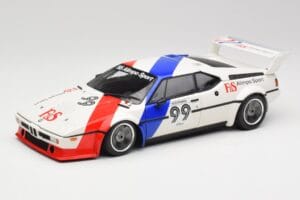
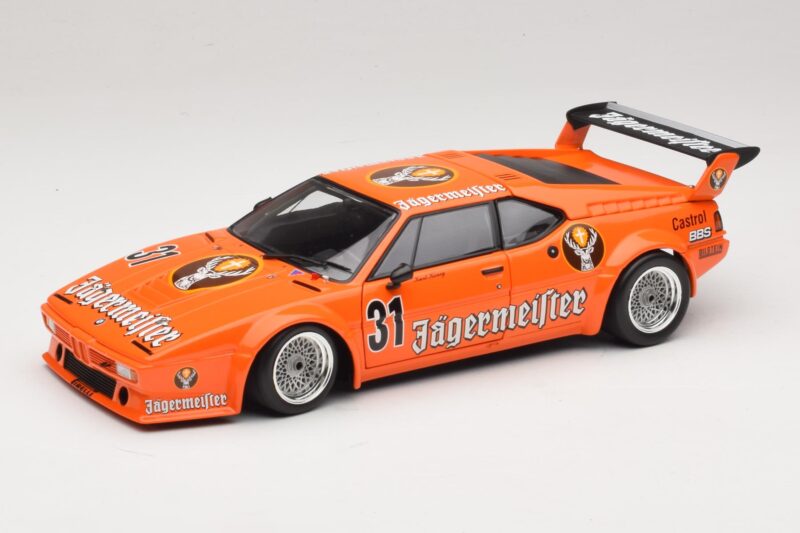
TL;DR: Minichamps' 1:18 diecast recreates K. König's #31 Jägermeister BMW M1 from the 1982 Deutsche Rennsport Meisterschaft, its flared Group 5 bodywork carrying the orange-and-white livery in crisp tampo print. The doors open on this diecast, revealing the tube-framed cockpit built beneath that silhouette-formula body.
German motorsport in the early 1980s ran wild on Group 5 rules, letting teams stretch production silhouettes into something closer to a purpose-built racer underneath standard-looking skin. The BMW M1's flared bodywork and the orange Jägermeister livery are two of the era's most recognizable combinations, immediately readable even at a glance across a paddock. Minichamps captures König's #31 car exactly as it ran that season.
The BMW M1 began life as a mid-engine road car built to homologate BMW for endurance racing, styled by Giugiaro's studio and built in low numbers through Baur. Group 5 regulations let teams keep only the silhouette of that shape while rebuilding almost everything beneath it: a tubular space frame chassis, wide-flared fiberglass fenders bolted over racing-width wheels and tires, and aerodynamic addenda far beyond anything the production M1 wore. The result kept the M1's distinctive wedge profile and pop-up headlights recognizable while turning the car into something closer to a prototype in silhouette form. Minichamps' casting follows those flared proportions closely, the fender width reading as dramatically wider than the standard road car's.
Orange liveries carrying the Jägermeister stag-and-cross emblem became one of German motorsport's most durable visual signatures through the 1970s and 1980s, appearing across touring cars, sports prototypes, and silhouette racers from multiple manufacturers. The color scheme's high contrast made cars easy to track through a field, which mattered on a grid as visually chaotic as Group 5 racing produced. König's M1 wears that scheme applied in Minichamps' tampo printing rather than as a simple decal, so the orange sits directly on the shell and follows the fender's compound curves without lifting at the edges the way a flat sticker would.
This BMW M1 is built with doors that open, a genuine point of difference from the sealed racing bodies many GT3-era models use. Lifting one reveals the tube-frame construction and roll cage that Group 5 rules demanded beneath the silhouette bodywork, a level of underlying detail that only makes sense to include on a casting designed to be opened. The hinge action on a well-built diecast door like this settles with a defined resistance rather than swinging loosely, staying wherever it is placed rather than drifting back to the closed position under its own weight.
Group 5 cars are interesting specifically because the interior tells a different story from the exterior, a tube frame and stripped cockpit hiding under production-looking sheet metal. A sealed body would flatten that contrast into a single painted shell, losing the reason the silhouette formula mattered in the first place. Opening this M1's doors lets a collector see both halves of the story at once: the flared, liveried exterior built to look like a road car, and the purpose-built racing structure underneath that had almost nothing left in common with one. That contrast is part of what makes Group 5 machinery a distinct collecting category from later, purpose-built GT3 silhouettes.
Diecast construction gives this M1 real heft, the kind of density that signals zinc alloy the moment it clears the packaging tray. That weight matters on a car defined by its flared fenders: the wider a body panel runs, the more a lightweight material would show flex or warp over years on a shelf, and metal holds its shape without that risk. Minichamps casts the fender flares with a crisp lip where they meet the door line, a detail that separates a well-tooled Group 5 casting from a softer, rounded interpretation of the same shape. The rivets and overlap seams that held the fiberglass flares onto the real M1's steel body are picked out in fine relief rather than smoothed away, and the wheels sit at the correct racing offset beneath those flares rather than tucked in a way that would understate the width. Paint on a diecast body like this holds a deep, even gloss because it sits on a hard metal substrate rather than a porous one, which matters when the base color has to read clean under a display lamp before the tampo graphics go on top. The overall proportions, low nose, high rear haunches, pop-up headlight housings, come through recognizably despite the exaggerated Group 5 width.
Group 5 silhouette racers occupy a specific niche between production touring cars and outright prototypes, and a BMW M1 in period Jägermeister colors gives a collector a distinctive anchor for that category. It reads well alongside other early-1980s German silhouette machinery, whether that means other BMW entries from the same era or the wilder Porsche and Ford silhouettes campaigned under the same rules. At 1:18, the M1's proportions hold their own on a shelf without needing the largest scale to make an impression, and the opening doors add a layer of inspection value that many race-liveried diecasts skip entirely. For a buyer building a Group 5 or DRM theme rather than a strictly BTCC or DTM shelf, this König entry fills a distinct chapter the later touring car generations do not cover.