Last one
Used
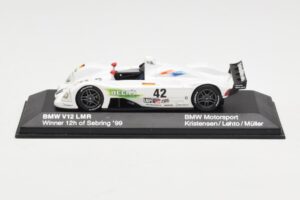
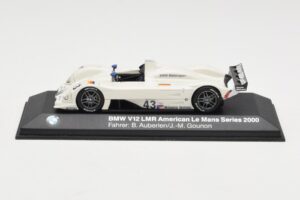
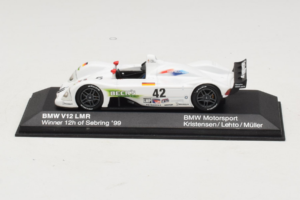
BMW V12 LMR LMP1 #42 J. Müller / J. Lehto 24 Hours of Le Mans 2000 Minichamps 1:43
Only 1 left
Price:
47.00 €
This model is currently sold out. Enter your email and we'll let you know when it's back in stock.
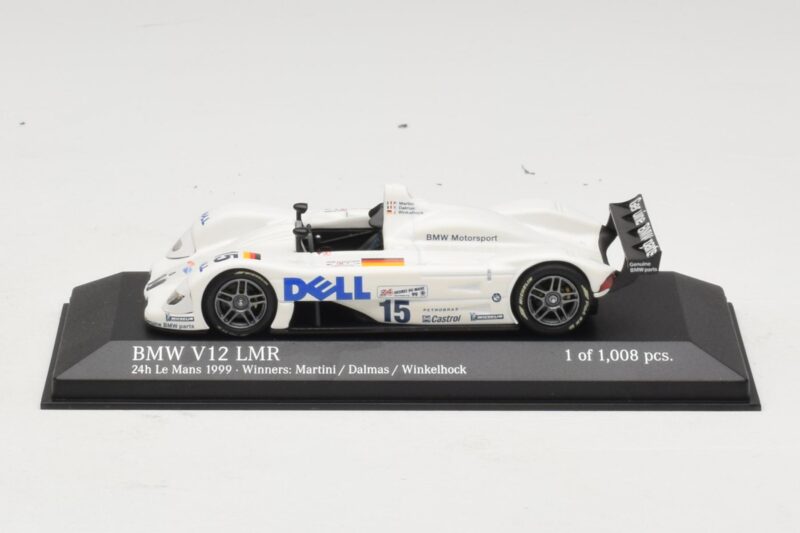
TL;DR: Minichamps' 1:43 diecast reproduces the #15 BMW V12 LMR that won the 1999 24 Hours of Le Mans outright, driven by Pierluigi Martini, Yannick Dalmas, and Joachim Winkelhock. The sealed zinc alloy body captures the closed-cockpit prototype's low silhouette and factory BMW Motorsport livery, marking BMW's return to Le Mans victory.
BMW's factory return to Le Mans had one goal, an outright win, and in 1999 the V12 LMR delivered it on the first serious attempt of that programme. This #15 casting reproduces the winning car directly, a genuine championship-caliber prototype rather than a privateer entry built around it.
This casting is a sealed zinc alloy shell at 1:43, the closed cockpit, low nose, and rear wing molded as one continuous form rather than an assembly of separate panels. That construction suits a prototype particularly well, since the V12 LMR's aerodynamic surfaces are meant to read as unbroken curves rather than a collection of visible seams. Weight in the hand signals the metal shell immediately, and the paint holds a hard, deep gloss over BMW's factory white and blue livery. That unbroken surface treatment also holds up well under a display lamp, since there's no shut-line interruption to catch shadow across the bodywork's long curves.
BMW ran multiple V12 LMR entries at the 1999 race, so confirming this casting's #15 number, driver credits, and sponsor placement against the specific winning car matters more here than on a generic prototype livery. The low, wide stance and correctly proportioned rear wing are the details that separate a faithful Le Mans prototype casting from a generic sports-racer silhouette. Getting those specifics right matters on a car this significant, since a Le Mans overall winner tends to draw closer scrutiny than a mid-field prototype would. At 1:43, the V12 LMR's proportions, long and low compared with the shorter, taller GT cars sharing the same era's grids, are worth checking first, since that stance is what a good prototype casting has to get right before anything else.
The V12 LMR was developed specifically for BMW's renewed Le Mans programme in the late 1990s, built as a closed-cockpit prototype around a V12 engine and engineered with factory resources rather than run as a customer effort. That level of commitment showed in the result: on a race defined as much by reliability as by outright pace, the V12 LMR ran a controlled, largely trouble-free race to take the overall win in 1999. That single-minded focus is part of why the V12 LMR's competitive life at Le Mans stayed relatively short. BMW had proven its point and moved on.
The winning line-up combined Pierluigi Martini's open-wheel and touring car background, Yannick Dalmas's considerable Le Mans experience from previous overall wins with other manufacturers, and Joachim Winkelhock's touring car pedigree, a driver mix built for consistency across 24 hours rather than outright one-lap speed. That balance mattered more than raw pace on a race where finishing strongly beats leading briefly. Dalmas in particular arrived with genuine Le Mans-winning pedigree already, which gave the effort real depth beyond just having BMW's factory backing behind it. Winning outright on a manufacturer's first serious factory attempt is rare in endurance racing, and it's exactly what makes the V12 LMR's 1999 result worth commemorating on a shelf rather than treating as just another period prototype.
A Le Mans overall winner carries more weight on a shelf than a class winner or a mid-field finisher, and this #15 V12 LMR earns that anchor status honestly. Check the livery registration and the wing profile against period photography, the usual markers of a faithful prototype casting. Displayed alongside other Le Mans winners across eras, it traces one of BMW's clearest competitive statements in sports car racing. That single result carries more collecting weight than several lesser prototype liveries combined. It's a genuine centerpiece for anyone building an endurance racing shelf around outright winners rather than participants. Few 1:43 prototypes carry this much documented racing significance behind them. That combination of history and casting quality is what earns it the anchor spot.