Last one
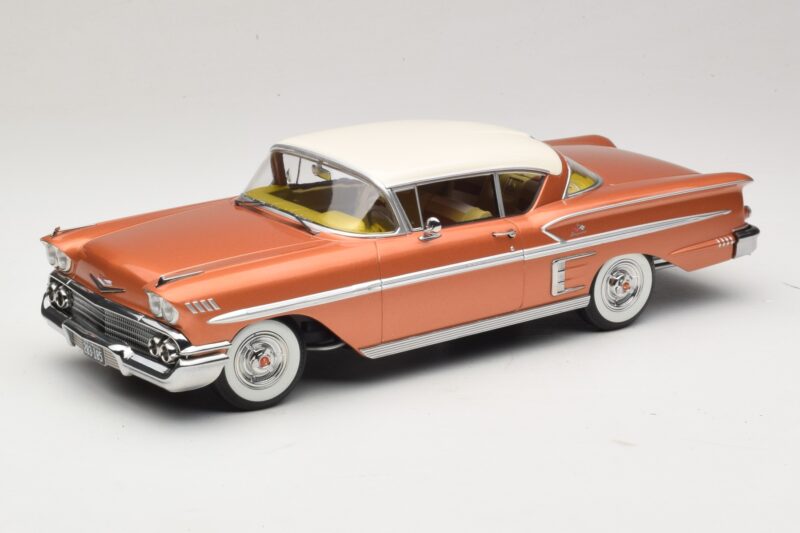
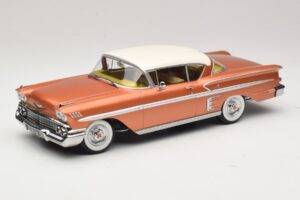
TL;DR: KK-Scale's 1:18 diecast Chevrolet Bel Air Impala reproduces the 1958 two-door coupe in copper and cream, built as a sealed one-piece body with the model year's distinctive quad taillights and heavy chrome. A one-year-only body style, this Impala represents a markedly different Chevrolet era than the brand's earlier Tri-Five cars.
Chevrolet introduced the Impala in 1958 as a premium two-door hardtop and convertible trim atop the Bel Air lineup, riding on a new full-size body built only for that single model year before Chevrolet reshaped its entire range again in 1959. This copper-and-cream coupe captures the heavier, more ornamented look that defined American styling at the close of the decade.
KK-Scale casts this Impala in zinc alloy diecast, and the weight is apparent the moment it clears its packaging, matching the real car's reputation as one of the heaviest and most chrome-laden American sedans of its decade. The body is a sealed one-piece shell, doors, hood, and trunk cast closed rather than hinged, a construction choice that lets the casting hold tight, consistent shutlines along the 1958 body's distinctively wide, flat flanks and its signature quad taillight arrangement at the rear, a detail unique to this single model year.
Two-tone paint defines this era of Chevrolet just as strongly as it did two years earlier on the Nomad, and the copper-over-cream split here follows the correct beltline separation, with a clean, straight edge where the colors meet. Chrome trim is especially heavy on the 1958 body, running along the hood, the side spears, the taillight surrounds, and the grille, and this casting keeps that trim separated distinctly from both body colors rather than blending into a dull gray mass, a common failure point on lower-tier diecast at this scale. The glazing sits flush in the door and rear windows, the Chevrolet bowtie and Impala script hold crisp detail under close inspection, and the wheels carry period-correct hubcaps consistent with the trim level.
Chevrolet built an entirely new full-size body for the 1958 model year, longer, wider, and noticeably heavier than the Tri-Five cars that preceded it, and used it for only that single year before replacing it again with the very different 1959 lineup. The Impala nameplate debuted that year as a distinct, upscale trim level above the standard Bel Air, offered initially as a two-door hardtop coupe and convertible before growing into its own full model line in 1959. Engineering followed the stylistic shift: Chevrolet introduced a new X-frame chassis for 1958 that allowed a lower overall stance despite the car's larger dimensions.
The quad headlights adopted that year, newly legal in most states, gave the front end a wider, more assertive look than the single-headlight 1957 models, and the quad taillights at the rear, arranged in a distinctive triple-lens cluster per side on Impala models, became one of the most recognizable identifying details of the 1958 model year. Because this body style lasted only a single model year before Chevrolet moved on to the famous batwing-tailfin 1959 design, the 1958 Impala occupies an unusual place in Chevrolet history, overshadowed on one side by the beloved Tri-Five cars and on the other by the dramatic 1959 restyle, despite introducing the Impala name that would go on to become one of the longest-running nameplates in American automotive history.
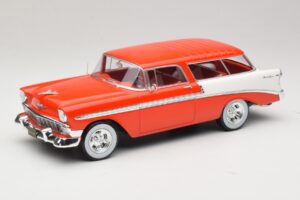
Displayed next to KK-Scale's 1956 Bel Air Nomad wagon, this 1958 Impala coupe shows just how quickly American full-size car design changed within a single decade, from the Nomad's relatively clean Tri-Five lines to the Impala's heavier chrome and quad-light front end. At 1:18, the Impala's wider, longer body gives it noticeably more shelf footprint than the Nomad, a physical reminder of how much larger American cars grew by the end of the 1950s. For a collector building a Vintage Classics shelf around Chevrolet's evolution through the decade, pairing these two models tells a more complete story than either could alone. The Impala nameplate launched on this exact body would go on to outlive nearly every rival nameplate from the era, a legacy this coupe sits at the very start of.